
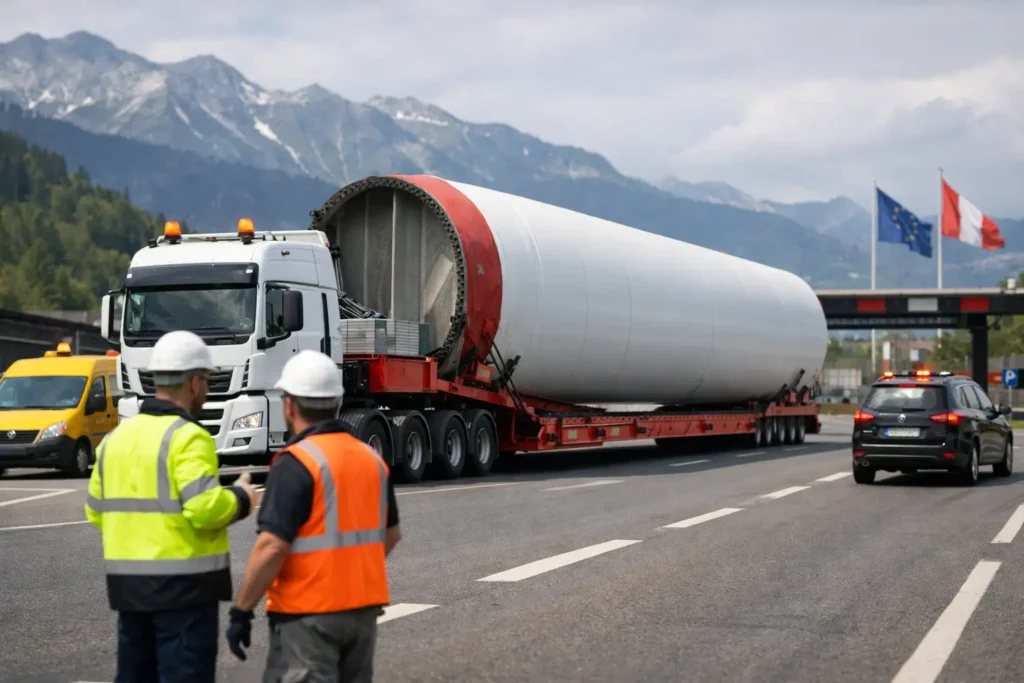
A production line waiting on one oversized machine part can burn through a week’s margin faster than most transport budgets allow. That is why oversized load transport is rarely just about moving something big from A to B. For supply chain managers, it is a risk-control exercise involving permits, escort requirements, route constraints, border formalities and delivery slot pressure. When the load is heading to the UK, Switzerland or Turkey, the margin for error narrows further. The practical question is not whether a carrier can move the freight. It is whether they can plan the movement properly, communicate clearly and protect your timeline when conditions change.
Why oversized load transport fails in practice
Most delays do not start on the road. They start in the planning phase, when shipment data is incomplete or assumptions are made too early. A few centimetres in height, a missing lifting point, or an inaccurate gross weight can change the required permit, the trailer type and even the approved route.
That matters because exceptional road freight works within tight legal and operational limits. In Europe, oversize movements may require prior authorisation, restricted driving windows, police or private escort support, and route validation around bridges, tunnels and roadworks. According to the European Commission, road freight still carries the largest share of inland freight transport in the EU, which means capacity and infrastructure pressure are real operational factors, not background noise.
A common issue is assuming the shortest route is the best route. It often is not. A direct corridor may have low bridges, weekend restrictions or customs queues that make a slightly longer route more reliable overall. For a logistics manager measured on delivery certainty, reliable is usually more valuable than theoretically faster.
The planning data that actually matters
When an oversized shipment is quoted too quickly, risk usually gets pushed downstream. The right starting point is not just dimensions and weight, but the full operating profile of the load.
The critical details usually include exact loaded length, width and height, axle load distribution, centre of gravity, loading method, packaging or bare equipment status, and whether the freight can be partially dismantled. Collection and delivery site conditions matter just as much. A factory with restricted yard access or no craning window can turn a simple movement into an expensive standstill.
For example, moving an industrial press from northern Spain to a consignee in southern Germany may look straightforward on paper. In reality, collection may need a low-bed vehicle, timed loading outside plant traffic hours, and a route adjusted to avoid bridge constraints in one federal region. If the final delivery site only accepts unloading before midday, the whole movement has to be sequenced backwards from that slot.
This is where tailored planning matters more than generic capacity. Vehicle selection should follow the load, not the other way round. Some shipments need extendable trailers, some need lower deck height, and some need escort coordination built into the departure plan from the first call.
Oversized load transport on complex cross-border routes
Cross-border oversized load transport becomes more sensitive when permits, customs and transit timing interact. The route itself may be possible, but the administrative path may not support the delivery date unless it is managed early.
UK movements
For the UK, border timing and documentation discipline are still central. An oversize movement that misses a booked crossing or arrives with inconsistencies in paperwork can lose valuable hours quickly. That may not sound dramatic until the delivery window is tied to a crane booking, road closure permit or installation team already on site.
Switzerland and non-EU formalities
Switzerland adds another layer because non-EU customs procedures sit alongside transport compliance. If the load is moving under temporary import, inward processing or project-based delivery terms, the documentation needs to line up with the transport plan. Delays here are rarely caused by one major mistake. More often, they come from small mismatches between commercial, customs and operational documents.
Turkey and extended corridors
Turkey and routes extending towards the Caucasus require even more care around transit planning, border waiting time and local operating conditions. A permit may be valid, but if road restrictions, escort availability or customs congestion are not factored in, the plan becomes fragile. For critical industrial freight, that fragility shows up as idle labour, production disruption and avoidable premium costs.
How to reduce delay risk before the lorry moves
The best oversized projects are usually the least dramatic because the issues were solved before departure. That means building a transport plan around likely failure points, not just ideal conditions.
First, confirm whether the cargo can be reconfigured. A minor reduction in width or height can materially change permit complexity and route options. Second, validate all measurement data at source. It is worth checking dimensions physically when the cargo value or project impact is high. Third, align transport timing with site readiness. There is little value in an on-time arrival if unloading equipment, site access or personnel are not available.
One operational insight that often gets missed is permit lead time versus production volatility. If your factory release date changes every 48 hours, a highly constrained exceptional movement may need a different planning model than your standard freight. In some cases, it is better to secure a realistic delivery range and keep all stakeholders aligned than to promise a specific date too early and then pay for changes.
Communication also needs to be more disciplined than with standard loads. Supply chain teams typically need milestone visibility at permit application, route approval, vehicle assignment, border crossing and final ETA confirmation. “In transit” is not enough when installation crews, customs brokers and site managers are all working off the same delivery promise.
Cost control in oversized load transport
The headline transport price rarely tells the full story. With oversized freight, the bigger cost question is what happens if the movement slips.
A delayed exceptional shipment can trigger demurrage-like waiting charges, crane rebooking costs, overtime at site, production downtime or contractual penalties. In that context, a cheaper quote can become the most expensive option if planning depth is weak.
This is why experienced shippers look beyond linehaul. They ask how permits are managed, how route changes are handled, who communicates with escorts, and what happens if customs or weather affect the schedule. They also want to know whether the provider can combine standard, urgent and exceptional flows under one operational logic. That flexibility matters when a delayed oversized unit has to be supported by urgent components or follow-up deliveries.
As a rule, cost control improves when responsibilities are clear from the start. Who is providing accurate technical data? Who confirms loading readiness? Who handles customs documents? Who updates the consignee if the ETA changes? The fewer grey areas, the fewer costly surprises.
What a reliable oversized transport partner should manage
For complex shipments, service quality is visible in the details. A dependable partner should be able to assess route feasibility early, flag documentation risks before collection, and adapt the movement if conditions change. That is especially relevant on flows involving the UK, Switzerland, Turkey or time-sensitive industrial deliveries across Europe.
Since 1985, MAP Transport has worked with manufacturers, distributors and industrial shippers who need more than simple capacity. The value is in coordinated execution – from quoting and route planning to follow-up during transit – with the right vehicle and operating model for the shipment rather than a standard template.
For supply chain managers, that means fewer blind spots. It means knowing whether the route has been checked, whether permit timing is realistic, whether customs exposure has been considered, and whether someone is actively following the movement instead of reacting after a delay has already happened.
Oversized load transport is manageable when the planning is honest, the communication is precise and the route is built around real constraints rather than optimistic assumptions. If your next movement involves tight delivery windows, border complexity or non-standard dimensions, it pays to solve those variables before the lorry is loaded.
Need support on your transport flows? Contact our team for a tailored solution.
Have a question or need a quote? Contact us at (+34) 943 62 95 77 (ask for Raquel) or by email at lo*******@**********rt.com