
A shipment can be ready on time, fully packed and commercially urgent – then still miss collection because the dimensions sent to the carrier are wrong. For supply chain teams, that kind of error is rarely minor. It can lead to the wrong vehicle being dispatched, a part-load becoming a dedicated run, or a border movement facing unnecessary checks because the declared load does not match reality. If you need to know how to prepare freight dimensions properly, the goal is simple: give transport planners accurate data that supports pricing, routing, loading and compliance from the start.
Why freight dimensions matter more than many teams expect
In road freight, dimensions are not just a quoting formality. They affect vehicle selection, loading sequence, route feasibility and, in some cases, whether a shipment can move under standard service at all. A pallet that is 20 cm higher than declared may not sound dramatic on paper, but operationally it can change the loading plan for the whole vehicle.
This matters even more on complex routes involving the UK, Switzerland or Turkey, where customs data and physical cargo details need to align. If declared dimensions, weight or package count differ from what is presented at collection or inspection, delays become much more likely. According to the European Commission, road freight still carries the largest share of inland freight transport in the EU, which means small data errors get repeated across a very high volume of cross-border movements. See the latest figures from the European Commission: https://ec.europa.eu/eurostat
A practical example: a manufacturer shipping industrial components from northern Spain to Switzerland declares 6 pallets at 120 cm height. At loading, two pallets are actually 155 cm because of reinforced top packing. The original vehicle plan no longer fits the load safely, and the transport team has to change equipment at the last minute. That usually means extra cost, collection delay and pressure on the delivery slot.
How to prepare freight dimensions for a quote
The best way to prepare freight dimensions is to think like the planner who must assign the right vehicle within minutes. They need precise, usable figures – not estimates based on memory or an old shipment profile.
Start with the basics for each handling unit: length, width, height and gross weight. Use centimetres and kilograms unless your transport partner requests another format. If the shipment includes multiple pallets or crates with different sizes, separate them clearly instead of averaging them into one line. A quote based on “10 pallets, standard size” is risky if two of those pallets are oversized or stackable only under restrictions.
You should also state the packaging type. A pallet, crate, stillage, reel and loose machine part do not load in the same way, even at similar dimensions. The footprint may be identical, but the handling constraints are not. If goods cannot be stacked, if they are top-heavy, or if they require side loading or a tail-lift, note this immediately.
For teams moving urgent freight, dimensional accuracy is even more important. Express road transport often depends on very fast vehicle assignment. If the freight turns out to be larger than declared, the nearest suitable van or lorry may no longer be an option, which can add hours to lead time.
Measuring freight without creating avoidable risk
Most dimension errors come from routine assumptions rather than negligence. Someone measures the product but not the pallet. Someone records the crate size before final protective packing is added. Someone reuses dimensions from the previous shipment even though the supplier changed the palletisation pattern.
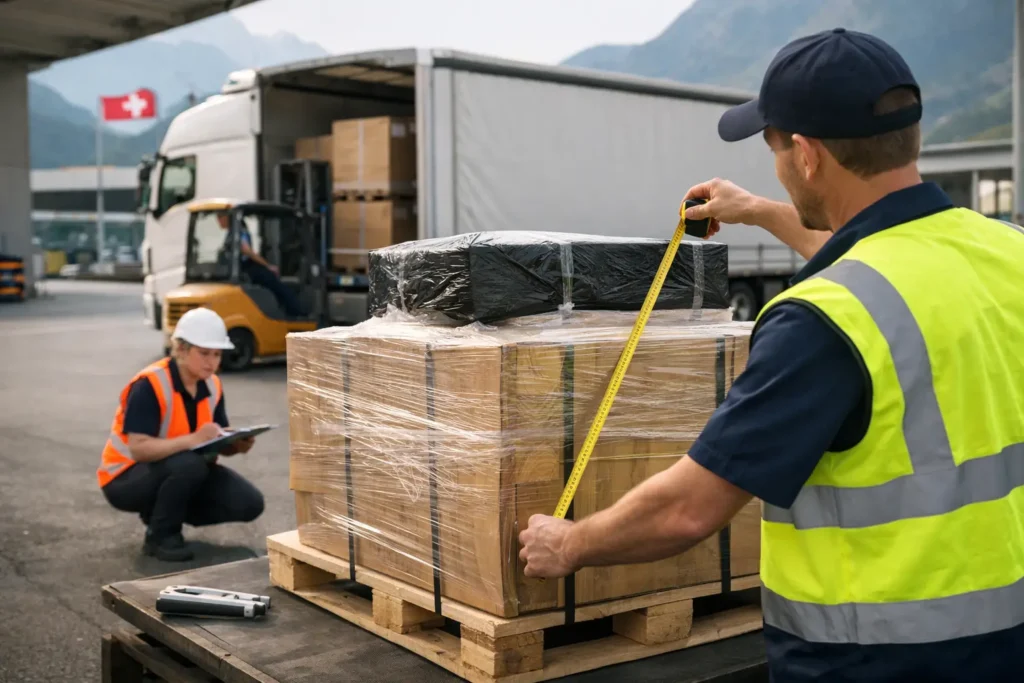
The safer approach is to measure the freight in its final transport condition. That means after wrapping, strapping, corner protection and any weather cover have been applied. Measure the maximum outer points, not the neatest internal estimate. If the load overhangs the pallet by even a few centimetres, include that overhang.
Weight should also reflect the final unit, including pallet, crate or frame. This is not only a transport issue but a safety one. The IRU and other industry bodies regularly stress the importance of correct load information for safe road operations. Reference material is available from IRU: https://www.iru.org
An operational insight that often helps: ask the warehouse team to photograph one measured unit beside a tape measure before dispatch. That gives the transport coordinator a quick verification point if any doubt arises during booking, customs review or collection.
The details that often get missed in freight dimensions
When people ask how to prepare freight dimensions, they usually focus on size and weight. In practice, planners need a fuller picture.
Stackability is one of the most common missing details. Ten pallets at 120 x 80 x 140 cm may fit very differently depending on whether they can be double-stacked. If they cannot, the shipment can occupy twice the effective loading space. The same applies to fragile goods, uneven tops or machinery with protruding parts.
Loading method matters too. A long crate may fit in a curtain-sided lorry loaded from the side but not in a standard box vehicle loaded from the rear. If your shipment needs forklift access from a specific side, lifting points, or crane loading, include it early. These are not minor remarks – they shape which vehicle can be assigned without delay.
For customs-sensitive routes, declared dimensions should also match commercial and transport documents. On movements involving Turkey or Switzerland, inconsistent cargo descriptions can trigger questions that slow clearance. Official customs guidance for traders is available through HMRC and national customs authorities, including here: https://www.gov.uk/guidance/export-goods-from-the-uk-step-by-step
Common mistakes when preparing freight dimensions
Several patterns appear again and again in cross-border road freight. The first is rounding down. A pallet that is 123 cm high gets declared as 120 cm because it seems close enough. That may be harmless on one shipment and disruptive on another, particularly if the load is being consolidated tightly.
The second is combining unlike units. If a shipment includes eight euro pallets and two oversized crates, present them separately. Blending them into one average size produces bad planning data and weakens the quote quality.
The third is omitting special handling constraints. A heavy machine base at modest dimensions may still require specialist equipment because of its weight concentration or loading position. That is where standard transport and exceptional shipments diverge.
A fourth mistake is treating freight dimensions as static master data. In reality, dimensions can shift with production changes, export packing standards or customer-specific labelling requirements. A shipment to Scandinavia in winter, for example, may need additional protective packaging that changes the final dimensions enough to affect loading.
A simple process for better dimensional accuracy
For regular shippers, the most effective fix is process discipline rather than extra administration. Build one clear checkpoint before every booking: confirm final packed dimensions, gross weight, package count and handling constraints from the dispatch point. If the shipment is urgent, assign responsibility to one named person so the transport team is not chasing three departments for one answer.
It also helps to standardise how shipment data is submitted. A consistent format reduces back-and-forth and speeds up quotation. Many experienced transport buyers now include origin, destination, ready date, dimensions, weight and any customs or access notes in the first message because they know speed depends on clean data.
Where shipments are non-standard, say so early. Oversized loads, heavy units and unusual loading requirements are manageable when known in advance. They become expensive when discovered at the bay. For companies moving across Europe, the UK, Switzerland or Turkey, that distinction has a direct effect on transit reliability.
At MAP Transport, this is where tailored planning makes a difference. Standard freight, urgent movements and exceptional loads do not belong in the same operational template. Accurate dimensions allow the right service to be selected from the start, reducing rework and protecting delivery performance.
Better dimension data leads to better transport decisions
Preparing freight dimensions properly is not box-ticking. It improves quote accuracy, vehicle allocation, loading safety and border readiness. More importantly, it reduces the hidden costs of road freight – failed collections, replanning, redelivery pressure and avoidable delays on critical orders.
If your team wants fewer surprises, start by treating dimensions as operational data, not approximate shipping information. Measure the final packed unit, declare each handling type clearly, and flag any non-standard constraint before the vehicle is booked. That one habit tends to pay back quickly across routine flows and urgent shipments alike.
Need support on your transport flows? Contact our team for a tailored solution.
Have a question or need a quote? Contact us at (+34) 943 62 95 77 (ask for Raquel) or by email at lo*******@**********rt.com