
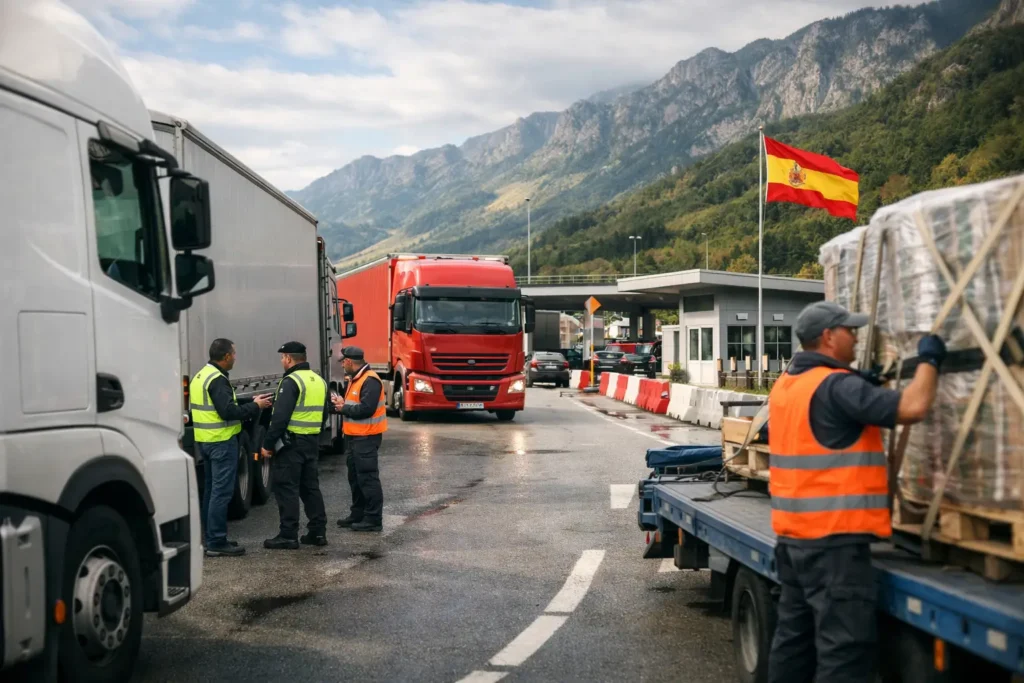
A delivery to Spain rarely goes wrong because of one big mistake. More often, it slips because of three or four small ones: the wrong vehicle for urban access, a loose delivery slot, incomplete paperwork for a non-EU origin, or a pick-up booked too late for the required lead time. For supply chain managers, road freight to Spain is usually less about finding capacity and more about controlling variables that affect cost, timing and delivery performance. If the shipment is urgent, oversized or crossing a customs border before entering Spain, those variables multiply fast.
Why road freight to Spain needs route planning, not just capacity
Spain is a core road freight market, but it is not a simple end-point on a map. Lead times vary significantly depending on origin, final delivery area and the type of goods being moved. A full load from France into northern Spain is one thing. A part load from Central Europe to Andalusia with a fixed unloading appointment is another.
Distance is only part of the equation. Congestion around border corridors, driver hour constraints, regional delivery restrictions and receiver requirements can all change the practical transit time. According to Eurostat, Spain remains one of the largest freight transport markets in the EU by tonne-kilometres, which tells you something useful: the volume is there, competition for reliable capacity is there, and poor planning gets exposed quickly.
For routine freight, the right question is not simply, « How many days to Spain? » It is, « What route, what vehicle, what handover points and what delivery conditions are needed to hit the target without adding avoidable cost? » That is where experienced planning makes a difference.
The main risks in road freight to Spain
Most delays on Spain-bound traffic fall into a few operational categories. The first is timing mismatch. A shipper may release goods late in the day but still expect a next-day linehaul connection. If the collection misses the cut-off, the whole schedule moves.
The second is paperwork. Spain is within the EU customs area, but many shipments do not start there. Goods coming from the UK, Turkey or Switzerland may require customs clearance before or during the road movement. If commodity codes, invoice values or supporting documents are not aligned, the issue appears at the border, not at the booking stage.
The third is delivery access. Industrial zones outside major cities are usually straightforward, but city-centre or tightly regulated delivery points are not. Height limits, unloading equipment, timed access and local restrictions matter. Sending a standard curtain-sided lorry when the consignee actually needs a smaller vehicle with a tail lift is the sort of detail that turns a planned delivery into a failed one.
A fourth risk is treating urgent freight like standard freight. If a production line in Zaragoza is waiting on components from Belgium, a groupage model may be cheaper on paper, but the saving disappears if the line stops. In those cases, an express van or dedicated vehicle is not a premium option. It is a risk-control decision.
Customs and compliance can still affect Spain deliveries
This is where many transport plans become too simplistic. Spain itself may not be the customs problem, but the route into Spain often is. For companies importing from the UK into mainland Europe, or moving goods from Turkey through the EU road network, customs timing has to be built into the transport plan from the start.
The European Commission continues to publish guidance on customs formalities, and the IRU regularly tracks cross-border road transport issues affecting operators and shippers. Those sources matter because customs friction is not theoretical. It changes lead times, waiting times and vehicle utilisation.
A practical example: a manufacturer shipping industrial parts from the UK to a customer near Valencia may assume the critical stage is the long haul across France. In reality, the biggest risk may be at departure if export documents and commercial invoices do not fully match the cargo details. A few hours lost before the vehicle even clears the first border can be the difference between on-time delivery and a missed unloading slot in Spain.
For regulated, sensitive or unusual cargo, the need for accuracy is even higher. If the goods include residues, specialist materials or non-standard declarations, the transport partner needs to spot issues before dispatch. That is an operational discipline, not an admin extra.
Choosing the right service level for Spain-bound freight
Not every Spain movement needs the same transport model. That sounds obvious, but many shipping problems come from forcing unlike shipments into the same service structure.
Standard road freight works well for predictable flows where lead time is stable and the delivery window has some flexibility. This is often the right fit for repeat shipments into Spanish manufacturing, distribution or industrial sites. It keeps cost under control while still delivering a dependable service level.
Urgent freight is different. If a consignee needs delivery in hours rather than days, dedicated express transport is usually the correct choice. That can mean a van for smaller high-value parts or a direct lorry movement for larger urgent loads. The operational advantage is control: no hub delay, no transhipment risk, and live oversight from collection to delivery.
Exceptional shipments require another layer again. Oversized machinery, heavy industrial components or awkward cargo for Spain need route checks, permit review and often a more detailed loading plan. In those cases, the cheapest transport option is often the one most likely to create delay.
The practical point is simple: service level should follow business impact. If delay would trigger a plant stoppage, contractual penalty or customer escalation, the transport model should reflect that from the outset.
A concrete example: when a “simple” Spain delivery is not simple
Consider a shipment of metal components moving from southern Germany to a production site near Madrid. The cargo is not oversized, and on paper it looks like a standard cross-border move. But the consignee only accepts unloading between 07:00 and 10:00, the goods must arrive on specific stillages, and the site charges for failed delivery attempts.
If the collection is booked on a part load basis without checking the fixed unloading conditions, the risk rises immediately. Any delay in consolidation, linehaul or local delivery handoff could push arrival outside the slot. The better plan may be a dedicated vehicle or a tightly managed direct movement, even if the pallet count does not seem to justify it at first glance.
This is the kind of operational judgement that protects total cost. Paying a little more for the right setup is often cheaper than paying for storage, redelivery, production disruption and internal firefighting.
How to reduce delays and cost on road freight to Spain
The strongest transport outcomes usually come from better briefing before the quote stage. Supply chain teams that provide full shipment data early tend to get more accurate pricing and fewer delivery surprises. Weight, dimensions, stackability, collection readiness, unloading constraints and document status all affect how the movement should be planned.
It also helps to separate what is fixed from what is flexible. If the delivery date is non-negotiable, say so. If a morning slot matters more than the exact day of collection, that matters too. Transport planners can build around constraints, but only if they know them.
One operational insight worth keeping in mind: vehicle choice is often more important than buyers expect. For Spain, especially on urgent or difficult deliveries, matching the vehicle to the cargo and delivery point can remove a surprising amount of risk. A dedicated van may outperform a larger vehicle on speed. A specialist setup may avoid handling issues altogether. One-size-fits-all planning rarely performs well across mixed flows.
This is also where a responsive logistics partner adds value beyond haulage. Quick decisions on rerouting, document correction, vehicle replacement or service upgrade can stop a minor issue becoming a major one. For businesses managing imports and exports across multiple European lanes, that responsiveness is often what keeps service levels stable.
Road freight to Spain works best when it is treated as an operational flow, not just a price request. The route may be common, but the shipment conditions rarely are. With the right planning, realistic lead times and a service model matched to the risk, Spain-bound freight can be both reliable and cost-efficient. That is exactly where a specialist road freight partner proves its worth, especially on urgent, customs-sensitive or non-standard movements.
Need support on your transport flows? Contact our team for a tailored solution.
Have a question or need a quote? Contact us at (+34) 943 62 95 77 (ask for Raquel) or by email at lo*******@**********rt.com