
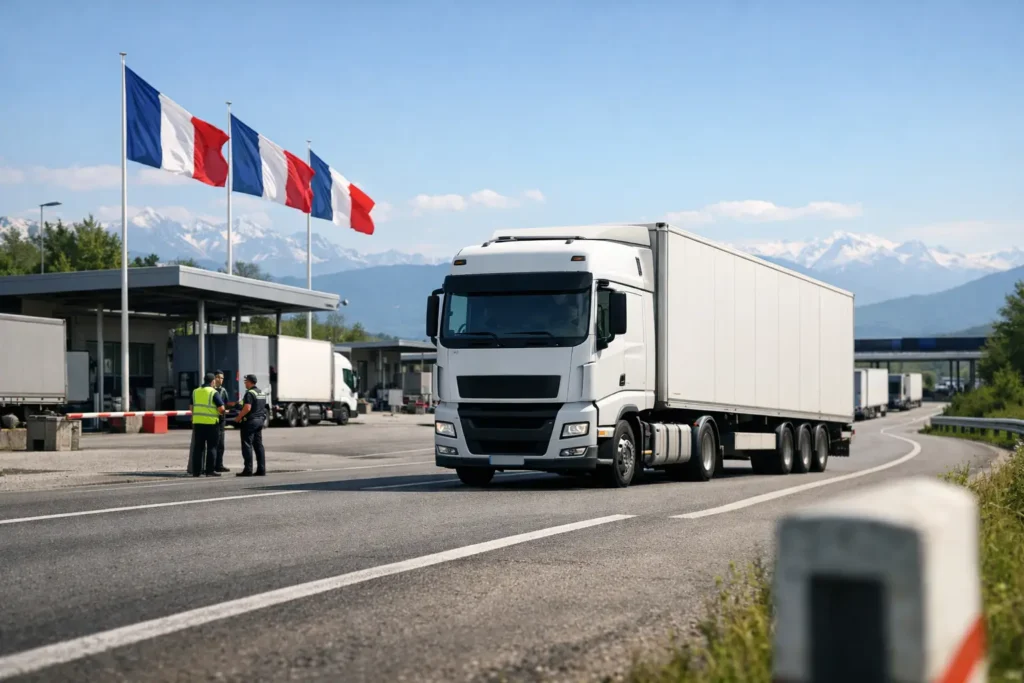
A production line rarely stops because of one big mistake. More often, it is a missed collection slot in Belgium, an incomplete customs file for a UK departure, or a consignee in Lyon changing delivery hours at short notice. That is why road freight to France needs more than available capacity. It needs route planning, document control and fast operational follow-up. For supply chain managers moving industrial goods, retail stock or urgent spare parts, France is a high-volume market with real opportunities – but also congestion points, compliance checks and timing pressures that can affect cost and service levels very quickly.
Why road freight to France can go wrong so easily
France sits at the centre of many European transport flows, which makes it commercially attractive and operationally demanding at the same time. Goods move into the country from Spain, Benelux, Germany, Italy and, through customs formalities, from the UK and Switzerland. That density creates options, but it also creates friction.
One of the main issues is that transit time on paper is not always transit time in practice. A route that looks straightforward can be affected by border waiting times, regional traffic restrictions, strikes, urban delivery windows and documentation checks. According to Eurostat, France remains one of the largest road freight markets in Europe by inland freight volume, which tells you something simple: capacity is there, but competition for reliable delivery slots is high.
For manufacturers and distributors, the real risk is not only delay. It is loss of planning accuracy. If your inbound material reaches Lille six hours late, the problem is not just transport spend. It can mean labour rescheduling, missed production output, or penalties from a customer further down the chain.
The route matters as much as the destination
Not every road freight to France movement should be planned in the same way. The right solution depends on origin, urgency, cargo profile and whether customs formalities apply.
A standard full or part load from northern Spain to Toulouse is a very different job from an urgent van shipment from Birmingham to Paris. The first may need cost efficiency and stable lead times. The second may need immediate collection, driver coordination and customs clearance prepared before the vehicle even leaves site.
This is where many transport plans become too generic. If the vehicle is chosen simply on availability rather than shipment requirement, cost and performance both suffer. A palletised industrial shipment with flexible lead time does not need the same service design as an aerospace component required within hours. Matching the load to the vehicle and service level is often where the biggest operational gains are made.
A practical example: a supplier shipping machine parts from the Basque Country to a plant near Bordeaux may choose a classic groupage or dedicated road option depending on delivery tolerance. If the consignee has a fixed unloading slot and the line is waiting, a dedicated vehicle usually protects the schedule better, even if the line-haul rate is higher. The cheaper option on the quote can become the expensive one once disruption starts.
Customs and compliance in road freight to France
If the shipment enters France from another EU country, customs may not be the central issue. If it moves from the UK, Switzerland or Turkey, customs preparation becomes critical. This is where avoidable delays still happen.
For UK-France flows, incomplete commodity data, missing EORI details, or poor coordination between exporter, importer and carrier can hold a vehicle before or after crossing. The French Customs authority makes clear that customs declarations and supporting commercial information must be accurate and aligned before arrival. On time-sensitive shipments, that means checking paperwork at booking stage, not after collection.
Swiss exports into France bring a different challenge. Customs processes are familiar to experienced shippers, but assumptions are dangerous. Preference documents, invoice wording and delivery terms all affect how smoothly the movement runs. If a buyer expects delivered duty paid handling but the transport instruction does not reflect that, the delay may happen at the border rather than at tender stage – when it is already costly.
There is also the compliance side inside France itself. Certain goods, delivery points and urban areas involve access constraints or specific scheduling rules. If the final mile is not reviewed properly, the line-haul plan can still fail at the last step.
Useful references include the French Customs portal at douane.gouv.fr and EU guidance on intra-European transport rules at europa.eu. For wider operational road freight standards, IRU remains a reliable source.
When urgent road freight to France is the right choice
Urgent transport should not be the default answer to weak planning. But there are moments when speed is the only sensible decision.
A delayed component for an automotive supplier, a replacement part for industrial machinery, or a high-value consignment needed before a weekend shutdown can justify an express movement. In these cases, the value of the shipment is not the invoice amount alone. It is the avoided downtime.
An operational insight that experienced transport buyers already know: the best urgent shipments are prepared like planned shipments. Fast service only works when collection details, dimensions, weight, customs data and consignee readiness are confirmed immediately. The haulier that asks the right questions in the first ten minutes usually protects the delivery better than the one that simply says yes fastest.
MAP Transport’s approach is built around that reality. For urgent European movements, the vehicle and route are adapted to the consignment rather than forcing a standard template onto every job. You can see how that logic applies across its express road freight services at https://www.maptransport.com.
Cost control without sacrificing delivery reliability
Every logistics manager is under pressure to reduce transport spend, but the lowest line rate is not always the lowest total cost. Road freight to France often involves a trade-off between consolidation savings and schedule control.
If your goods can tolerate a broader delivery window, shared capacity can make sense. If your customer applies strict booking slots, penalty clauses or production-linked delivery requirements, a dedicated option may be cheaper overall. The right question is not, “What is the cheapest route to France?” It is, “What level of transport cost protects my service target with the least risk?”
A useful benchmark is to review failure cost against freight cost. If a dedicated vehicle costs 18 per cent more but prevents a missed production sequence or retailer penalty, the decision may be straightforward. This matters especially for metal, industrial and specialised goods, where one late delivery can disrupt multiple downstream operations.
There are simple ways to improve cost control without weakening service:
- give precise shipment data from the start, including weight, dimensions and loading constraints
- identify whether the load is standard, urgent or exceptional before requesting rates
- share consignee restrictions early, especially for Paris, Lyon and other time-sensitive delivery zones
- align commercial and customs data before collection on non-EU flows
That level of preparation often reduces re-planning, waiting time and access problems more effectively than rate negotiation alone.
Choosing a freight partner for France-bound flows
The real test of a transport partner is not whether they can move freight to France. Many can. The test is whether they can manage the exceptions without losing control of the shipment.
That means giving clear updates, reacting quickly when collection details change, and understanding when a route needs customs support, express handling or specialist equipment. For shippers with regular France-bound volumes, consistency matters more than sales promises. You need a team that can quote quickly, spot document risks before dispatch and keep your planners informed at any time of the progress.
For more complex or oversized loads, specialist coordination becomes even more important. Exceptional shipments need route checks, permit planning and realistic timing rather than optimistic assumptions. That is particularly relevant for industrial projects moving into French manufacturing sites or infrastructure locations. More detail on tailored transport options is available at https://www.maptransport.com/services and operational enquiries can be directed via https://www.maptransport.com/contact.
Reliable road freight to France is built on small decisions made well – correct paperwork, suitable vehicle choice, realistic lead time and fast communication when conditions change. That is where experienced operators make the difference, especially on cross-border flows where one weak handover creates hours of delay.
If your France-bound transport has become harder to predict, that is usually a planning signal rather than bad luck. Need support on your transport flows? Contact our team for a tailored solution.
Have a question or need a quote? Contact us at (+34) 943 62 95 77 (ask for Raquel) or by email at lo*******@**********rt.com