
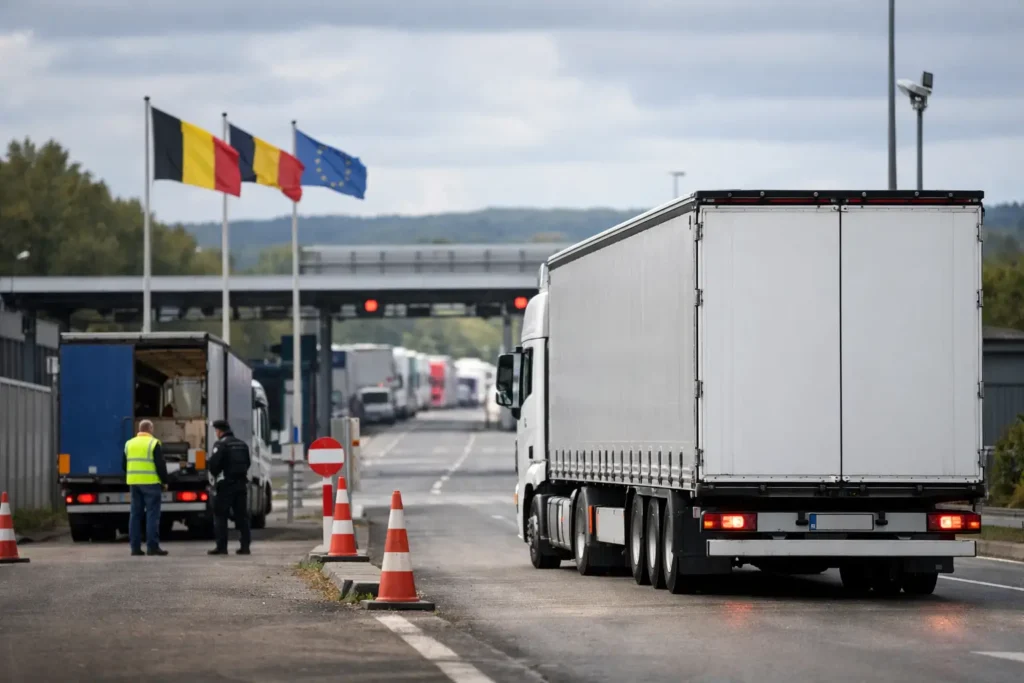
When a shipment to Belgium misses its delivery slot, the issue is rarely the mileage alone. More often, road freight to Belgium gets slowed by a poor handover at origin, incomplete delivery instructions, customs checks on non-EU flows, or congestion around major gateways such as Antwerp and Brussels. For supply chain managers, that means extra cost, production pressure and awkward conversations with customers who expected a firm ETA. Belgium looks straightforward on the map, but in practice it is a high-traffic logistics market where timing, paperwork and local delivery constraints matter more than many shippers expect.
Why Belgium demands tighter transport planning
Belgium sits at the centre of dense European freight corridors, which is exactly why it can be demanding. Goods moving in from France, the Netherlands, Germany and beyond often pass through the same motorway network and industrial zones. That concentration is commercially useful, but it increases the risk of queueing, missed unloading windows and last-minute changes at consignee sites.
This matters even more for industrial freight. A palletised shipment for Liège, a part-load for Ghent and urgent components for a production site near Antwerp may all face different access rules, booking procedures and unloading expectations. Treating all Belgian deliveries as standard groupage-style drops is where avoidable delays begin.
There is also a wider European context. Belgium is a key transit and destination market for importers, manufacturers and distributors, so service reliability matters more than headline price. According to Eurostat, road remains the dominant inland freight mode across much of Europe, which means pressure on core routes does not disappear – it has to be managed operationally.
Road freight to Belgium: the delays we see most often
The most common problems are simple, but they are not minor. The first is incomplete shipment data. If weights, dimensions, stackability, ADR status or site restrictions are unclear at booking stage, vehicle selection becomes guesswork. That can lead to a lorry arriving that cannot unload safely or cannot meet the consignee’s slot conditions.
The second is weak delivery information. Belgian consignees, particularly in industrial estates and city-adjacent zones, may require pre-booked unloading times, reference numbers or specific contact protocols. If that detail is missing, the vehicle can be kept waiting or turned away.
The third is customs friction on non-EU movements. Belgium itself is in the EU, but many supply chains feeding Belgian sites originate in the UK, Turkey or Switzerland. In those cases, road transport is no longer just a straightforward cross-border run. Errors in customs data, commodity codes or accompanying documents can hold freight at a border point before it even reaches Belgium.
A practical example: a manufacturer shipping urgent machine parts from northern Spain to a plant outside Brussels may assume the route is routine. If the loading is delayed by two hours, the consignee’s unloading slot may be lost. If the site then refuses out-of-hours receipt, the delivery rolls into the next day, with direct impact on production. The transport leg was fast enough – the planning around it was not.
Choosing the right setup for road freight to Belgium
Not every Belgian shipment should move under the same service model. Standard freight works well when lead times are realistic, delivery requirements are stable and the goods do not justify dedicated capacity. But if the delivery window is tight, or the cargo is tied to production continuity, an express option is often more cost-effective than dealing with stoppages, line downtime or contractual penalties.
This is where transport planning should start with the shipment, not with a default vehicle. A smaller dedicated van can make sense for urgent, high-value parts. A full lorry is more suitable for regular industrial flows with predictable loading patterns. Oversized or non-standard freight may need a specialist configuration and route assessment before collection is even confirmed.
That flexibility is especially relevant on Belgium flows because final delivery conditions vary so much. A distribution centre outside Antwerp is not the same as a city-centre delivery in Brussels or a factory unload in Wallonia. Matching the service to the operational reality usually saves more than chasing the lowest line-haul rate.
Customs and cross-border risk on Belgium flows
For EU-origin freight, customs is not usually the main issue. For UK, Turkish and Swiss shipments heading to Belgium, it often is. Since post-Brexit border processes changed, many shippers have learned that a fast vehicle does not compensate for incomplete customs readiness. The same applies to freight entering from Turkey, where documentation accuracy and timing affect the whole route.
The European Commission continues to update customs guidance, and operators working on these routes need to stay aligned with current requirements. In practice, that means checking document consistency before departure, not once the lorry is already in transit. Commodity descriptions, invoice values, EORI details and accompanying references must match across the file.
An operational insight that gets overlooked: customs errors do not only create border delay. They also disrupt downstream planning in Belgium. Once the original ETA slips, unloading bookings, labour allocation and onward production schedules may all need to be rearranged. One document issue can become a chain-wide service failure.
For urgent freight, the margin for error is even smaller. If a shipment needs delivery in under 24 hours, customs preparation has to be part of the transport plan from the first call. The International Road Transport Union has repeatedly highlighted how border efficiency and documentation quality directly affect road freight performance across Europe.
Urgent and exceptional shipments need a different approach
Belgium sees a high volume of time-critical industrial traffic, especially for manufacturing, automotive-linked supply and technical equipment. When a customer needs delivery within hours rather than days, the normal assumptions around consolidation and flexible timing no longer apply. The vehicle must be allocated quickly, route monitoring has to be active, and communication must stay live throughout the journey.
That is equally true for exceptional loads. Heavy, oversized or awkward freight moving to Belgian industrial sites may require route checks, permits or special unloading coordination. These are not details to solve on the road. They need to be confirmed in advance, including site access, equipment availability and any local restrictions.
A useful benchmark is this: according to INRIX traffic reporting on European urban congestion trends, Brussels regularly ranks among the more congested cities in Europe. That does not mean every shipment into Belgium will be delayed, but it does mean ETA promises should account for urban access conditions rather than motorway transit time alone.
How to reduce risk before your freight leaves
The best-performing Belgium shipments usually have one thing in common: the transport brief is complete from the start. That includes the exact collection and delivery addresses, goods description, dimensions, weight, loading metres, packaging type, delivery references, site constraints and target timing. If the load is urgent, that urgency needs to be defined in operational terms – same day, next morning, fixed slot, or production-stop recovery.
It also helps to pressure-test the route before dispatch. Is the consignee booked in? Is there a customs exposure because the freight starts in the UK, Switzerland or Turkey? Does the load require a dedicated vehicle instead of shared capacity? Is there any risk around low-emission zones, urban access or unloading equipment?
For supply chain teams running recurring flows, a regular review of failed deliveries or late arrivals into Belgium can reveal patterns quickly. In many cases, the issue is not carrier availability but inconsistent booking data or unrealistic delivery assumptions. Fixing that upstream improves cost control and service reliability at the same time.
This is where an experienced road freight partner adds value beyond moving the load. Since 1985, MAP Transport has focused on matching service type and vehicle choice to the actual shipment, whether the need is standard freight, urgent delivery within hours, or specialist handling for non-standard cargo.
Belgium rewards preparation more than optimism. If your freight plan reflects the true route, the real delivery conditions and any customs exposure, arrivals are more predictable and exceptions are easier to manage. Need support on your transport flows? Contact our team for a tailored solution.
Have a question or need a quote? Contact us at (+34) 943 62 95 77 (ask for Raquel) or by email at lo*******@**********rt.com