
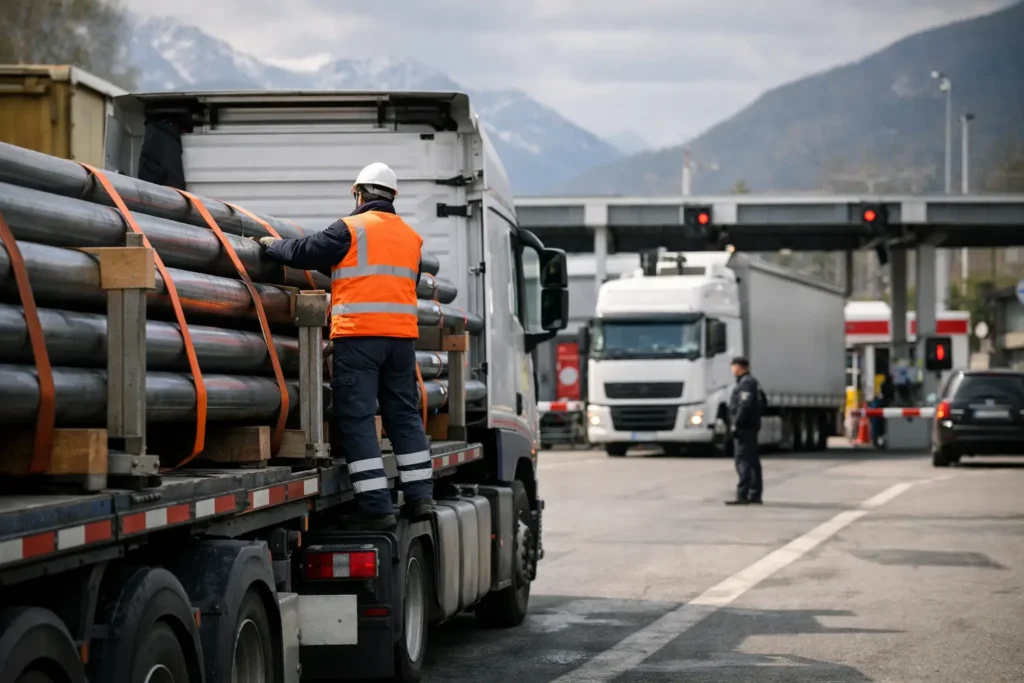
A coil misses its production slot by six hours, and the problem rarely stays in transport. The press line waits, installers are rescheduled, and a customer order slips with it. That is why steel transport Europe is less about moving weight from A to B and more about controlling risk across borders, delivery windows and handling constraints. For supply chain managers moving coils, sheets, bars or fabricated steel, the real question is not simply price per load. It is whether the shipment arrives safely, compliantly and on time, with enough visibility to act before a delay turns into a disruption.
Why steel transport Europe is operationally demanding
Steel is straightforward to describe and difficult to move well. It is dense, often high value, sometimes awkward in shape, and highly sensitive to poor securing. A standard pallet network approach does not work when the load includes slit coils, long bars or oversized fabricated parts for a construction or industrial project.
The pressure increases on international routes. According to the European Commission, road freight still carries the majority of inland freight volumes across the EU, which means steel shipments compete daily for vehicle capacity, driver hours and border throughput. On paper, a route from northern Spain to Belgium may look routine. In practice, lead time can be affected by loading slot delays, weekend driving restrictions, weather disruption and unloading requirements at the consignee’s site.
A common mistake is to treat steel like any other industrial commodity. It is not. The loading method, axle distribution, lashing plan and unloading equipment at destination all shape the transport plan. If one of those elements is unclear at booking stage, the risk shows up later as a refused collection, a roadside issue or damage claim.
The route matters as much as the rate
For steel flows across mainland Europe, transit time is only one part of the decision. Route complexity often matters more. A low-cost option can quickly become expensive if it introduces extra handling, transhipment or weak coordination between origin and destination.
This is especially true on complex corridors such as the UK, Switzerland and Turkey. Each adds its own operational layer. UK movements involve customs processing and strict document accuracy. Switzerland sits outside the EU customs union, so delays often start with incomplete paperwork rather than road conditions. Turkey adds border waiting times, permit planning and closer control over document consistency.
Take a practical example. A manufacturer shipping steel profiles from France to a customer site in Turkey may have a stable production schedule but still face variable delivery times. The reason is rarely just mileage. Border procedures, driver scheduling, weekend constraints and consignee readiness can each add hours or days. On these lanes, choosing a carrier on headline transit time alone is risky. What matters is whether the operator can plan for exceptions before they happen.
For route guidance and customs updates, many shippers monitor official sources such as the European Commission transport pages and national customs authorities. Industry bodies such as IRU also publish operational updates that can affect international road freight planning.
Load security is not an admin detail
In steel transport Europe, load restraint is one of the clearest dividing lines between a controlled shipment and an exposed one. Steel moves under force. A poorly secured coil or bundle does not need a collision to create a serious problem. Sudden braking, an evasive manoeuvre or even poor road surfaces can shift weight enough to damage goods, equipment or other road users.
This is why booking data has to be precise from the start. Weight alone is not enough. Carriers need dimensions, packaging type, centre of gravity where relevant, loading orientation, and details on whether cranes, forklifts or side loading are required. If the steel is oily, banded loosely or loaded without suitable friction material, the securing method changes.
An operational insight that often gets missed: the best transport plan can fail at the loading bay. If the shipper and carrier have not agreed the exact loading sequence, the wrong vehicle may arrive, or the correct vehicle may be loaded in a way that makes compliant securing difficult. That creates delay at source and raises risk on the road.
This is where tailored vehicle selection matters. Standard road freight may suit palletised steel parts or packed sheet. Urgent parts for a production stop may need a dedicated van or express vehicle. Heavy or non-standard loads may need exceptional shipment planning. Matching the vehicle to the freight is not a premium extra. It is basic risk control.
Customs and documents can stop steel faster than traffic can
On intra-EU routes, steel usually moves without customs formalities, but documentation still matters. Delivery references, weight data, Incoterms alignment and unloading instructions all affect how quickly a shipment is accepted and processed. Once the movement touches the UK, Switzerland or Turkey, the margin for error tightens.
A missing commodity code, a mismatch between invoice and packing details, or unclear origin information can hold a lorry long before the goods reach site. For some steel products, trade measures and import controls may also affect movement planning. Shippers who only review documents after the vehicle is booked tend to create avoidable waiting time.
The more reliable process is simple. Confirm the commercial and customs file before collection, not during transit. Align shipper, consignee and transport operator on references and delivery contact points. Check whether the receiver has site restrictions, booking systems or unloading slot rules. These steps are not glamorous, but they reduce the kind of delay that no amount of chasing can fix later.
Official customs pages from HMRC, Swiss authorities and Turkish trade authorities are worth checking whenever route or product requirements change. For many supply chain teams, this becomes even more important when steel shipments move on tight contractual deadlines.
When urgent steel moves, speed only works with control
Urgent steel transport is usually a symptom of a bigger issue – a production shortfall, a rejected batch, a maintenance stop or a customer deadline that cannot move. In those moments, every hour matters, but speed without proper planning can create a second problem.
If a replacement steel component must reach a plant in under 24 hours, the transport decision has to balance urgency with handling reality. Can the load be safely moved in a dedicated van, or does it require a larger vehicle and specific securing equipment? Is the consignee ready to unload outside standard hours? Are customs formalities cleared if the route crosses a non-EU border?
This is where experienced road freight coordination makes the difference. A time-critical shipment is not just a faster version of standard freight. It requires immediate vehicle sourcing, direct communication, live monitoring and a realistic view of what can actually be delivered within the promised window.
MAP Transport has built much of its service model around this distinction. Standard flows, express requirements and exceptional shipments need different planning logic. For steel shippers, that means the transport solution should fit the load and deadline rather than force the shipment into a generic service pattern.
How to reduce risk on your steel flows
The strongest steel transport operations are usually built on a few disciplined habits. First, provide complete shipment data at quote stage – weight, dimensions, packaging, loading method, collection and delivery constraints. Second, treat route complexity as a planning factor, not an afterthought, especially on UK, Swiss and Turkish lanes. Third, agree communication points early so your team knows who is updating whom if the plan changes.
It also helps to review recurrent problems honestly. If the same lane repeatedly suffers loading delays, the issue may sit with slot management rather than carrier performance. If damage claims keep appearing, the problem may be packaging or loading practice rather than transit conditions. Good transport management is often about finding the real point of failure, not just reacting to the latest delay.
One useful benchmark is responsiveness. If a transport partner cannot clarify vehicle type, transit assumptions, document requirements and escalation contacts before collection, they are unlikely to improve under pressure once the load is on the road. Steel shipments leave little room for vague communication.
For companies moving steel regularly across Europe and into more complex markets, the value of a specialist is not theoretical. It shows up in fewer refused loads, better timing discipline, clearer customs handling and quicker action when an urgent shipment has to move the same day.
Reliable steel transport Europe depends on detailed preparation and fast decisions when conditions change. That is exactly where an experienced road freight partner adds value – not by promising perfect conditions, but by managing the variables that usually cause delay.
Need support on your transport flows? Contact our team for a tailored solution.
Have a question or need a quote? Contact us at (+34) 943 62 95 77 (ask for Raquel) or by email at lo*******@**********rt.com