
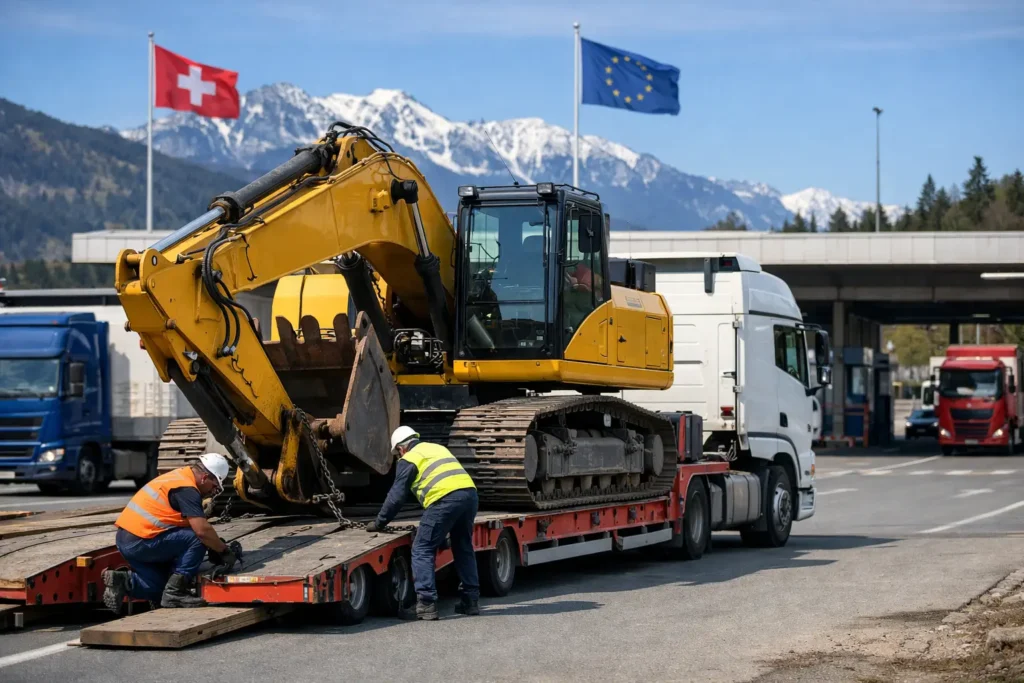
A milling machine ready on Friday, a site crane needed on Monday, and a border crossing that closes your preferred route to abnormal loads overnight – this is where heavy machinery transport Europe becomes a supply chain risk, not just a transport booking. For manufacturers, industrial suppliers and project teams, the challenge is rarely the move alone. It is timing, permits, escort requirements, loading points, customs where relevant, and keeping production or installation plans intact when one detail shifts.
Why heavy machinery transport Europe is rarely a standard shipment
Moving heavy machinery across Europe looks straightforward until dimensions, axle loads or delivery windows start narrowing your options. A standard pallet network model does not work when the cargo is a press, turbine component, production line module or oversized metal structure. The transport plan has to be built around the machinery, not the other way round.
That matters because oversized and heavy loads trigger constraints at several levels. Road restrictions differ by country and sometimes by region. Night movements may be required on one route and prohibited on another. Bridge limits, escort rules, ferry acceptance and loading bay access can all change the final plan. If the destination is in the UK, Switzerland or Turkey, border procedures add another layer of risk.
For supply chain managers, the practical implication is clear: the cheapest quote is often not the lowest-cost option once delays, redelivery, waiting time or site disruption are counted. In exceptional freight, poor planning usually shows up later as cost.
The planning points that decide whether the move runs on time
The first operational question is not vehicle availability. It is whether the shipment data is complete enough to build a workable route. Weight, exact dimensions, centre of gravity, loading method, lifting points and packaging condition all affect feasibility. A machine listed as 3.2 metres high may travel very differently from one at 3.45 metres once route restrictions are checked.
This is where many projects lose time. Procurement may confirm collection and delivery addresses, but not whether the collection site has a crane, whether side loading is possible, or whether the consignee can receive a low-loader at the planned hour. Those details decide whether a movement is practical.
A useful rule is to validate five points before booking:
- exact loaded dimensions and gross weight
- collection and delivery access constraints
- loading and unloading equipment on both ends
- permit or escort needs by country
- customs status for non-EU legs such as the UK, Switzerland or Turkey
The European road freight market remains under pressure on capacity and regulation. According to the IRU, driver shortages continue to affect road transport operations across Europe, which makes early planning even more valuable on specialist loads. Heavy machinery shipments need experienced allocation, not last-minute improvisation.
Permits, escorts and route studies: where delays often begin
In heavy machinery transport Europe, permits are not an afterthought. They are often the critical path. Oversized cargo may require single-trip authorisation, police notification or pilot vehicles depending on the countries crossed. Even when a movement is legally possible, the timing of permit approval can change the loading date.
The trade-off is speed versus certainty. Some shippers try to compress lead times by fixing collection dates before permit feasibility is confirmed. That can work on familiar lanes, but on unusual dimensions or multi-country routes it creates avoidable risk. A better approach is to align production, collection and permit timing from the start.
A concrete example: a 28-tonne industrial unit moving from northern Spain to southern Germany may look manageable on paper. But if the loaded width exceeds permit thresholds in one transit country, the route may need to bypass sections of motorway, switch to night travel and add an escort. The extra distance is not the main issue. The real impact is delivery predictability and on-site coordination at destination.
For official requirements and cross-border road transport rules, operators often need to work in line with European guidance and national transport authorities, including material published by the European Commission and customs authorities. On UK-bound or UK-origin moves, HM Revenue and Customs procedures can also affect release times if documentation is incomplete.
Customs can still disrupt machinery movements inside wider European flows
Not every heavy machinery movement in Europe involves customs, but enough of them do that it should be assessed early. The most obvious examples are the UK, Switzerland and Turkey. If the machinery is temporary, refurbished, sold, returned or moved for installation before final invoicing, the customs setup must match the commercial reality.
This is where operational nuance matters. A new machine sold outright is one scenario. A used production unit sent for repair and return is another. A project cargo movement into Turkey with supporting commercial documents, packing details and customs classification creates a different workflow again. If the paperwork does not reflect the shipment purpose, clearance delays can stop a vehicle that is otherwise perfectly planned.
For supply chain teams, the lesson is simple: customs is part of transport design, not a box to tick after dispatch. That is especially true when delivery slots are fixed and site teams are waiting.
Urgent heavy machinery transport needs a different decision model
When a line stops, the transport brief changes immediately. Cost still matters, but downtime usually matters more. If a replacement machine part, tooling unit or industrial component must move within hours, the right decision depends on what is actually urgent – the full machine, one critical sub-assembly, or a smaller component needed to restart production.
This distinction is often where money is saved. There are cases where sending the full oversized unit urgently is justified. There are others where splitting the movement is smarter: dispatch the critical component by express service, then move the remaining machinery on a planned exceptional load. That keeps the plant moving while controlling the wider transport spend.
For example, if a fabrication plant in France is waiting for a specialist machine head from northern Italy, an express dedicated vehicle may recover production faster than waiting for the entire associated structure to travel under exceptional load conditions. The operational insight is that urgency should be defined by business impact, not by shipment description.
How to reduce risk on complex heavy machinery routes
Reliable execution usually comes down to communication discipline and realistic sequencing. Heavy machinery moves fail less often because of one major mistake than because of several minor assumptions. A collection point says loading will take one hour, but it takes three. A consignee expects morning delivery, but permit conditions allow movement only later in the day. A route is approved, then local roadworks force a revision.
The best protection is a transport partner that validates assumptions early and keeps live contact with all parties during transit. That includes checking route feasibility before confirming dates, matching the vehicle to the load profile, confirming site equipment, reviewing customs status where relevant, and updating the shipper as conditions change.
This tailored approach is particularly valuable on routes that combine abnormal dimensions with border formalities. A movement from Belgium to Turkey, for instance, is not difficult for one single reason. It is difficult because route design, timing, transit formalities and customer communication all need to hold together at once.
Since 1985, MAP Transport has worked on exactly these kinds of cross-border road freight challenges, combining standard, urgent and exceptional shipment planning depending on what the load and deadline actually require.
Choosing the right transport setup for heavy machinery
There is no single best model for heavy machinery transport Europe. It depends on the machinery profile, route, border exposure, urgency and site conditions. Some loads move efficiently with a straightforward exceptional road solution. Others need a staged plan, permit lead time, or a split between urgent components and the main unit.
What matters for decision-makers is not theoretical optimisation. It is whether the transport plan protects delivery dates, controls avoidable cost and reduces the chance of disruption at collection, on the road and at destination. That usually means sharing full shipment data early, pressure-testing route assumptions, and building customs and permit requirements into the schedule from day one.
If your team is planning a heavy machinery move across Europe, the right question is not just how fast a lorry can be assigned. It is whether the whole movement has been designed to arrive without surprises. Need support on your transport flows? Contact our team for a tailored solution.
Have a question or need a quote? Contact us at (+34) 943 62 95 77 (ask for Raquel) or by email at lo*******@**********rt.com