
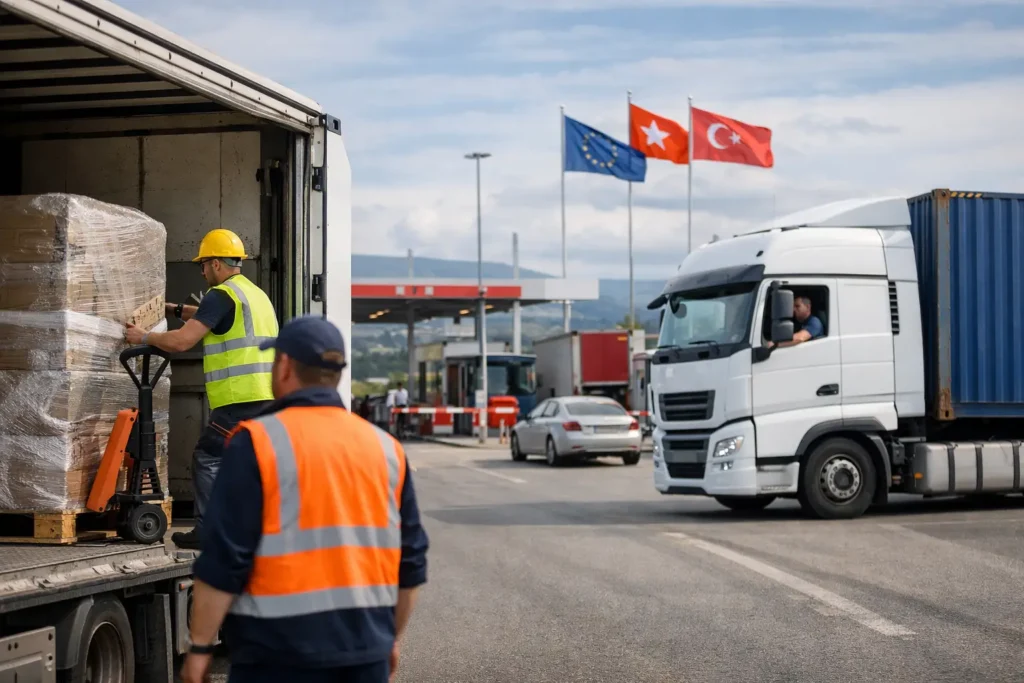
A production line rarely stops because of one big failure. More often, it is a late pallet from northern Italy, a customs hold on a UK return load, or a missed delivery slot at a plant in Germany that causes the real damage. That is why manufacturing logistics Europe is not just about moving freight from A to B. For supply chain managers, it is about protecting output, avoiding idle labour, and keeping customer commitments intact when routes, lead times and border formalities shift with very little warning.
Why manufacturing logistics Europe is under pressure
European manufacturing depends on frequent, cross-border road movements. Components, finished goods, tooling, packaging and urgent replacement parts often move on tight schedules across several countries before they reach the end customer or final assembly site. When those flows pass through the UK, Switzerland or Turkey, the transport plan also has to absorb customs, transit procedures and the risk of checks that do not affect intra-EU traffic.
The pressure is structural, not temporary. According to the European Commission, road freight carries the majority of inland freight transport in the EU. That matters because road remains the most adaptable mode for manufacturers dealing with variable order profiles, changing call-off quantities and multiple delivery points in one week. Flexibility is the advantage, but it also means exposure to congestion, cabotage rules, border waiting times and restricted unloading windows.
A common mistake is to treat all industrial shipments as standard. In practice, manufacturing flows vary sharply. A repeat full-load movement of metal parts from Spain to France is one thing. An urgent van delivery of machine components from Belgium to a plant in the Midlands within hours is another. The route, the paperwork and the consequences of delay are completely different.
The routes where manufacturing logistics Europe gets complicated
Some of the most sensitive transport flows in Europe are not the longest ones. They are the ones where a small disruption has a direct production impact.
The UK remains a clear example. Even when the transport itself is straightforward, customs declarations, commodity code accuracy, proof of origin and inbound booking processes can create avoidable delays. For manufacturers shipping regular loads into Britain, a missing document can turn a next-day plan into a multi-day problem. The transport provider needs to spot those risks before departure, not after the vehicle reaches the port.
Switzerland creates a different challenge. Transit through the EU into a non-EU market requires disciplined document handling and timing. If a supplier is moving industrial goods from Germany into Switzerland and then arranging a return flow of finished items back into the EU, both legs need to be planned with equal care. Border formalities are manageable, but only when the shipment data is right from the start.
Turkey adds another layer. Lead times can still be competitive by road, but customs controls, route planning and local operational realities mean that shipment visibility matters far more than on a simple intra-EU lane. For manufacturers dealing with upstream materials or downstream exports into Turkey, the best result usually comes from a transport set-up that combines route knowledge with active follow-up during transit.
This is where tailored service matters. A standard part-load solution may work perfectly for non-critical replenishment. It is the wrong tool for a plant shutdown risk or a booked production slot that cannot move.
How to reduce delay risk in manufacturing logistics Europe
The strongest transport plans are usually simple on paper and strict in execution. They start with accurate shipment data, realistic transit planning and the right vehicle for the job.
First, match the service level to the operational consequence of delay. If a shipment is feeding production within 12 hours, it should not be booked as if it were routine stock movement. Time-critical road transport, including dedicated vans or direct lorries, costs more than a standard groupage movement, but the extra spend is often minor compared with the cost of idle machines, missed customer despatches or weekend recovery work.
Second, build documentation checks into the booking process. For UK, Swiss or Turkish flows, the transport booking should include a review of commercial invoice data, packing details, Incoterms, customs references and any route-specific requirements. Many delays blamed on the haulier actually begin with incomplete shipper data.
Third, avoid one-size-fits-all vehicle allocation. A manufacturer sending oversized fabricated components, high-value equipment or urgent spare parts should not expect the same operating model to fit every case. One load may need a standard tautliner. Another may require a dedicated van for speed. A third may need specialist handling because of dimensions, securing requirements or unloading constraints.
There is also a planning point that gets overlooked: delivery windows at factories are often less flexible than transport teams assume. If the consignee accepts unloading only between 07:00 and 10:00, a carrier arriving at 11:30 is not just late. The load may sit until the next shift, with knock-on cost for both sides.
A practical example: one late component, one stopped line
Consider a manufacturer shipping precision components from northern Spain to a customer site in southern Germany. The standard flow moves twice a week on planned road freight. On paper, it is a stable lane. Then a supplier quality issue forces a last-minute replacement batch on a Thursday afternoon, with assembly scheduled for Friday morning.
In that situation, the decision is not simply whether transport is available. The real question is which transport model protects the production schedule. A conventional shared load may look cheaper, but it introduces handling points and timing dependencies that the shipment cannot absorb. A dedicated express vehicle is more appropriate because it removes intermediate stops and keeps the consignee informed with live progress updates.
That operational choice can decide whether the customer loses a shift. It is a good example of why manufacturing logistics Europe should be managed around consequences, not just tariff tables.
Where cost control and reliability need a balance
Every logistics manager is under pressure to manage freight spend. But on manufacturing flows, the cheapest rate is not always the lowest transport cost.
If a lower-priced option increases the likelihood of delay, re-delivery, border issues or plant downtime, the total cost rises quickly. This is especially true for cross-border movements with customs exposure. The better question is whether the chosen service level fits the commercial and operational value of the goods.
There is also a balance between consolidation and control. Grouped transport can make sense for predictable, non-urgent freight. Dedicated transport makes more sense when the shipment is urgent, high-value, difficult to handle or linked to production continuity. The right answer depends on the route, the timing and the cost of failure.
Manufacturers that perform well in this area usually segment their transport flows. They do not buy every movement the same way. They separate routine freight, urgent freight and exceptional loads, then apply clear rules for each. That creates better cost discipline without exposing the plant to unnecessary risk.
What to expect from a road freight partner
For manufacturing businesses, a transport provider should do more than collect and deliver. The value is in anticipating where a load could fail and managing that risk before it becomes expensive.
That means fast quoting, but also asking the right operational questions: exact dimensions, collection constraints, customs status, unloading equipment, booking references and required delivery time. It means clear follow-up during transit, especially on sensitive routes. And it means being able to switch from standard road freight to express or specialist transport when the shipment profile changes.
This is particularly relevant for companies shipping across Europe, the UK, Switzerland, Turkey and the Caucasus, where route complexity varies from one movement to the next. Since 1985, MAP Transport has worked with manufacturers that need this kind of flexible road freight support, whether the load is routine, urgent or outside standard dimensions.
Manufacturing logistics Europe works best when transport planning reflects the realities of production, not just the theory of freight buying. If your flows involve customs, urgent timelines or difficult routes, the safest option is usually the one built around visibility, speed and accountability from the start.
Need support on your transport flows? Contact our team for a tailored solution.
Have a question or need a quote? Contact us at (+34) 943 62 95 77 (ask for Raquel) or by email at lo*******@**********rt.com