
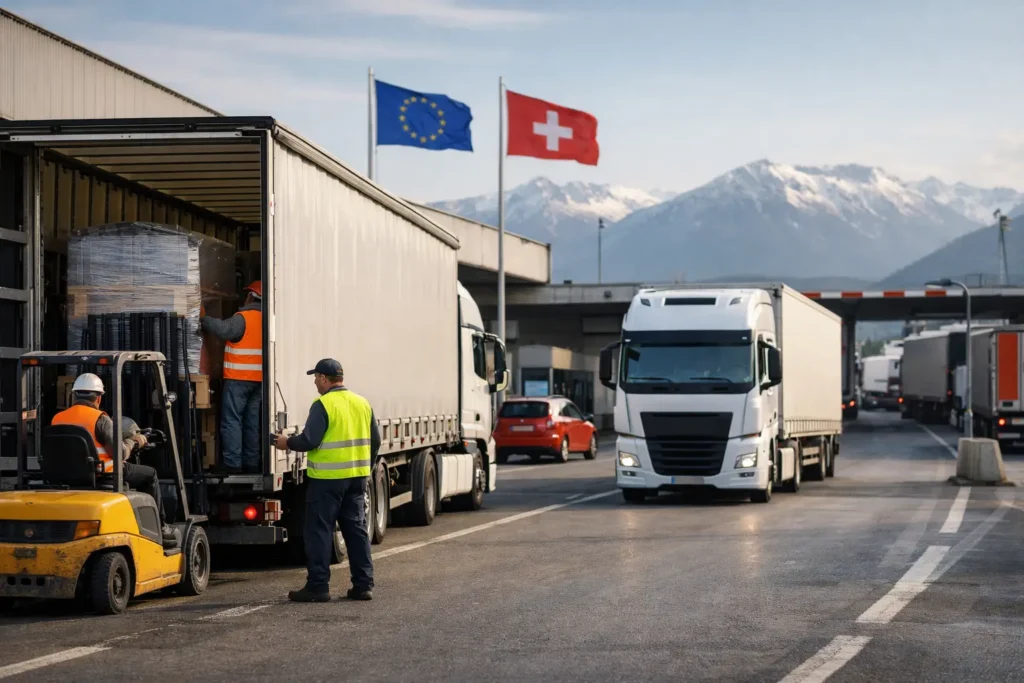
A missed slot in Rotterdam can ripple across an entire European delivery plan. One delayed collection, one customs query, or one wrong vehicle choice is often enough to turn a routine movement into a cost problem. That is why Dutch freight transport is rarely just about moving freight from A to B. For supply chain managers, it is about protecting delivery windows, controlling exception costs, and keeping customers informed when routes involve ports, cross-border paperwork, urgent replenishment, or non-standard loads. The Netherlands sits at the centre of many European flows, but that advantage only pays off when transport planning is precise.
Why Dutch freight transport matters in European road logistics
The Netherlands is a strategic road freight market because it connects port traffic, manufacturing demand, distribution hubs, and onward European routes in a very compact geography. In practice, that creates opportunity and pressure at the same time. You can move goods quickly into Belgium, Germany, northern France, and beyond, but you also face dense traffic, fixed warehouse booking times, and strict requirements around documents and load readiness.
For many manufacturers and distributors, Dutch flows are not isolated moves. They are part of wider transport chains linking the UK, Switzerland, Scandinavia, or Turkey. A pallet leaving Eindhoven may be feeding a production line in northern France. A part collected near Utrecht may need to cross into the UK with complete export documentation. A shipment arriving from Turkey may require careful timing before final delivery into the Netherlands. The route itself is often simple. The operational coordination is not.
This is why road freight decisions in the Netherlands need to be made with the next border, the next handover, and the next delivery deadline in mind. According to the European Commission, road freight remains the dominant inland freight mode across Europe, which means small inefficiencies in planning quickly scale into larger network delays when volumes are high. See: https://transport.ec.europa.eu/transport-modes/road_en
The main risks behind delays in Dutch freight transport
Most delays do not come from one dramatic incident. They come from a series of small planning errors that reduce your margin for recovery. In Dutch freight transport, three issues appear repeatedly.
The first is a mismatch between shipment profile and vehicle assignment. A standard groupage-style plan may look cost-efficient on paper, but it does not suit freight that has a fixed unloading appointment, sensitive handling requirements, or a same-day production impact. If the goods are urgent, a dedicated van or direct lorry route is often the safer choice.
The second is document quality. This is especially relevant when Dutch movements connect with non-EU routes such as the UK, Switzerland, or Turkey. A missing commodity code, incomplete commercial invoice, or unclear consignee reference can hold a vehicle longer than the actual driving time saved by optimised routing. The Dutch leg may be short, but the cross-border consequence is not.
The third is poor communication during transit. When transport teams only react after a missed slot or border hold-up, the customer loses time twice – first in the delay itself, then in the late response. The better model is active follow-up, with updates tied to operational milestones, not just final delivery.
A practical example is an urgent replacement part collected in the Rotterdam area for delivery to a production site in western Germany. If the part misses the afternoon unloading slot, the consignee may lose a full shift. In this case, the lowest-rate option is often the most expensive outcome. Direct routing, confirmed paperwork, and live progress updates are worth more than a nominal saving on transport cost.
How to plan Dutch freight transport for urgent and complex flows
Urgent transport in the Netherlands needs more than speed. It needs decision-making discipline in the first hour. The strongest planning starts with four details: exact dimensions, actual weight, loading readiness, and the real delivery deadline. Without those, even a fast quote can lead to the wrong operational choice.
For time-critical freight, planners should ask whether the shipment truly needs a direct vehicle or whether a fast scheduled service is enough. There is a clear trade-off. A dedicated express solution costs more, but it reduces handling points and cuts the risk of missed connections. For factory stoppages, line-down situations, and late supplier recoveries, that trade-off is usually justified.
The Netherlands is also a common launch point for urgent flows into Belgium, Germany, and northern France because distances are manageable and response times can be very short. For wider European coverage, it helps to work with an operator that can quickly match vans and lorries to the load rather than trying to force every job into a fixed service pattern. That is particularly important when an urgent movement later connects to a customs-sensitive route.
An operational insight that often gets overlooked is cut-off discipline at collection. If the goods are not fully packed, labelled, and document-ready before vehicle arrival, the transport plan is already under pressure. Speed starts at the loading bay, not on the motorway.
Customs and cross-border issues linked to Dutch freight flows
The Netherlands often sits at the start, middle, or end of customs-sensitive road freight. That matters for companies shipping to the UK, Switzerland, or Turkey, where the commercial and customs file can have more impact on delivery time than the route itself.
For UK-bound freight, Dutch exporters and forwarders need to align export declarations, invoice data, and consignee instructions before departure. HMRC guidance is clear that incomplete customs data creates avoidable border friction. See: https://www.gov.uk/guidance/trading-and-moving-goods-in-and-out-of-northern-ireland
For Switzerland, delays often come from underestimating formalities on what looks like a straightforward European road movement. For Turkey, transit planning needs even closer attention because lead time, border procedures, and handover quality all affect reliability. The International Road Transport Union regularly highlights how document accuracy and border processes shape road freight performance on international corridors. See: https://www.iru.org
This is where tailored transport planning matters. A shipment from the Netherlands to Switzerland may require a different vehicle and document preparation standard than a standard Benelux move. Likewise, freight moving from Dutch distribution centres towards Turkey should be planned with contingency time and proactive status follow-up, not just a nominal transit estimate.
Choosing the right service level for Dutch freight transport
Not every Dutch road movement needs the same service intensity. The mistake is treating all loads as equal when the business impact of delay is clearly different.
Classic road freight works well for standard shipments with flexible delivery windows and stable lead times. It gives shippers a dependable option for routine replenishment and regular export or import flows. However, when a delivery is tied to production continuity, event timing, or a missed supplier commitment, express transport becomes the better fit. A few hours saved can prevent far higher downstream costs.
Exceptional shipments are a separate category again. Oversized, heavy, or non-standard freight moving in or out of the Netherlands requires route planning, handling controls, and often additional compliance checks. These are not jobs to price quickly and hope for the best. They need a transport partner that can evaluate feasibility before confirming timing.
The useful question for procurement and logistics teams is not just, “What is the rate?” It is, “What level of control does this load require?” That shift in thinking usually leads to better transport decisions and fewer costly exceptions.
What reliable Dutch freight coordination looks like in practice
Reliable Dutch freight transport is built on responsiveness before the vehicle moves and accountability while it is moving. That means clear quote turnaround, realistic transit times, multilingual coordination, and shipment monitoring that does not stop after collection.
A good operator should be able to assess whether the route is standard, urgent, or exceptional within the first exchange of information. They should also challenge assumptions when needed. If your team asks for a standard service on a load that risks a line stoppage, the right response is not silent acceptance. It is a better transport recommendation.
MAP Transport has worked with European road freight since 1985, supporting companies that need routine shipments, urgent deliveries within hours, and specialist handling for non-standard loads. For supply chain managers moving freight through the Netherlands and onwards into more complex corridors, that kind of operational fit matters more than generic capacity claims.
The Netherlands offers speed, reach, and strong access to European markets, but only if the transport plan reflects the true risk profile of the shipment. If your Dutch flows connect with tight booking slots, customs exposure, urgent delivery deadlines, or specialist load requirements, treating them as ordinary road freight is where delays begin. Need support on your transport flows? Contact our team for a tailored solution.
Have a question or need a quote? Contact us at (+34) 943 62 95 77 (ask for Raquel) or by email at lo*******@**********rt.com