
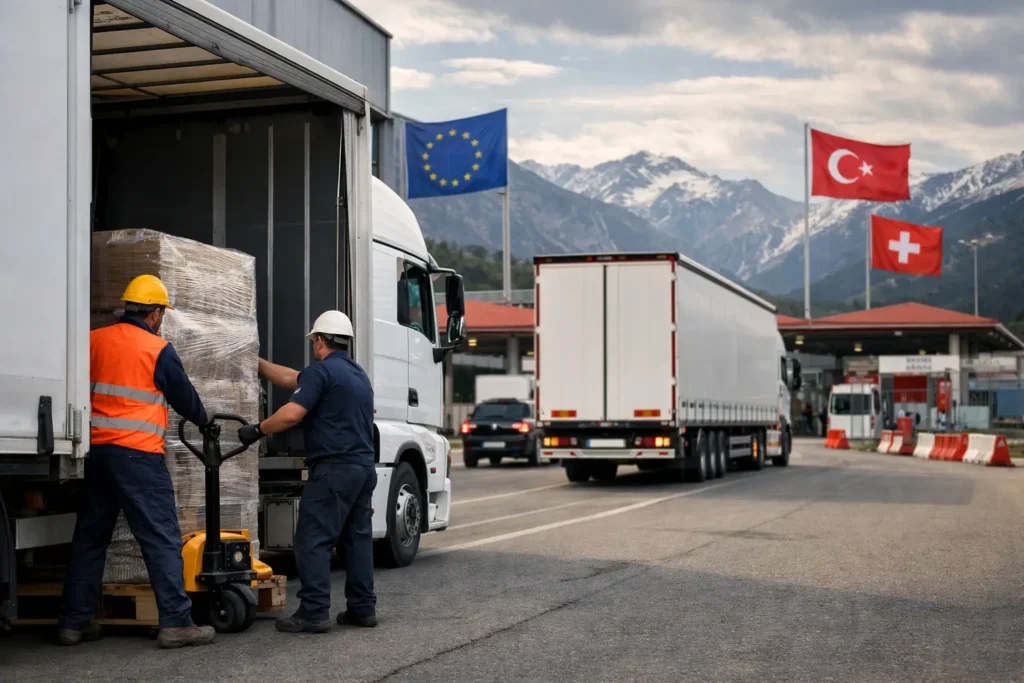
A shipment can be ready on the production floor and still miss its delivery slot because the transport plan was built around a rate rather than the actual risk. For exporters, freight transport for exporters is not simply a question of finding a lorry from A to B. It means protecting production commitments, managing border formalities, selecting capacity that fits the consignment and keeping customers informed when timing matters. This is especially true on routes involving the UK, Switzerland, Turkey or the Caucasus, where a missing document or unsuitable vehicle can turn a routine collection into an expensive delay.
Start with the delivery commitment, not the vehicle
The first decision should be the required delivery outcome: a fixed unloading appointment, a production-line deadline, a trade fair installation window or a customer promise with contractual consequences. Only then can the transport solution be designed properly.
A standard full-load or groupage movement may be the sensible choice where lead times are stable and the consignee can receive within an agreed window. But it is rarely the best option for a critical spare part, a last-minute production release or a shipment that needs delivery in a few hours. In those cases, a dedicated van or express vehicle can reduce handling points and provide greater control over the collection-to-delivery timeline.
The operational insight is straightforward: every additional terminal, cross-dock or handover creates another point where a shipment can lose time. Lower-cost routing may be appropriate for predictable flows, but exporters should make that trade-off consciously. A rate that saves a small amount at dispatch can cost far more if it causes a stopped production line or a rejected delivery appointment.
MAP Transport plans road movements across 45 countries, matching vans and lorries to the shipment rather than forcing each consignment into a fixed service model. That matters when a regular export flow suddenly becomes urgent.
Freight transport for exporters on customs-sensitive routes
European road freight becomes more complex when the route crosses a customs border. The UK, Switzerland and Turkey are familiar examples, but the same discipline applies to movements extending towards Azerbaijan and Kazakhstan. The physical journey may be planned accurately, yet the freight can remain stationary if export, transit or import documentation is incomplete or inconsistent.
For a UK export, the transport booking needs to account for more than the collection postcode and delivery address. The exporter must confirm who is responsible for export declarations, import clearance, commodity classification, commercial invoice data and any required licences. Incoterms also need to match the commercial agreement and the practical division of responsibility at the border.
Consider a Spanish machinery supplier sending a replacement component to a factory in Birmingham. The component weighs only 180 kg, so a dedicated express van may be the fastest way to meet the customer’s next-shift deadline. However, that speed disappears if the invoice description is vague, the consignee’s import instructions are unavailable or the customs reference is not ready before the vehicle reaches the crossing. For an urgent shipment, documents must be treated as part of the departure checklist, not as paperwork to resolve while the vehicle is already moving.
Switzerland requires the same attention. Although it is geographically central to many European supply chains, it sits outside the EU customs union. A movement from France or Germany into Switzerland should include clear commodity descriptions, accurate values, origin information where applicable and agreed customs representation. A specialist freight partner can coordinate the transport process, but exporters remain responsible for providing correct commercial data promptly.
Build a shipment brief that prevents avoidable delays
A useful transport brief gives the carrier enough information to quote accurately, allocate the right equipment and identify risks before collection. It should be practical rather than lengthy. For most export movements, the essential fields are origin and destination, collection and delivery dates, weight, dimensions, number of pallets or packages, goods description, customs requirements and contact details at both ends.
Dimensions deserve particular attention. A shipment described as five pallets may require a different vehicle once pallet height, non-stackability or overhang are considered. Likewise, a load that appears to fit into a standard curtain-sider may need a dedicated vehicle if it has loading restrictions, requires side loading or cannot be transhipped safely.
For exceptional shipments, the brief must go further. Industrial equipment, oversized steel components and non-standard loads can require route checks, permits, specialist loading arrangements or escort planning. The most reliable approach is to involve the transport provider while the dispatch date is still flexible. Leaving this until the goods are packed often limits options and increases cost.
A good rule for procurement and logistics teams is to flag any of the following at quote stage:
- a fixed delivery slot or penalty exposure;
- customs clearance outside the EU customs area;
- hazardous, regulated or controlled goods requirements;
- oversized, heavy or non-stackable freight; and
- an urgent collection or delivery requirement.
These details allow the transport plan to reflect the real shipment, rather than an assumption that has to be corrected later.
Choose standard, express or exceptional transport deliberately
Exporters with recurring flows benefit from separating their freight into service categories. This makes transport buying faster and reduces last-minute debate when a shipment is released.
Standard road freight works well for planned exports where transit time is important but not critical to the hour. It provides a cost-conscious option for full loads and part loads, provided collection dates, packaging and consignee availability are confirmed early.
Express transport is for consignments where delay carries a direct operational cost. It is often used for automotive parts, production tooling, medical equipment, urgent industrial spares and samples required for customer approval. A direct dedicated vehicle can be more expensive than consolidated freight, but it provides a shorter and more predictable route with fewer handling stages. The right question is not whether express is cheap. It is whether the cost of delay is higher.
Exceptional transport is a separate planning exercise. Heavy, wide or unusually shaped equipment cannot be treated as standard freight with a different price. Vehicle selection, securement, loading access, permits and route restrictions all influence feasibility. Early information is the difference between a controlled movement and a rushed operation with limited options.
Keep visibility active during transit
Tracking is valuable, but it does not replace active operational follow-up. A status update that confirms a delay after it has happened is less useful than early intervention when a border queue, loading issue or recipient problem is developing.
Export teams should agree what communications they need before the shipment leaves. For a routine movement, collection confirmation and delivery confirmation may be enough. For urgent or customs-sensitive freight, the plan should include milestone updates, immediate notification of exceptions and one named contact who can make a decision quickly.
This is particularly relevant on complex routes. A driver arriving at a site without the correct unloading reference, or reaching a border before clearance instructions are finalised, needs a rapid response from both the exporter and the transport coordinator. Multilingual communication can make a practical difference when the shipper, driver, customs contact and consignee are operating in different countries.
MAP Transport has coordinated international road freight since 1985, with personalised follow-up from quotation to delivery. For supply chain managers, this means having a transport partner accountable for the operational details, while their team remains informed at any time of the shipment’s progress.
Make freight performance part of export planning
The strongest export transport processes do not start when goods are ready to collect. They begin when sales, procurement and operations understand the delivery promise being made to the customer. That allows the logistics team to reserve the appropriate service, prepare customs data and manage costs before urgency narrows the available choices.
Review delayed shipments regularly and identify the actual cause. Was it late cargo readiness, incorrect dimensions, incomplete documents, a missed delivery booking or an unsuitable service level? This turns freight performance into an operational improvement process rather than a series of individual firefighting exercises.
For exporters managing Europe-wide flows, dependable road transport comes from clear shipment data, early customs preparation and a service level that matches the commercial risk. The objective is not to remove every exception. It is to identify exceptions early enough to protect the delivery.
Have a question or need a quote? Contact us at (+34) 943 62 95 77 (ask for Raquel) or by email at lo*******@**********rt.com
Need support on your transport flows? Contact our team for a tailored solution.