
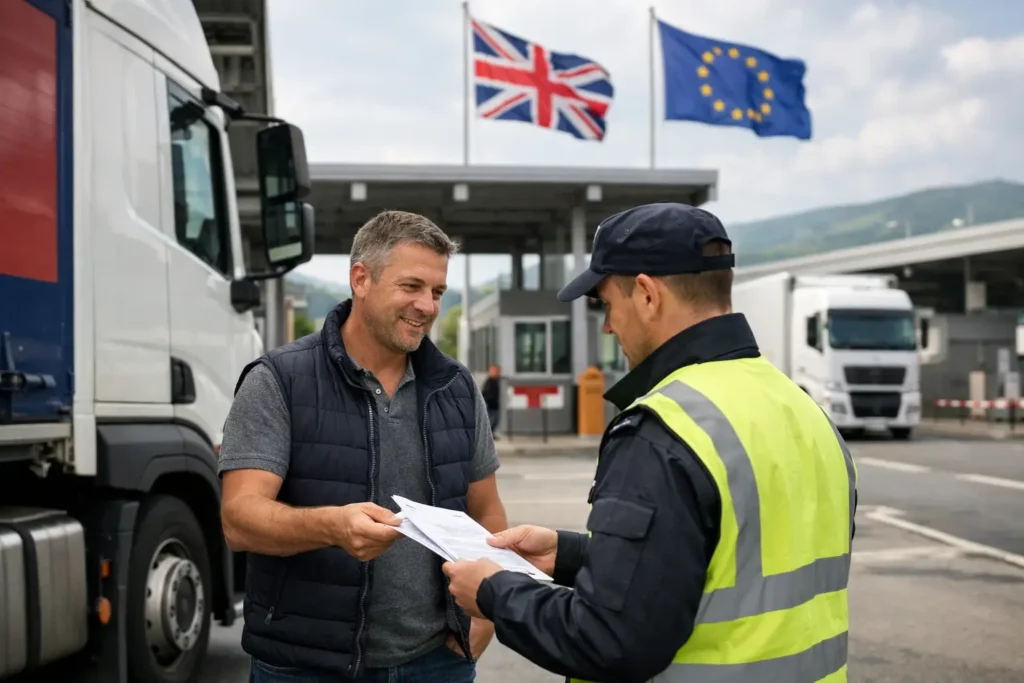
A lorry can be loaded on time in Birmingham, Rotterdam or Bilbao and still miss its delivery slot because one customs detail does not match the commercial paperwork. That is the daily reality of post-Brexit freight transport. For supply chain managers, the challenge is no longer simply securing capacity between the UK and continental Europe. It is controlling the documents, customs status, border timing and communication that sit around the journey. When production depends on a component arriving before a shift starts, a vague ETA or an incomplete declaration is not an inconvenience. It is a direct operational risk.
Why post-Brexit freight transport still creates delays
The UK-EU border is no longer a frictionless road freight corridor. Every commercial movement needs the right customs process, whether goods are moving permanently, returning after repair, travelling under temporary admission, or entering the UK through a transit procedure.
The most common disruption is not caused by the road journey itself. It starts before collection. A missing commodity code, an incorrect goods description, a mismatch between invoice value and declaration, or uncertainty over Incoterms can stop the customs process from progressing. If the driver reaches the port without the required reference numbers or boarding information, the vehicle may lose its booked crossing and the delivery plan can unravel quickly.
The risk is higher for businesses shipping mixed consignments. A single lorry carrying spare parts, finished goods and packaging may require several tariff classifications and a clear item-level commercial invoice. General descriptions such as “industrial equipment” are rarely enough for customs purposes.
There is also a practical timing issue. Ferry and Eurotunnel schedules may be predictable, but border readiness is not automatic. A shipment collected late on a Friday, for example, can face restricted broker availability, reduced warehouse receiving hours and a missed Monday production slot if documents were not approved before the weekend.
The documents that protect delivery dates
For post-Brexit freight transport, document control should begin when the shipment is quoted, not when the vehicle is already at the loading point. The transport provider, exporter, importer and customs representative need to work from the same commercial information.
At a minimum, the shipment file should confirm the exporter and importer of record, EORI numbers, commodity codes, goods value and currency, country of origin, weight, number of packages and Incoterms. The invoice and packing list must describe what is physically loaded. This sounds basic, but it is where many avoidable delays begin.
For road freight between the EU and Great Britain, managers should also establish who is responsible for export and import declarations, whether safety and security filings are required, and which party will provide the relevant customs movement reference numbers. For goods travelling through the Common Transit Convention, the transit document and discharge process must be planned in advance, particularly where the final destination is not close to the port of arrival.
A concrete example illustrates the point. A Spanish manufacturer sends an urgent replacement machine component to a factory near Coventry. The component is worth €18,000 and is needed before a planned maintenance stop ends the next morning. The vehicle capacity is available, but the shipment cannot move reliably until the commodity code, origin statement, commercial invoice, importer EORI and customs declaration responsibility are confirmed. In an urgent movement, a 30-minute document query can cost more than an express vehicle.
The operational insight is straightforward: treat customs data as part of the load plan. Do not regard it as a separate administrative task delegated at the last minute. The fastest vehicle cannot recover time lost at a border because the paperwork was prepared after collection.
How to plan UK-EU movements with less risk
The strongest transport plans build in decision points before the lorry departs. That means confirming customs readiness, route options and delivery constraints while there is still time to change the plan.
For regular flows, create a shipment profile for each lane. A profile should record the usual commodity codes, customs representation model, standard documents, crossing preferences, delivery restrictions and named contacts on both sides of the border. This reduces repetition and makes exceptions easier to spot. It also helps when a regular route changes from a full trailer load to a smaller, time-critical consignment.
For less frequent movements, use a pre-departure check. Confirm the following before collection:
- the goods description and tariff classification match the invoice and packing list;
- exporter, importer and customs representative responsibilities are agreed;
- customs references are available or have a confirmed submission deadline;
- the consignee can receive the goods at the planned arrival time; and
- the chosen service matches the commercial consequence of a delay.
That last point matters. Standard groupage or a conventional full-load service may be the right commercial choice for replenishment stock with a flexible delivery window. It may not be suitable for a line-stopping part, an exhibition unit with a fixed installation time or a critical repair component. Post-Brexit freight transport has made service selection more closely tied to customs readiness and delivery urgency.
Choosing the right vehicle and service level
The most economical transport solution is not always the lowest line-haul rate. A shared-load service can reduce cost for planned stock movements, but it introduces more handling points and less control over timing. A dedicated lorry gives greater control over collection and delivery, while a van can be the better choice for urgent, lower-volume cargo that needs to reach the UK within hours rather than days.
Vehicle choice also affects how easily a shipment can be managed at borders and delivery sites. A full trailer is suitable for high-volume industrial freight, but an articulated vehicle may face access constraints at city-centre sites or older manufacturing facilities. For oversized or non-standard cargo, route planning must consider dimensions, permits, escort requirements and the practicalities of port operations well before loading.
This is where a tailored approach pays off. The same UK destination may require a different service depending on whether the goods are routine components, temperature-sensitive material, a high-value prototype or machinery that cannot be reloaded. The transport plan should follow the shipment risk, not a fixed product category.
MAP Transport has coordinated international road freight since 1985 and supports more than 200 customers each year across 45 countries. That experience is useful when a UK movement needs more than a vehicle booking: it needs a clear escalation path, multilingual coordination and someone accountable for progress from collection to delivery.
Managing urgent post-Brexit freight transport
Urgent UK movements should be treated as controlled exceptions, not simply expedited standard shipments. The first question is not “How fast can the vehicle leave?” It is “What must be true for this vehicle to cross and deliver without interruption?”
A practical urgent-transport plan confirms the collection readiness time, driver availability, customs submission cut-off, crossing capacity, delivery contact and receiving-hour flexibility. It should also include a contingency: another port, an alternative crossing or a different vehicle type if the original plan becomes unworkable.
Communication is equally important. Supply chain teams need updates that help them make decisions, not generic tracking messages. If a customs query puts a planned arrival at risk, the consignee should know early enough to adjust labour, production or unloading arrangements. Good follow-up protects trust even when a disruption cannot be avoided.
For high-value or confidential cargo, control measures should be proportionate to the shipment. Direct transport, limited handling, verified collection and delivery contacts, and regular status updates can be more valuable than shaving a small amount from the freight rate.
Build border control into your transport procurement
Post-Brexit freight transport is now a procurement and operational-planning issue, not only a carrier-management task. When requesting a quote, provide the origin and destination, collection and delivery times, weight, dimensions, number of packages, goods description, urgency and any customs constraints. This allows the transport partner to recommend a realistic vehicle, service level and route rather than pricing a movement on incomplete information.
It also helps to measure the right outcomes. Cost per load matters, but so do customs-related holds, missed delivery appointments, document corrections, communication speed and the number of urgent movements that arrive within the required window. These indicators reveal whether a transport flow is genuinely under control.
The businesses that manage UK trade best are not those that expect borders to become simple again. They are the ones that make customs readiness, route flexibility and accountable follow-up part of every shipment decision.
Need support on your transport flows? Contact our team for a tailored solution.
Have a question or need a quote? Contact us at (+34) 943 62 95 77 (ask for Raquel) or by email at lo*******@**********rt.com