
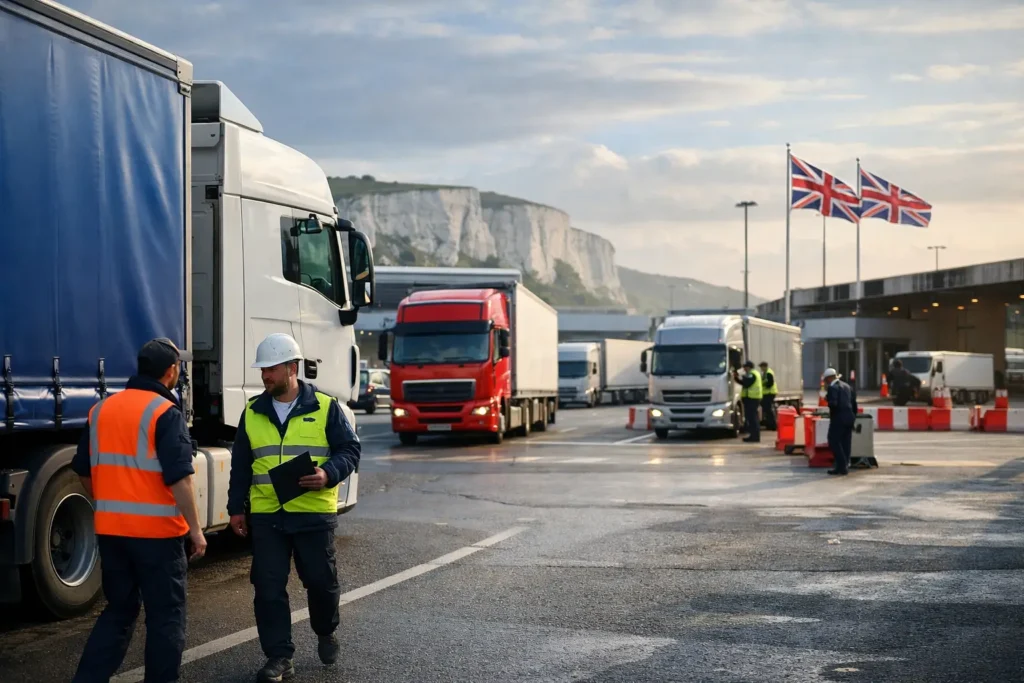
A production line in Birmingham waiting for parts from mainland Europe does not care whether a delay began with an incorrect commodity code, a missing safety declaration or a driver arriving outside a booked slot. It only sees the cost of stopped work. That is the reality of UK freight transport: the road journey may be straightforward, but the border process can turn a planned delivery into an expensive exception. For European manufacturers, distributors and procurement teams, reliable UK movements depend on treating customs, routing, vehicle selection and live communication as one operational plan.
Why UK freight transport needs a different planning model
The UK remains a major trading partner for European industry, but road freight is no longer a simple cross-Channel movement. Every import or export flow must account for customs formalities, commercial documents, the party responsible for declarations, and the specific requirements at the point of entry.
A booking that looks complete on a transport order can still fail at the border. A consignee may have an EORI number but no clear agreement on who acts as importer of record. An invoice may show a product description such as “steel parts”, when the customs declaration needs a sufficiently precise description, commodity code, origin and value. A time-critical shipment can lose its value if these points are resolved after the vehicle has departed.
The scale of the route makes this operationally significant. UK government trade statistics consistently show that goods trade between the UK and EU is measured in hundreds of billions of pounds each year. Even a small percentage of consignments held for document clarification creates a material volume of disruption across supply chains.
The practical lesson is simple: plan the border process at quotation stage, not when the lorry reaches the port. For each movement, confirm the Incoterms rule, importer and exporter details, EORI numbers, commodity codes, invoice values, origin statements where relevant, and whether any product-specific controls apply.
Customs accuracy prevents avoidable border delays
In UK freight transport, documentation quality is directly linked to delivery performance. Border staff and customs systems cannot correct vague commercial information on behalf of the shipper. Where data does not match across the invoice, packing list, transport instruction and customs declaration, the shipment may require intervention before it can proceed.
A common example is a Spanish industrial supplier sending replacement machine components to a customer near Manchester. The goods are needed the following morning after an equipment failure. The supplier provides dimensions, weight and collection address, but the invoice omits the commodity code and identifies the goods only as “machine spares”. The vehicle can be sourced quickly, yet the customs entry cannot be prepared with confidence. The risk is not the road distance. It is an incomplete data set delaying clearance.
Before collection, the transport team should verify three areas:
- The commercial data: accurate goods description, quantities, value, currency, commodity code and country of origin.
- The customs responsibility: who submits export and import declarations, and who pays duties and VAT where applicable.
- The route data: departure point, intended crossing, delivery deadline and any delivery-site booking reference.
This is also where specialist flows need additional attention. Controlled goods, regulated residues, food products, chemicals or goods subject to licences can require documents beyond the standard invoice and packing list. A low transport rate offers little value if the service provider discovers those requirements only after collection.
HM Revenue & Customs guidance and EU customs rules provide the framework, but the operational task is translating that framework into a file that is ready to move. Experienced freight management means identifying gaps early, escalating them to the correct party and keeping the customer informed before a delay becomes unavoidable.
Choose the vehicle around the UK freight requirement
The best vehicle for a UK movement depends on the shipment and the consequence of lateness. Sending a small urgent consignment in a full-size articulated lorry is inefficient. Trying to consolidate a critical machine part with standard freight can be equally costly if it misses the required delivery window.
For routine palletised freight, a planned groupage or full-load service may offer the right balance between cost and transit reliability. It works well when production has stock cover and the receiving site can accept a flexible delivery date. The key is to allow sufficient lead time for collection, customs processing, crossing capacity and final delivery booking.
For a factory-down situation, a dedicated van or express vehicle may be the better decision. A collection in northern France in the afternoon can be loaded onto a dedicated vehicle, cross overnight and deliver to the Midlands the next morning, subject to customs readiness and ferry or tunnel availability. The higher transport cost must be measured against the cost of lost production, emergency purchasing or a missed customer commitment.
Exceptional shipments need a separate plan. Heavy tooling, oversized equipment and non-standard industrial loads require suitable equipment, route checks, permits where applicable, loading supervision and enough time to manage border documentation. These are not movements to force into a standard schedule. Vehicle selection should follow the cargo, not the other way round.
Build resilience into the Channel crossing
The Channel crossing is a pressure point rather than a guaranteed timetable. Weather, port congestion, road incidents, booking cut-offs and security controls can all affect transit. A reliable plan therefore includes a primary crossing strategy and realistic alternatives.
For urgent UK freight transport, leaving no margin between collection, customs completion and the last available crossing is a high-risk approach. A more controlled plan sets document cut-offs before vehicle dispatch, confirms the crossing booking, checks driver instructions and preserves enough time to reroute if conditions change.
Communication is particularly important when the delivery is time-sensitive. A supply chain manager needs more than “the vehicle is on its way”. Useful updates explain the operational status: customs submitted, vehicle loaded, crossing confirmed, border cleared, delivery appointment maintained or revised. If there is a problem, the update should include the action being taken and the likely impact.
This is where a multilingual team adds practical value. A UK consignee, a French customs agent, a Polish haulier and an Italian supplier may all need to resolve the same issue quickly. Clear coordination reduces the risk of assumptions being lost between parties.
Measure performance beyond the transport rate
The cheapest quoted price can hide the highest total cost. UK flows should be assessed against the costs that matter to the business: late production, demurrage exposure, failed delivery appointments, administration time and the need for emergency recovery transport.
Review each lane using a small set of practical indicators. Track collection-to-delivery lead time, customs-related holds, delivery-slot compliance, quote response time and the frequency of status updates. If a lane experiences repeated delays, investigate the pattern. It may be a recurring documentation error, an unrealistic cut-off, a delivery site with restrictive booking rules or a mismatch between service level and urgency.
It also helps to separate predictable movements from true emergencies. A weekly flow of components from Germany to the UK should be planned as a repeatable transport programme with agreed data, collection windows and escalation contacts. A breakdown shipment should trigger a faster process, with a dedicated vehicle and direct communication between the shipper, customs parties and consignee.
MAP Transport has managed European road freight since 1985 and supports customers with standard, express and exceptional shipments based on the actual requirement. For UK routes, that means coordinating the movement from the first shipment details through to delivery, rather than treating customs and transport as separate tasks.
A dependable UK flow is built before the vehicle is loaded: accurate information, the right service level, a realistic crossing plan and someone accountable for progress. When those elements are in place, border complexity becomes manageable rather than a recurring source of disruption.
Need support on your transport flows? Contact our team for a tailored solution.
Have a question or need a quote? Contact us at (+34) 943 62 95 77 (ask for Raquel) or by email at lo*******@**********rt.com