
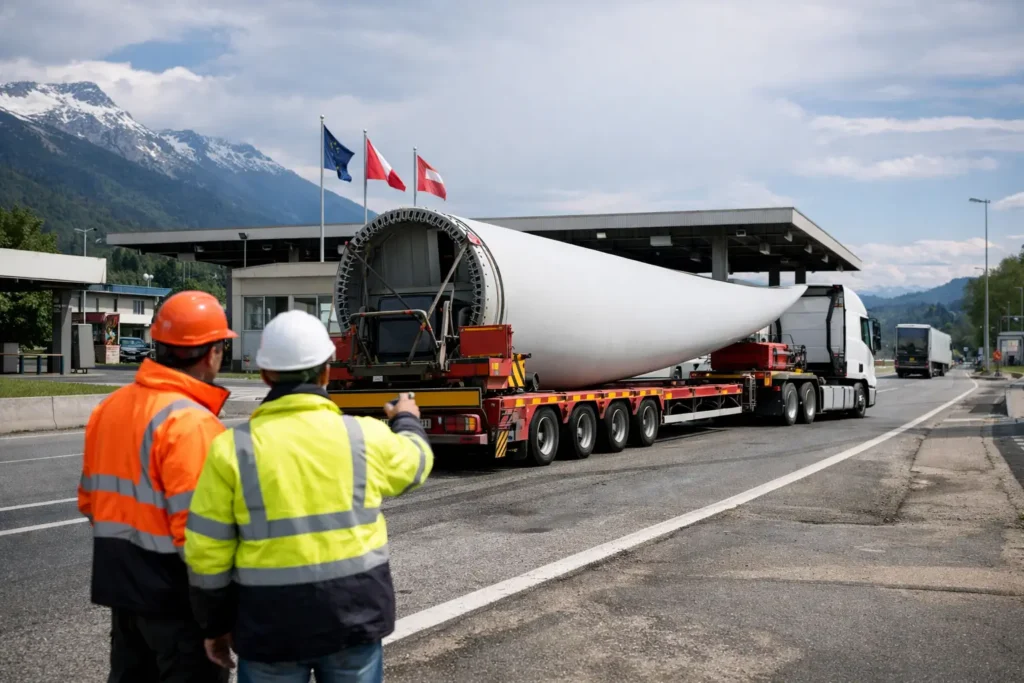
A 4.2-metre-wide steel structure can be ready on site, loaded correctly and still fail to move because a bridge restriction was identified too late. That is the commercial reality behind exceptional freight: the risk is rarely just the load itself. It is the permit lead time, the approved route, the escort requirement, customs clearance and the receiving site’s readiness working together. The best practices oversized transport teams use turn these variables into a controlled plan, protecting production schedules, project milestones and transport budgets across complex European corridors.
Start oversized transport planning with verified load data
Oversized transport should not begin with a vehicle request. It should begin with a precise load profile. Dimensions, gross weight, axle loads, centre of gravity, lifting points and loading orientation all affect which trailer can be used and which roads can be authorised.
A common issue is receiving dimensions for the product but not for its transport configuration. Protective frames, cradles, packing and lifting equipment can add decisive centimetres or tonnes. A load that appears suitable for a standard low-loader may require a different configuration once its true height or rear overhang is confirmed.
Before route planning starts, obtain and validate:
- total length, width and height after packing
- gross weight and, where relevant, axle-load distribution
- centre of gravity and any handling restrictions
- loading and unloading method, including crane capacity
- photographs or drawings that show protrusions and securing points
This information should be checked against the actual consignment, not only the purchase order. For industrial machinery, a revised drawing issued after transport has been booked can change permit conditions completely. Early verification prevents last-minute rework, premium vehicle changes and missed collection slots.
Best practices for oversized transport route approval
The shortest route is not automatically the safest, fastest or lowest-cost route. Height restrictions, bridge ratings, roadworks, seasonal closures and local curfews can force a longer itinerary. On certain movements, the final kilometres to an industrial estate or construction site create more risk than the international motorway section.
Road freight remains central to European supply chains. Eurostat data shows road transport accounts for roughly three quarters of inland freight moved in the EU by tonne-kilometres. For exceptional loads, however, that scale does not mean standardisation. Permit rules, escort requirements and authorised travel windows can differ by country and sometimes by region.
A practical example is a wide production module moving from northern Spain to southern Germany. A planner may find that the preferred motorway route includes a tunnel restriction, while an alternative route needs a police escort during a limited night-time window. The correct choice depends on permit timing, site delivery deadline and the cost of holding the module. Saving 60 kilometres is irrelevant if it adds two days of approval risk.
Route approval should therefore cover the full movement, including collection and final delivery access. Confirm road geometry, turning areas, bridge clearances, lay-bys, fuel stops and secure parking. If the route crosses several jurisdictions, give one coordinator clear ownership of permit status and schedule changes. Fragmented responsibility is where updates get missed.
Treat permits and customs as one critical path
Permits and customs are often managed as separate tasks. Operationally, they are one critical path: the load cannot move if either is incomplete. This matters particularly for UK movements, Switzerland, Turkey and routes extending into the Caucasus, where border processes can be as time-sensitive as route authorisation.
For a movement from France to the UK, an oversized load may require a booked crossing, a compliant export declaration, UK import readiness and authorised road movement on both sides of the Channel. A delay at customs can mean missing a permitted travel slot or an escort booking. The consequence is not simply waiting at the border; it can mean rebooking specialist resources and revising the full delivery plan.
Build the permit and customs schedule backwards from the required delivery time. Identify who supplies each document, who checks commodity descriptions and values, and who can respond if customs asks for clarification outside normal office hours. For Turkey and Caucasus routes, factor in transit documentation, border queues and the possibility that local conditions may alter the planned sequence.
The operational insight is simple: do not promise a collection date until the documents, authorisations and crossing plan have been checked together. A transport partner should raise gaps early, when there is still time to resolve them without putting the project at risk.
Match the vehicle and support plan to the real constraint
Exceptional transport is not a one-vehicle category. The right equipment depends on whether the constraint is height, width, length, weight, loading access or delivery timing. A low-loader may reduce overall height, while an extendable trailer may be necessary for long structural components. Some loads need support vehicles, escorts, route surveys or specialist lifting coordination.
Vehicle selection should also reflect the loading and unloading sites. A suitable trailer is of little use if the collection point cannot accommodate its approach, the site has restricted turning space or the receiver has not arranged the required crane. These details need confirming before the lorry arrives.
There is a cost trade-off. A more specialised configuration can increase transport spend, but it may reduce permit complexity, avoid route restrictions and protect the delivery date. The lowest initial quote is not necessarily the lowest total cost when factory downtime, crane rebooking or project penalties are considered.
MAP Transport plans exceptional shipments around the specific consignment rather than forcing the consignment into a standard service. That includes selecting an appropriate vehicle, coordinating the route and keeping the customer informed of progress throughout transit.
Build contingency into the delivery programme
Oversized transport is planned work, but it still needs an urgent-response mindset. Roadworks can appear after approval, adverse weather can affect travel restrictions and a border delay can disrupt a tightly timed delivery. The aim is not to predict every event. It is to agree in advance what happens when the original plan changes.
Set clear decision points. If a permit is not issued by an agreed date, does the project team accept a revised delivery slot? If a UK crossing is delayed, can the site receive the load the following morning? If snow affects a Scandinavian route, is there a secure holding location and does the receiver understand the revised ETA?
For time-critical industrial movements, contingency also means separating urgent components from the main exceptional load where practical. A replacement control unit or essential tool may travel by express van while the oversized item continues under its approved movement plan. This protects installation work without compromising the legal or safe handling of the main consignment.
Communication must be specific. “Delayed” is not useful to a site manager arranging cranes and labour. A useful update states the cause, the action being taken, the revised ETA and whether the next decision rests with the carrier, customs broker, site team or customer.
Prepare the receiving site as carefully as the route
A successful delivery is only complete when the load is safely handed over. The receiving site needs the arrival window, vehicle dimensions, unloading method, access route, contact names and any safety requirements well before the lorry reaches the gate.
This is especially relevant for infrastructure projects, metal fabricators and manufacturers receiving equipment during a planned shutdown. A site that is not ready can create expensive waiting time, breach permitted movement windows and leave a specialist vehicle unable to reposition. Confirm that unloading equipment is available, the area is clear and the receiving team has authority to accept the consignment.
The strongest oversized transport plans make the delivery site part of the transport process, not an afterthought. When load data, permits, customs, route approval and site readiness are managed as one programme, exceptional freight becomes far more predictable – even on complex cross-border routes.
Need support on your transport flows? Contact our team for a tailored solution.
Have a question or need a quote? Contact us at (+34) 943 62 95 77 (ask for Raquel) or by email at lo*******@**********rt.com