
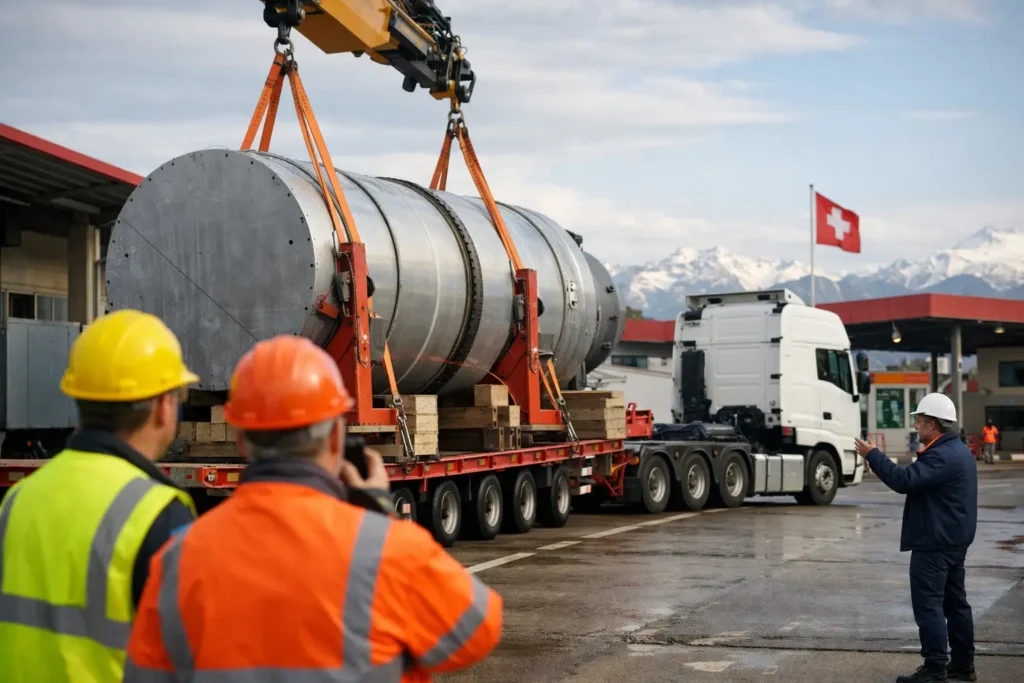
A production line is waiting for a press component, a turbine section must reach a site in Turkey, or a machine frame has to cross into the UK before a shutdown window closes. In these situations, knowing how to move oversized cargo is not simply a matter of booking a larger lorry. One missed bridge restriction, an incomplete permit or a customs document that does not match the load can stop the movement for days. The priority is to turn a difficult shipment into a controlled operation, with the right vehicle, route, documents and communication agreed before collection.
Start with the load data, not the vehicle
Oversized transport planning begins with accurate information from the shipper. Dimensions, gross weight and centre of gravity determine what can legally travel, which equipment is suitable and whether escort vehicles or route measures are needed. A description such as “large machinery” is not enough for a carrier to assess risk or provide a dependable price.
Provide the packed length, width and height, total weight, number of units, lifting points and any overhang. Include drawings and photographs where available, particularly when the cargo has an uneven profile or cannot be stacked. The loading and unloading method matters too. A low-loader may be right for the road movement, but the plan still fails if there is no crane, ramp access or safe space to manoeuvre at the delivery point.
The key operational insight is that a few centimetres can change the entire plan. A load that remains within a standard loading gauge may travel under a straightforward permit process. A slightly wider unit can require a different route, police coordination in some territories, night-time movement restrictions or temporary street controls. Confirming measurements before quoting protects the delivery date and avoids expensive last-minute changes.
How to move oversized cargo with the right route plan
The shortest route is not automatically the best route. For exceptional shipments, route planning must account for bridge load limits, tunnel restrictions, low clearances, roundabout geometry, roadworks and local curfews. This is particularly relevant when travelling through mountainous areas, Scandinavia, Switzerland or into Turkey, where terrain, weather and border procedures can materially affect transit times.
A route survey may be needed for high, long or especially heavy loads. The transport team checks whether the cargo can clear structures and make turns at critical junctions, as well as where the vehicle can park safely if timing restrictions apply. It also identifies viable alternatives before the lorry departs, rather than after it reaches an obstacle.
For example, a 4.2-metre-wide industrial frame moving from northern Spain to a project site in southern Germany may need a low-loader, permits in each transit country and a route that avoids narrow motorway access points. If delivery is scheduled for a Monday morning, the team must also assess weekend driving limits and the permitted travel windows for abnormal loads. The collection date alone does not define the schedule.
European road freight is governed by different national rules for exceptional transport. Permit lead times, maximum dimensions and escort requirements vary by country. Build this into the project timetable early, especially if the shipment is connected to a factory shutdown, installation crew or vessel departure.
Secure permits and customs before collection
Permits should never be treated as paperwork to finish after the vehicle has been assigned. They are central to whether and when the load can move. The application usually relies on confirmed dimensions, axle loads, vehicle configuration, origin, destination and proposed route. If any of these elements change, the permit may need amendment.
Cross-border movements add another layer of control. Within the EU, the focus is commonly on national abnormal-load permissions and country-specific operating conditions. For the UK, Switzerland, Turkey and the Caucasus, customs formalities must be planned alongside the transport permits. Commercial invoices, packing lists, tariff classification, export declarations, transit documentation and import arrangements need to describe the goods consistently.
This is where oversized cargo can be more exposed to delay than a routine pallet shipment. A border official may need to inspect a non-standard load, and there may be limited space or handling capability at the crossing. The documentation should therefore be checked before loading, while the consignment remains accessible at the shipper’s site.
If the cargo is temporarily exported for repair, demonstration or installation, identify this at the outset. The customs procedure may differ from a permanent sale, and an incorrect declaration can create avoidable duty exposure or delay the equipment’s return. For urgent movements, the best option is often to organise customs and permit actions in parallel, not one after the other.
Match the equipment and service level to the risk
A specialist movement is not improved by sending the biggest available vehicle. It is improved by selecting equipment that matches the load, route and site conditions. Depending on the shipment, that may mean a low-loader, extendable trailer, semi-low-loader, open platform or a vehicle with a specific loading arrangement.
The trade-off is usually between flexibility, capacity and speed. A tailored configuration may create the safest and most compliant solution, but it can require more planning and permit lead time. Conversely, if the cargo can be dismantled safely into standard-sized sections, standard road freight may reduce cost and broaden available routing options. The decision should consider reassembly time, cargo integrity and the cost of a missed delivery window, not transport price alone.
Urgency must also be defined precisely. An urgent oversized shipment cannot always operate like a same-day van service because legal travel windows and authorisations still apply. However, an Xpress or UltraExpress solution can be valuable for critical components, customs originals, specialised tools or smaller replacement parts travelling alongside the main exceptional load. Separating the urgent item from the abnormal load can keep an installation programme moving.
Control loading, transit and delivery as one operation
The movement becomes most vulnerable at the handovers. Loading must be supervised by people who understand the agreed securing method, weight distribution and loading sequence. The cargo should be secured for the forces it will encounter on the route, not merely positioned to fit the trailer.
Before collection, confirm who is responsible for lifting, who will inspect the load, what personal protective equipment is required and whether the site has time restrictions. At delivery, check access hours, crane availability, unloading space and the named site contact. A lorry arriving on time is not a successful delivery if it cannot enter the site or unload safely.
During transit, supply chain teams need clear updates rather than vague reassurance. For a complex route, useful progress information includes collection confirmation, permit status, border clearance, any weather-related restriction and a realistic updated arrival estimate. This gives the receiving site time to adjust labour, lifting equipment and installation planning when necessary.
MAP Transport has coordinated exceptional shipments since 1985, combining specialist vehicle selection with personalised follow-up across European routes and beyond. For each request, the essential starting point remains the same: accurate dimensions and weight, collection and delivery locations, cargo value, loading requirements and the required delivery date. With those facts in place, risks can be identified before they become disruptions.
Oversized cargo moves reliably when it is planned as a project rather than treated as an unusual booking. Early data, route validation, permit control and active communication give procurement and operations teams the certainty they need when every hour on site has a cost.
Have a question or need a quote? Contact us at (+34) 943 62 95 77 (ask for Raquel) or by email at lo*******@**********rt.com
Need support on your transport flows? Contact our team for a tailored solution.