
A production line in Birmingham is waiting for a replacement drive component from northern Italy. The part itself is small, but a missed delivery window can idle a team, disrupt customer orders and create costs far beyond the transport invoice. That is the context for any review of time critical road freight services. The question is not simply whether a carrier can collect quickly. It is whether it can assess the shipment correctly, allocate the right vehicle, manage border formalities where required and keep the consignee informed until proof of delivery is confirmed.
What a time-critical service should be judged on
A credible urgent road freight service is built around decision speed and operational control. A fast quote matters, but it is only useful when the quotation reflects the real shipment: collection readiness, dimensions, weight, loading constraints, delivery deadline and any customs exposure.
For a supply chain manager, the first test is the provider’s response to incomplete information. An experienced operator will ask practical questions rather than promise an unrealistic collection time. Is the goods-in team available for collection? Does the delivery site accept vehicles overnight? Is a tail-lift needed? Can the cargo travel in a dedicated van, or does it need a lorry with specific securing equipment?
The second test is accountability. Time-critical movements need a named team that follows the shipment from collection to delivery, rather than a booking that disappears into a general network. This is particularly relevant when the shipment carries a high consequence of delay, such as a line-stopping spare part, a medical-device component or urgent material required for a contracted installation.
MAP Transport has managed European road freight since 1985 and supports more than 200 customers each year. That experience matters most when the schedule is already under pressure and there is no room for assumptions.
Review of time critical road freight services: vehicle choice
Vehicle selection is where an urgent movement can either gain time or lose it. Sending an oversized vehicle for a few pallets may create avoidable access restrictions and cost. Sending a small van for goods that need proper securing, controlled loading or more space creates a different risk.
For many urgent consignments, a dedicated van provides the best balance of speed, direct routing and control. It avoids terminal handling and reduces the number of handovers. This can be the right option for several boxes of machine parts from Lyon to Manchester, where collection takes place in the afternoon and delivery is required the following morning.
However, dedicated transport is not automatically the right answer. A larger consignment from Germany to Sweden may require a dedicated lorry because of pallet count, loading method or weight. If the delivery window is fixed, the transport plan must also account for driving-time rules, ferry timings and the receiving site’s booking process. A vehicle that is physically suitable but operationally late is not suitable at all.
A useful review should therefore assess whether the provider explains its vehicle decision. The right service is tailored to the urgency and cargo profile, not sold as a one-size-fits-all express product.
Border routes expose weaknesses quickly
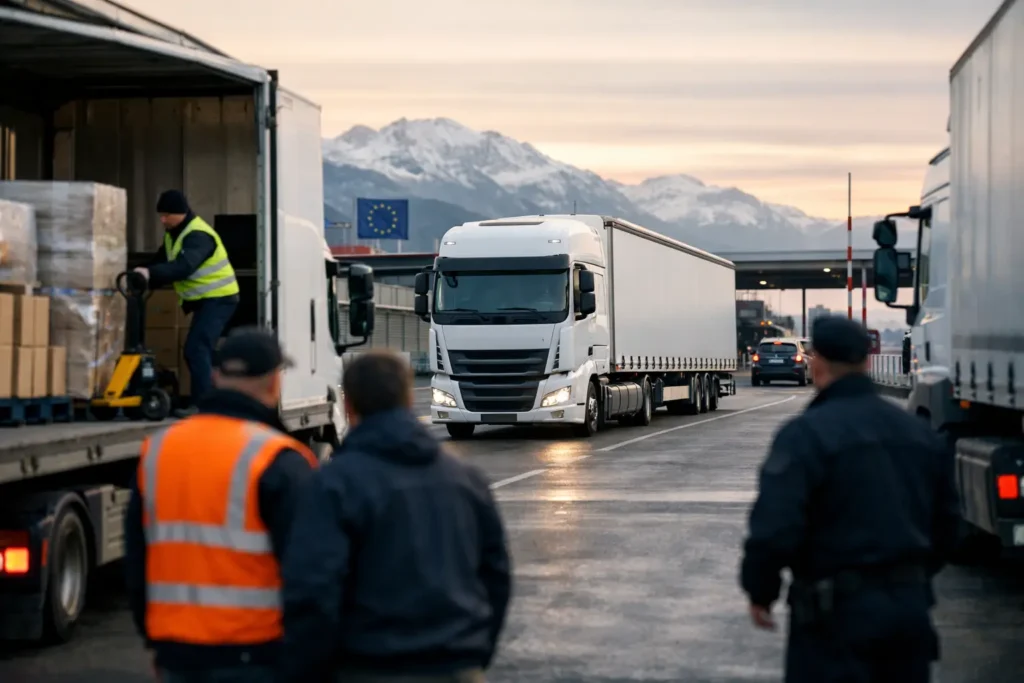
Urgent freight within much of continental Europe can move with fewer administrative interruptions than routes involving the UK, Switzerland or Turkey. Yet time-critical status does not remove customs obligations. In fact, a missing document can make an expensive express movement wait at the border.
Consider an emergency shipment of replacement tooling from Spain to a manufacturing site in the UK. The vehicle may be ready within hours, but movement cannot proceed reliably without correct commercial documentation, commodity classification, values, importer details and the relevant customs references. A last-minute discrepancy between paperwork and cargo can result in inspection, delay or rejection at the destination.
The same principle applies on Switzerland routes, where customs processes sit outside the EU framework, and on movements towards Turkey and the Caucasus, where border procedures and transit planning demand close coordination. The operational insight is simple: customs preparation must begin at quotation stage, not after the vehicle has been dispatched.
Before approving an urgent booking, confirm these points:
- the shipper and consignee details match the commercial invoice;
- the commodity description is clear enough for customs processing;
- customs clearance responsibility is agreed before collection;
- loading and border crossing plans reflect the actual delivery deadline.
This preparation can feel slower at the start. In practice, it protects the transit time that the urgent service is designed to save.
Visibility is part of the delivery promise
For routine freight, periodic status updates may be sufficient. For a time-critical consignment, visibility should be active. The transport provider should confirm collection, communicate material route changes and give a realistic delivery estimate based on the vehicle’s actual progress.
That does not mean flooding the customer with generic tracking messages. It means reporting what affects the receiving operation. If a ferry departure is missed due to a late collection, the consignee needs an immediate revised plan. If a border queue threatens a booked delivery slot, the transport team should be contacting the relevant parties before the vehicle arrives.
This is where multilingual coordination makes a practical difference. A Spanish shipper, French loading point, UK customs broker and German consignee may all need fast, clear information. A coordinator who can resolve an access issue or documentation query in the local working language removes friction at the moment it matters.
When reviewing performance, look beyond the final delivery time. Ask whether exceptions were identified early, whether updates were relevant and whether the transport team presented options rather than merely reporting a problem.
Cost control means choosing urgency precisely
A common mistake is to classify every difficult shipment as express. Dedicated urgent road freight carries a premium because capacity is reserved, routing is direct and operational monitoring is more intensive. It should be used where the cost of delay is higher than the additional transport cost.
For example, an overnight dedicated van may be justified to prevent a production stoppage. It may not be justified for stock that can safely reach the consignee on a scheduled service the next day. The most effective transport plan separates genuine emergencies from important but manageable movements.
A practical internal rule is to calculate the consequence of missing the required delivery time. Consider production downtime, contractual penalties, engineer waiting time, lost sales and the cost of holding a customer site open. If those figures exceed the express premium, urgent transport becomes a controlled commercial decision rather than a reactive expense.
It also helps to maintain shipment data for recurring lanes. When origin, destination, cargo dimensions, contact details and customs requirements are available in advance, a freight partner can provide a faster and more accurate response when an urgent request arises.
Questions to ask before placing the booking
The strongest review of a time-critical road freight service focuses on how the provider will manage the specific movement, not on broad claims about speed. Ask for the planned collection time, direct or multi-stop routing, vehicle type, delivery estimate, customs responsibilities and update process. For a complex route, ask what contingency exists if a border, ferry or receiving-site constraint changes the original plan.
It also pays to state the real deadline. “As soon as possible” is not enough for transport planning. “Delivered before 08:00 on Tuesday, with the consignee available from 07:30” gives the operator a usable target and makes performance measurable.
The right urgent freight partner will challenge unclear instructions, match the vehicle to the load and stay involved when the plan changes. For cross-border movements where customs, tight delivery slots and high-value cargo meet, that level of coordination is often the difference between a costly disruption and a controlled recovery.
Need support on your transport flows? Contact our team for a tailored solution.
Have a question or need a quote? Contact us at (+34) 943 62 95 77 (ask for Raquel) or by email at lo*******@**********rt.com