
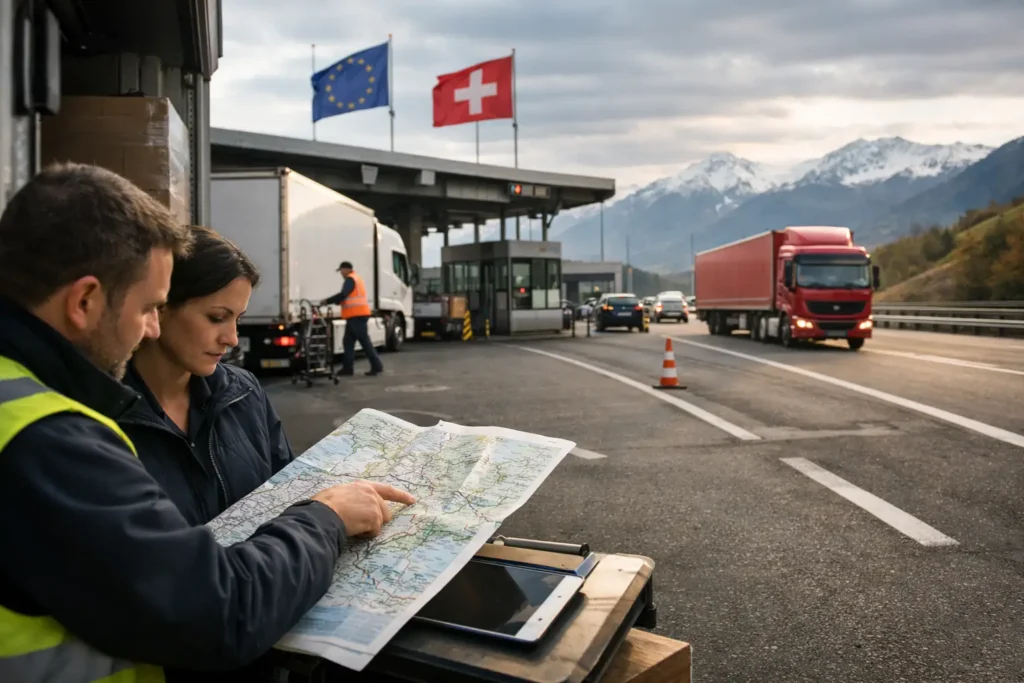
A route that looks shortest on a map can become the most expensive option once ferry cut-offs, border formalities, driving-time rules and delivery slots are added. For a supply chain manager, knowing how to plan a Europe road freight route is not simply about choosing motorways. It is about building a transport plan that protects a customer commitment while keeping costs, risk and communication under control. This matters most on UK, Swiss, Turkish and Scandinavian flows, where a missed document, a congested crossing or the wrong vehicle choice can quickly turn a routine shipment into an operational escalation.
Start with the freight, not the map
The route should be designed around the shipment’s actual constraints before anyone selects a crossing or estimates a transit time. Weight, loading metres, dimensions, loading method, delivery deadline and cargo sensitivity all affect the lorry and service level required. A palletised consignment with a flexible delivery window can move on a standard groupage or dedicated road service. A production-stopping component needed the following morning may require a dedicated van, two-driver operation or an express vehicle positioned close to collection.
This first stage also identifies restrictions that maps do not show. A site may only accept deliveries before 10:00, require a tail lift, prohibit certain vehicle lengths or insist on a booked unloading slot. Industrial sites in city centres, mountain locations and remote Scandinavian destinations can add practical access constraints even when the main road corridor is straightforward.
Before requesting a quote, provide the origin and destination postcodes, collection and delivery windows, number of packages, gross weight, dimensions, cargo description and any customs status. If the freight is oversized, high-value, temperature-sensitive or classed as regulated material, say so at the outset. Early accuracy gives the transport planner room to select the right equipment rather than forcing a solution after collection.
How to plan a Europe road freight route around borders
A European route is only as reliable as its border plan. Within much of the EU, road freight can move without routine frontier checks, but the route changes immediately when it includes the UK, Switzerland, Turkey or onward movements towards the Caucasus. The physical distance may be manageable; the documentation and crossing process often determine the real lead time.
For UK traffic, route planning must connect export clearance, the ferry or Eurotunnel booking, pre-lodgement requirements and import clearance with the driver’s arrival at the port. A lorry arriving at Dover with an incorrect reference or incomplete data may lose its crossing slot. The same principle applies to Switzerland, where an EU-to-Switzerland movement requires export and import declarations despite the country’s central location in Europe.
Turkey requires even more careful sequencing. The route may involve queue risk at land borders, transit documents, local public holidays and different opening hours for customs offices. For time-critical freight, a theoretically cheaper route through several border points can be a false economy. Fewer borders, stronger document control and a realistic time buffer often deliver a better result.
Eurostat reported that road transport accounted for 77.8% of inland freight tonne-kilometres in the EU in 2023. That scale explains why capacity pressure, weather disruption and congestion can affect even well-established corridors. Planning needs to account for the route as it operates, not simply as it appears on a route-planning tool.
A practical UK route example
Consider urgent machine parts moving from northern Spain to Birmingham. The direct road distance is only one part of the plan. Collection timing must allow for the drive to the northern French port, the ferry cut-off, export and UK import formalities, the Dover crossing, drivers’ legal rest requirements and the booked delivery slot in the Midlands.
If the parts are required to restart a production line the next day, sending a standard shared-load service may expose the customer to avoidable risk. A dedicated express vehicle may cost more, but it provides direct control of collection, border timing and delivery progress. The correct decision depends on the cost of a late delivery, not on the line-haul rate alone.
Build transit times from operating reality
Promising a delivery date based on unconstrained driving hours is one of the fastest ways to create a service failure. A sound route plan includes loading time, traffic exposure, driver breaks and rest periods, fuel stops, ferry check-in, border processing, terminal queues and the final-mile delivery appointment.
Operational insight: the final 50 kilometres often carry more risk than the first 500. Delays at a factory gate, restricted delivery hours and a missed booking slot can erase the benefit of a faster motorway route. Confirm the consignee’s receiving rules directly rather than relying on an old address record or assumptions from a previous shipment.
Build two timings into the plan: the expected arrival and the latest acceptable arrival. The difference is your usable buffer. On regular lanes, that buffer can be informed by previous movements. On new routes, especially to northern Norway, eastern Turkey or destinations reached through multiple border processes, it should be deliberately conservative until performance data is established.
Route choice also involves trade-offs. A ferry may reduce driving distance but introduce schedule dependency. A longer land route may offer more flexibility but increase exposure to driving-time constraints and road congestion. For urgent freight, the right answer is often the route with the fewest handovers and the clearest contingency options, rather than the lowest nominal mileage.
Match the vehicle and service to the risk
Vehicle selection is a route-planning decision, not just a capacity calculation. A standard articulated lorry may be efficient for a full load with normal lead time, while a van can be the more reliable option for a small urgent consignment that must arrive in a few hours. Exceptional shipments require another level of preparation, including dimensions, axle considerations, permits, escort requirements and suitable loading and unloading arrangements.
For recurring flows, avoid treating every shipment as identical. A customer may use a classic road freight service for weekly replenishment, while reserving express capacity for line-stop risks and specialist transport for non-standard equipment. This creates a practical escalation path without paying express rates for every movement.
Ask three questions before confirming the service: what is the cost of missing the delivery window, what route restrictions apply to this load, and what alternative vehicle can be mobilised if the original plan changes? The answers should guide the level of service, not habit or a default purchasing rule.
Put customs and documents on the critical path
Documentation should be prepared alongside route planning, not after the vehicle has been allocated. The commercial invoice, packing list, commodity information, exporter and importer details, customs representation arrangements and relevant transit references must be checked before collection. For controlled, high-value or specialised goods, further paperwork may apply.
The most common avoidable issue is a mismatch between documents and physical freight. Package counts, weights, descriptions and values need to be consistent. A vague goods description can trigger questions at the border, while an incorrect consignee detail can delay import processing at the point when the vehicle is already waiting.
Set a document cut-off before collection and assign ownership clearly. Your team may prepare the commercial data, a customs intermediary may lodge declarations, and the transport provider may need confirmed references before the lorry reaches the border. The process only works when each party knows the deadline and has a contact available outside normal office hours.
Plan contingencies before the lorry leaves
A dependable route plan has a response for disruption. That does not mean assuming every movement will fail. It means identifying the events that would materially affect delivery and agreeing what happens next. On cross-border freight, these are usually a missed crossing, congestion at a border, unavailable unloading, customs queries, vehicle restrictions or severe weather.
For high-priority movements, agree escalation contacts at both collection and delivery points, an alternative crossing where practical, and a decision point for upgrading the service. Status updates should communicate what has happened, the delivery impact and the next action. Vague reassurance does not help an operations team reschedule production or notify its customer.
This is where an experienced road freight partner adds value. MAP Transport has coordinated European road transport since 1985, matching standard, express and exceptional services to the shipment rather than applying a one-size-fits-all route. For complex flows, the objective is straightforward: keep the consignee informed at any time of the progress and resolve issues before they become delivery failures.
A strong freight route is a working plan, not a static itinerary. Review actual transit performance, border dwell time, recurring loading delays and delivery-site constraints after each critical movement. That evidence makes the next booking faster to organise and more predictable to deliver.
Have a question or need a quote? Contact us at (+34) 943 62 95 77 (ask for Raquel) or by email at lo*******@**********rt.com
Need support on your transport flows? Contact our team for a tailored solution.