
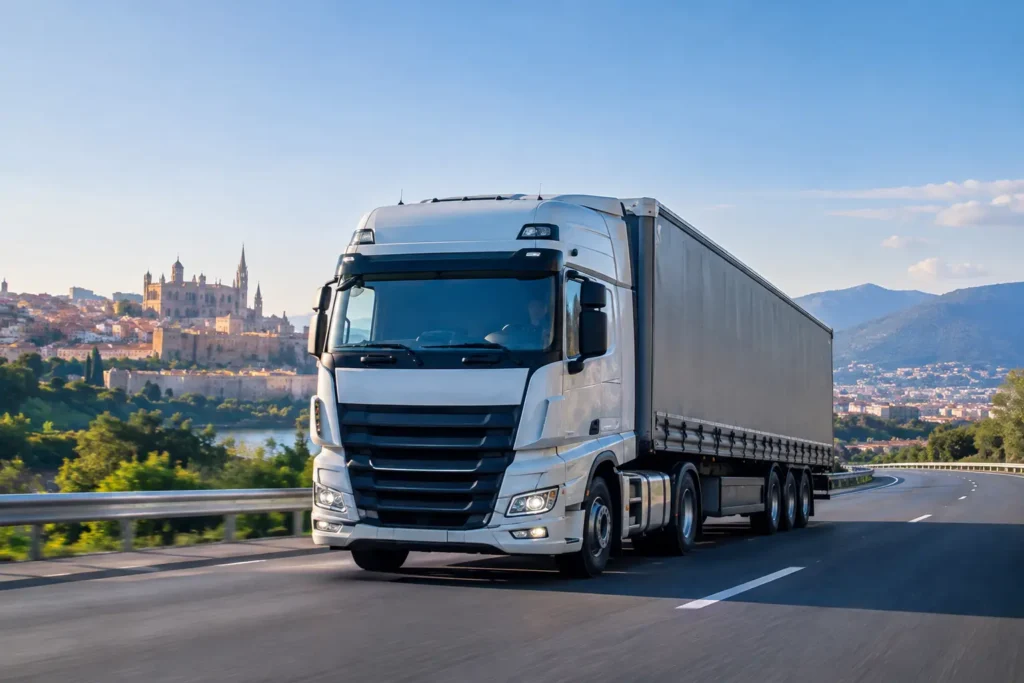
A production line in southern Germany cannot wait because a pallet left Barcelona one day late. Equally, a Spanish distributor facing a missed inbound delivery may lose a customer before the lorry reaches its depot. Spain Germany road freight is a high-value flow for manufacturers, industrial suppliers and distributors, but reliable delivery depends on more than finding available capacity. Collection cut-offs, loading conditions, route choice, vehicle matching and clear communication all affect the final delivery time. For regular flows and urgent consignments alike, the objective is simple: protect the delivery commitment without paying for an inappropriate service level.
Spain Germany road freight: the operational reality
The direct road distance varies significantly by origin and destination. A shipment from Bilbao to Cologne is a very different movement from one travelling from Murcia to Munich. In practice, road freight commonly travels through France, with transit time shaped by loading location, delivery slot availability, driving-time rules, traffic around major urban areas and any weekend restrictions along the route.
Road remains central to European industrial supply chains. Eurostat data consistently shows that road freight accounts for roughly three quarters of inland freight transport in the EU when measured in tonne-kilometres. That reliance makes predictability important: when a road movement slips, it can quickly affect assembly schedules, stock availability and onward customer deliveries.
A standard groupage service can be commercially sensible for flexible freight, especially when the shipment does not require a fixed vehicle or a precise arrival window. It also introduces handling points and consolidation dependencies. For a production-critical component, a dedicated lorry or express vehicle often reduces risk because collection, transit and delivery are planned around one consignment rather than a network timetable.
The right question is not simply, “What is the cheapest rate?” It is, “What level of control does this delivery require?”
Match the vehicle and service to the consignment
Vehicle choice is one of the most practical ways to control cost and delivery performance. Sending a small urgent crate in a full articulated lorry wastes budget. Trying to move several industrial pallets in a van can create capacity, loading or security issues. The transport plan should reflect the cargo, not force the cargo into a standard solution.
For Spain-Germany flows, three service choices usually cover most requirements:
- Standard road freight for planned full loads, part loads and non-urgent palletised goods.
- Dedicated express transport for time-critical parts, samples, repair equipment or stock recovery movements.
- Specialist transport for oversized machinery, high-weight units or non-standard loads needing route assessment, permits or tailored loading arrangements.
Consider an industrial supplier in Zaragoza sending six pallets of replacement parts to a plant near Stuttgart. If the parts are needed to prevent downtime on Monday morning, a Friday groupage collection carries obvious risk. A dedicated express vehicle collected on Friday can maintain control of the timeline and provide direct progress updates. If the same six pallets replenish routine stock for the following week, a planned road freight service may offer the better cost-to-risk balance.
Dimensions, weight, stackability, loading method and delivery access should be confirmed before quoting. A consignment described only as “four pallets” is rarely enough. Is there a forklift at both ends? Can the goods be double stacked? Does the German delivery point require a vehicle with a tail-lift? These details determine whether the price is accurate and whether the collection proceeds without delay.
Build reliable transit time into the transport plan
A quoted transit time is only meaningful when the underlying assumptions are clear. Supply chain teams should agree the collection readiness time, the latest acceptable delivery time and whether the destination has a booked slot. A lorry arriving early at a restricted industrial site may still wait hours if no unloading appointment has been organised.
Driver-hours rules are also a planning factor, not an excuse to be discovered after collection. Rest periods, distance and traffic conditions must be considered when setting expectations for a time-sensitive movement. For urgent freight, relay driving or a dedicated van may be appropriate, but only if the value of earlier delivery justifies the additional cost.
There are four details that should be provided at the booking stage for every critical movement:
- Exact collection and delivery postcodes, including site opening hours.
- Cargo weight, dimensions, number of handling units and any loading restrictions.
- The required delivery deadline, rather than a vague request for “urgent” transport.
- A named operational contact at each end who can resolve loading or unloading questions quickly.
This information allows the transport partner to give a realistic plan rather than an optimistic estimate. It also reduces avoidable waiting time, failed collections and last-minute vehicle changes.
Customs and route risk should not be treated as an afterthought
Spain and Germany are both within the EU customs union, so most movements between them do not require import or export customs formalities. That does not mean documentation is irrelevant. A clear commercial invoice, packing information and correct consignee data support traceability and help resolve discrepancies at delivery.
Customs becomes more relevant when the flow connects with non-EU trade. For example, goods entering Spain from the UK and then moving onwards to Germany may need carefully managed import documentation and proof of customs status. The same applies where goods are routed through Switzerland. Although Switzerland can be geographically attractive for certain southern German destinations, it is outside the EU customs union. Using that route without the correct transit process can turn a time-saving idea into a border delay.
Operational insight: do not choose a route based only on kilometres. A route through France may be longer on paper for a particular destination, yet offer lower administrative risk than a Swiss transit. The best route depends on delivery urgency, cargo type, border documentation and the consignee’s tolerance for disruption.
For regulated products, high-value cargo or shipments linked to repairs and returns, documentation should be checked before the vehicle is dispatched. Resolving a discrepancy while the goods are still at origin is quicker and less costly than dealing with it at a border point or after a refused delivery.
Visibility protects both the customer relationship and the budget
The most damaging freight issue is often not the delay itself. It is discovering too late that there is a delay and having no practical recovery option. Logistics managers need clear milestones: vehicle assigned, collected, in transit, approaching delivery and delivered. For urgent freight, updates should be proactive rather than requested repeatedly by email or phone.
This level of follow-up matters particularly when a Spanish sender is coordinating with a German plant, purchasing team or end customer. Language, working hours and delivery-site procedures can slow decisions if there is no single operational contact managing the flow. A multilingual team can reduce friction by communicating directly with the relevant parties and keeping the shipper informed at each stage.
Visibility also improves cost control. When waiting time, unsuccessful collections or delivery restrictions are identified early, the team can act before extra charges accumulate. That may mean rebooking a slot, confirming unloading equipment or arranging a different vehicle type. These are small interventions, but they protect margin across recurring freight lanes.
When standard service is not enough
Routine Spain-Germany lanes benefit from repeatable planning, but exceptions should have a defined escalation path. A line-stop risk, a missed ferry connection on an onward route, an urgent replacement part or an oversized machine component requires a different response from normal pallet freight.
The priority is to define the commercial consequence of late delivery. If a one-day delay is manageable, standard road freight and an agreed contingency may be sufficient. If each hour affects production or contractual performance, the movement should be treated as time-critical from the first call, with dedicated capacity and direct operational monitoring.
MAP Transport has managed international road freight since 1985, coordinating standard, urgent and exceptional consignments with vehicle selection based on the actual requirement. For Spain-Germany transport, that means assessing the shipment details and delivery commitment before committing to a plan – not after the vehicle is already waiting at the loading bay.
A dependable route is built before collection: accurate cargo information, a realistic delivery window, suitable capacity and someone accountable for the exceptions. That preparation gives your team more control when the next urgent requirement arrives.
Need support on your transport flows? Contact our team for a tailored solution.
Have a question or need a quote? Contact us at (+34) 943 62 95 77 (ask for Raquel) or by email at lo*******@**********rt.com