
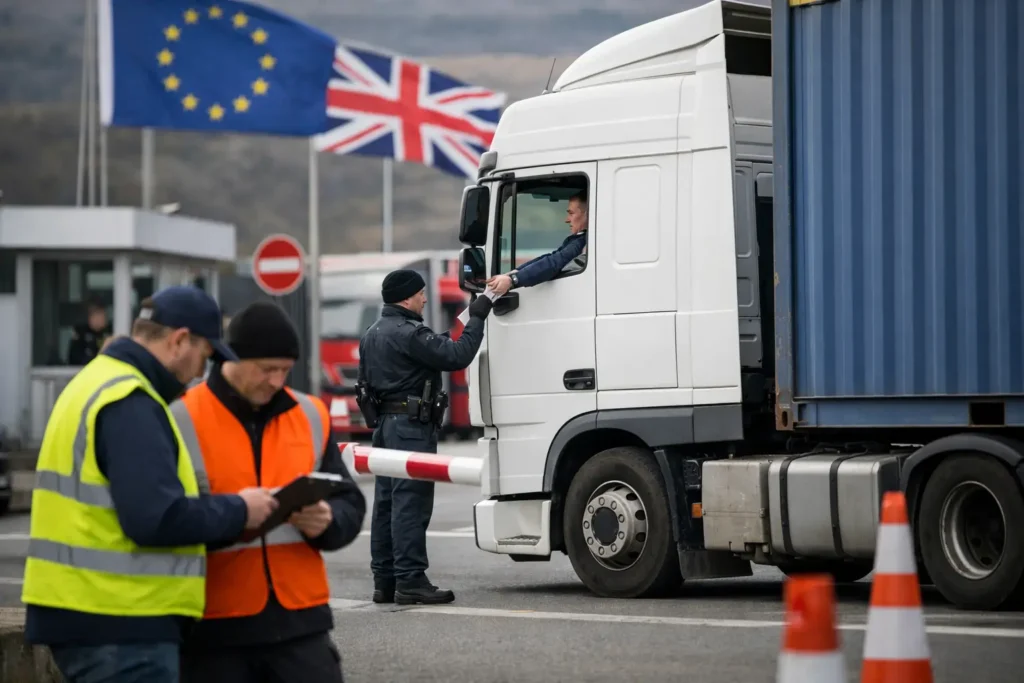
A lorry can leave the Midlands with a perfectly saleable load and still lose a full day before it reaches mainland Europe – not because of a strike or a ferry cancellation, but because one reference number is wrong, one commodity code is too broad, or one party in the chain assumed someone else had handled customs. That is why Brexit logistics: what still surprises exporters in 2026 is still a live issue for supply chain managers. The shock is no longer that Brexit created paperwork. It is that, five years on, experienced exporters still get caught by small operational gaps that trigger delays, extra cost and unhappy customers.
Why Brexit logistics still catches out established exporters
The biggest surprise in 2026 is not the existence of border controls. It is how uneven the impact remains. Some flows move with little friction for months, then one shipment is pulled into document checks, held for clarification, or refused boarding because the pre-lodgement trail does not match the goods on the vehicle.
For many exporters, this creates a false sense of stability. If ten shipments moved without issue, teams assume the process is now routine. In practice, UK-EU road freight still depends on multiple linked data points being right at the same time: invoice values, EORI details, Incoterms, commodity codes, safety and security filings, and the correct movement references for the port system being used.
That dependency matters because the UK border model is more digital than many legacy shipping teams expect. A driver arriving at port without the right Goods Movement Reference can lose a sailing slot quickly. The official UK guidance on the Goods Vehicle Movement Service makes clear that the system is central to many border crossings, yet errors still happen because commercial, customs and transport teams often work in separate silos. See the UK government guidance on GVMS and border processes for the latest operational rules: Goods Movement Reference guidance.
Brexit logistics in 2026: the paperwork is smaller, the penalties are sharper
A common assumption is that customs work has become lighter because teams have learned the basics. In reality, the volume of surprise often comes from edge cases rather than routine declarations. Returned goods, temporary exports, warranty replacements, mixed-load consignments and dual-use descriptions create problems faster than standard pallet flows.
One practical example: a manufacturer shipping machine components from northern Spain to a customer in the UK may have no issue with regular sale shipments. But when a defective part is returned for repair and sent back again, the original team may reuse a standard export template. If the customs treatment does not reflect repair or return status correctly, duty exposure can change and clearance questions follow. The transport itself is straightforward. The customs logic is not.
That is why many delays in 2026 are no longer caused by missing documents, but by documents that exist and are wrong in a subtle way. HMRC and EU customs authorities are not looking only for presence. They are looking for consistency. The European Commission’s customs guidance remains a useful benchmark because it shows how formalities continue to shape EU-facing trade: EU customs controls.
The commercial impact is easy to underestimate. According to reporting and industry monitoring since the post-Brexit transition, even short border delays can add meaningful cost once driver hours, missed delivery windows and customer service escalation are included. For urgent or production-linked freight, one failed crossing can be more expensive than the transport itself.
The hidden cost surprise: landed cost is still moving
Another reason exporters still get caught out is that the transport quote is often treated as the freight cost, when the real business question is landed cost. In 2026, that number still shifts because customs brokerage, deferment arrangements, inspection risk, waiting time and failed delivery appointments remain variable.
This is especially visible on lower-margin product lines. A shipment that looked commercially viable on paper can become marginal once customs handling fees, document correction charges and downstream rescheduling are added. The surprise for many finance and purchasing teams is that Brexit costs are no longer dramatic one-off shocks. They are small recurring leaks.
Incoterms are often part of the problem. Exporters may agree Delivered Duty Paid or similar arrangements to keep the sale simple for the customer, but operationally that can leave them carrying tax, compliance and clearance exposure in a market where the importer-side requirements are not always under their direct control. If there is one lesson in 2026, it is this: commercial convenience and transport control are not the same thing.
A more resilient approach is to align sales, customs and freight planning before the shipment is booked. That means checking who is acting as importer of record, who is paying duties and VAT, whether the consignee can clear promptly, and what happens if the load is selected for inspection. These questions feel administrative until a just-in-time delivery is sitting at the border.
Urgent freight is where Brexit friction hurts most
Standard groupage can absorb a delay more easily than a critical direct movement. For urgent road freight, the surprise is how little tolerance remains in the chain once a border issue appears. A shipment promised for next-day delivery across the Channel can still be realistic in 2026, but only if the customs file is built for speed rather than assembled at the last minute.
That is where operational discipline matters. On time-critical shipments, transport teams need the final invoice data, commodity coding, origin details and consignee information before vehicle dispatch, not while the vehicle is already moving. Waiting to “tidy up the paperwork later” is still one of the fastest ways to turn express freight into expensive standing time.
For supply chain managers handling outage risks, this changes the carrier brief. It is no longer enough to ask whether a haulier can collect in a few hours. The real question is whether the operator can coordinate the customs and border side tightly enough to protect the transit promise. On routes into the UK, that distinction is often what separates a successful emergency delivery from a very costly near miss.
MAP Transport’s approach to express transport across Europe is built around that reality: vehicle choice, routing and documentation flow need to support the urgency, not work against it.
What still surprises exporters on complex UK routes
The route itself still matters more than many planners expect. Dover is not the same as unaccompanied trailer traffic. Northern industrial pick-ups are not the same as southern port collections. Scottish outbound freight has different timing pressures from Midlands distribution. Brexit logistics is not one problem. It is a set of route-specific operating conditions.
Mixed consignments are a good example. An exporter may assume a part-load movement is the efficient option, but if the shipment includes sensitive customs lines, timing-critical delivery slots or cargo descriptions likely to trigger queries, the saving on transport can be outweighed by the extra complexity. In some cases, a dedicated vehicle is simply the lower-risk choice.
There is also a continuing knowledge gap around who owns the border process in a multi-party movement. Supplier, customer, customs broker and carrier can each believe another party has validated the data. When that happens, the driver becomes the last checkpoint in the chain, which is far too late.
For companies shipping regularly between the EU and UK, the best operational insight is simple: standardise the handover. Build a shipment checklist around commodity code, Incoterm, EORI numbers, invoice logic, movement references and consignee clearance status. Not because your team lacks experience, but because experienced teams are the ones most likely to move quickly and assume the basics are already covered.
If your flows include specialist or oversized cargo, the risk rises further because border formalities sit alongside routing permits, loading constraints and delivery-site planning. That is why tailored planning matters more than a one-size-fits-all booking process. More on that is covered in MAP’s international road freight services.
How exporters reduce Brexit surprises in 2026
The companies coping best are not necessarily the ones with the biggest transport budgets. They are the ones that treat customs readiness as part of transport execution. They pre-validate shipment data, define responsibility clearly and use partners who can react quickly when a border requirement changes mid-movement.
There is also a human factor. Drivers, planners and customer service teams need fast access to accurate information when something goes wrong. The International Road Transport Union continues to highlight how border efficiency and digital compliance affect road freight performance across Europe: IRU. In practice, that means exporters benefit from working with operators who do not just move the load, but actively follow the movement and resolve issues before they become missed deliveries.
For businesses with regular UK traffic, the best gains often come from reviewing exception cases rather than normal ones. Ask where delays happened in the last six months. Was it commodity classification, port reference mismatch, importer readiness, or timing on urgent paperwork? That review usually shows that the real cost of Brexit in 2026 sits in repeated operational details, not headline policy changes.
If your business is shipping into the UK, Switzerland or Turkey, that mindset is even more useful. These are all corridors where customs, timing and route selection can decide whether a delivery performs as planned or starts generating avoidable cost.
Brexit has settled into the background of European road freight, but it has not become harmless. The exporters performing best are the ones that accept that border friction is now part of everyday transport design and plan around it early. If you want a practical second look at your UK flows, the team at MAP Transport can help identify where risk still sits before it turns into delay.
Need support on your transport flows? Contact our team for a tailored solution.
Have a question or need a quote? Contact us at (+34) 943 62 95 77 (ask for Raquel) or by email at lo*******@**********rt.com