
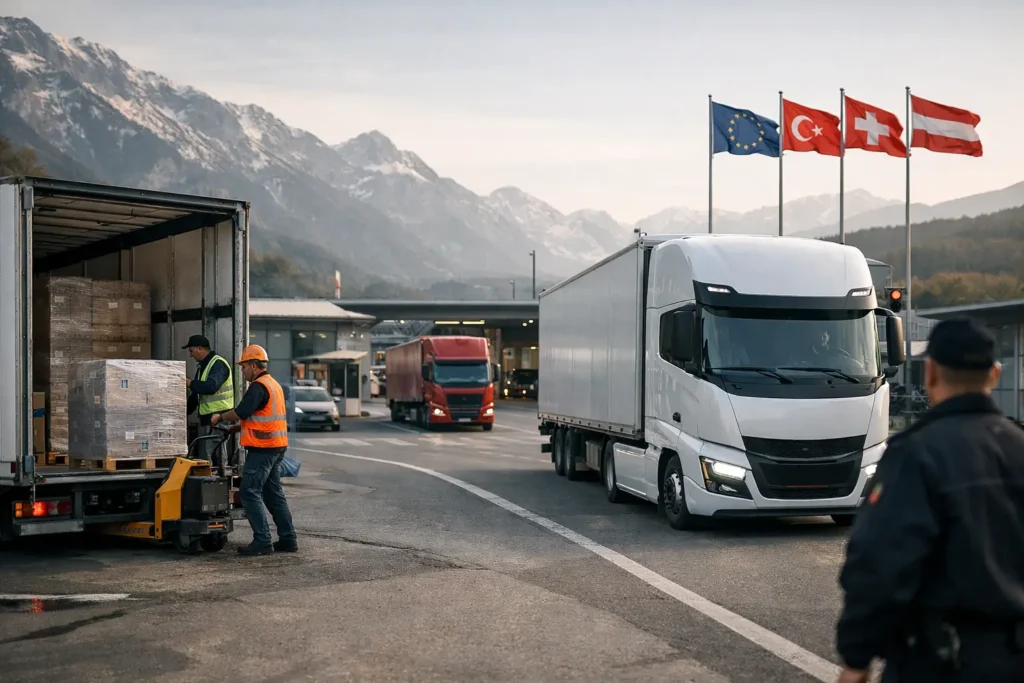
A late collection in northern Italy, a customs hold on the UK leg, a delivery slot missed in Belgium – this is how a normal week turns expensive. For logistics managers, the future of road freight in Europe is not an abstract trend report. It is about whether your inbound materials arrive on time, whether your export customer accepts the delivery, and whether your transport budget can absorb another round of disruption. The market is moving quickly, but not in one direction. Costs, compliance, capacity and customer expectations are all changing at once, which makes transport planning more operationally demanding than it was even two years ago.
The future of road freight in Europe is being shaped by volatility, not just growth
Road freight demand across Europe remains essential for industry, but the operating conditions are less predictable. Energy prices still swing sharply, driver availability remains uneven by corridor, and geopolitical pressure continues to affect border flows. At the same time, customers expect tighter lead times and more accurate delivery windows.
One figure tells the story well: road transport carries roughly three quarters of inland freight in the EU, according to European Commission data. That dependence means even small disturbances have a wide impact. When a key Alpine route faces restrictions or a cross-Channel movement slows at customs, the knock-on effect is felt across production schedules, not just transport desks.
For logistics managers, this changes the priority from finding the cheapest rate on paper to securing the most dependable routing and service design. A lower price loses its appeal quickly if it comes with missed unloading appointments, demurrage, or stock gaps at the plant.
Capacity pressure will reward shippers who plan earlier and specify better
The old assumption that capacity can always be found with a few phone calls is becoming risky, especially on complex or time-sensitive lanes. This is particularly true for routes involving the UK, Switzerland, Scandinavia, Turkey and the Caucasus, where border formalities, ferry space, weather exposure or permit-related issues can narrow the practical options.
The better-managed shippers are not simply booking earlier. They are giving more complete shipment instructions from the start – weight, dimensions, loading method, delivery constraints, customs status and whether the freight can move on a standard trailer or needs a van, dedicated vehicle or specialist equipment. That detail matters because the wrong vehicle choice creates avoidable delay.
A simple operational example: a manufacturer in Spain needs urgent replacement parts delivered to southern Germany after a production stoppage. If the request is treated like a standard groupage enquiry, precious hours are lost. If it is classified correctly at once as an express dedicated movement, the vehicle can be dispatched within hours and the plant restart protected. Speed often comes less from driving faster and more from deciding faster.
This is one of the clearest trends in the future of road freight in Europe: carriers and freight partners will favour customers who provide usable, decision-ready shipment data. In return, those customers get faster quotes, better routing choices and fewer last-minute surprises.
Customs competence is now a transport performance issue
For many European shippers, customs is no longer a side topic handled somewhere outside transport. On UK, Swiss and Turkey-related flows, documentation quality directly affects delivery performance. A lorry can be perfectly scheduled and still lose a full day if the paperwork is incomplete or inconsistent.
This is where many transport plans fail. Teams focus on collection slots and transit time, but not enough on whether the invoice data, commodity codes, origin statements or transit documents are aligned before departure. That gap becomes expensive at the border.
The practical implication is clear: future-ready road freight management needs customs awareness built into the booking process, not added at the end. If your business regularly moves goods between the EU and the UK, or between the EU and Turkey, transport partners should be checking document readiness as part of operational planning. The same applies to Switzerland, where border formalities remain a decisive factor despite the route being well established.
For logistics managers, this is less about becoming customs specialists and more about choosing partners who understand that border compliance and on-time delivery are part of the same job.
Real-time visibility matters, but proactive communication matters more
Most buyers now expect tracking. That is reasonable, but visibility on its own does not solve transport issues. A tracking screen can show that a vehicle is delayed. It does not tell your customer what revised ETA is realistic, whether a slot can still be saved, or whether a recovery plan is already in motion.
The next phase of road freight service in Europe will favour companies that combine visibility with active follow-up. That means real people who can intervene early, update stakeholders in the right language, and propose alternatives before the issue escalates.
This becomes critical on urgent and high-value freight. If an express vehicle heading from France to the Netherlands is delayed by an accident-related closure, the useful response is not just a red status on a dashboard. The useful response is immediate communication, revised timing, and where necessary a practical workaround. Logistics managers do not need more data alone. They need data translated into decisions.
That is especially relevant for manufacturers and distributors managing customer commitments across multiple countries. The operational insight here is simple: the quality of exception handling often matters more than the quality of normal-day execution, because most providers can perform when nothing goes wrong.
Decarbonisation will influence routing and procurement, but trade-offs are real
Pressure to cut transport emissions is increasing from customers, regulators and procurement teams. This will affect road freight procurement across Europe, but not every lane will change at the same speed. Long-distance industrial flows, urgent deliveries and difficult cross-border routes still depend heavily on conventional road capacity.
So yes, greener transport expectations are part of the future. But logistics managers should be careful with blanket assumptions. On some routes, consolidation and better load planning will cut emissions more effectively in the short term than switching to a lower-emission vehicle option that is not operationally reliable. On other lanes, especially regular regional flows, alternative solutions may become increasingly viable.
The key point is that decarbonisation should be treated as an operational design question, not a slogan. What matters is whether the chosen solution protects service levels, lead times and cargo integrity. If it does not, the environmental gain may be offset by repeat deliveries, emergency recoveries or disrupted production.
Resilience will come from tailored service, not one-size-fits-all transport
One of the biggest mistakes in freight planning is trying to fit every movement into the same service model. Standard freight, urgent parts, and oversized industrial loads do not carry the same risk profile. They should not be managed in the same way.
This is where the market is becoming more demanding. Buyers increasingly need transport partners who can handle routine shipments efficiently, but can also switch fast when the job changes – a same-day van for a critical spare part, a dedicated lorry for a sensitive export movement, or a specialist set-up for an exceptional load.
A practical example is project freight moving from central Europe into Turkey. On paper, it is a road movement. In reality, it may involve permit planning, customs sequencing, cargo-specific equipment and strict delivery coordination. The carrier choice matters far more here than on a simple palletised run between neighbouring EU countries.
This is also why personalised follow-up remains valuable. In complex freight, standardisation helps only up to a point. Beyond that, responsiveness and judgement become the service.
What logistics managers should do next
The transport teams best prepared for the future are already tightening three things: shipment data quality, border-readiness checks and contingency planning for urgent flows. They are also reviewing where a standard service is enough and where a more tailored set-up would reduce risk.
That does not mean paying for premium transport on every lane. It means matching the service to the consequence of failure. If a delay stops production, misses a vessel connection or breaches a delivery commitment, the cheapest option is often the most expensive one.
Road freight in Europe will remain full of opportunity, but it will reward precision. The businesses that perform well will be the ones that treat transport as a managed operational risk, not a last-minute purchase. That is where experienced cross-border coordination still makes a measurable difference, especially on urgent, customs-sensitive and non-standard movements.
Need support on your transport flows? Contact our team for a tailored solution.
Have a question or need a quote? Contact us at (+34) 943 62 95 77 (ask for Raquel) or by email at lo*******@**********rt.com
https://shorturl.fm/ns1Kc