
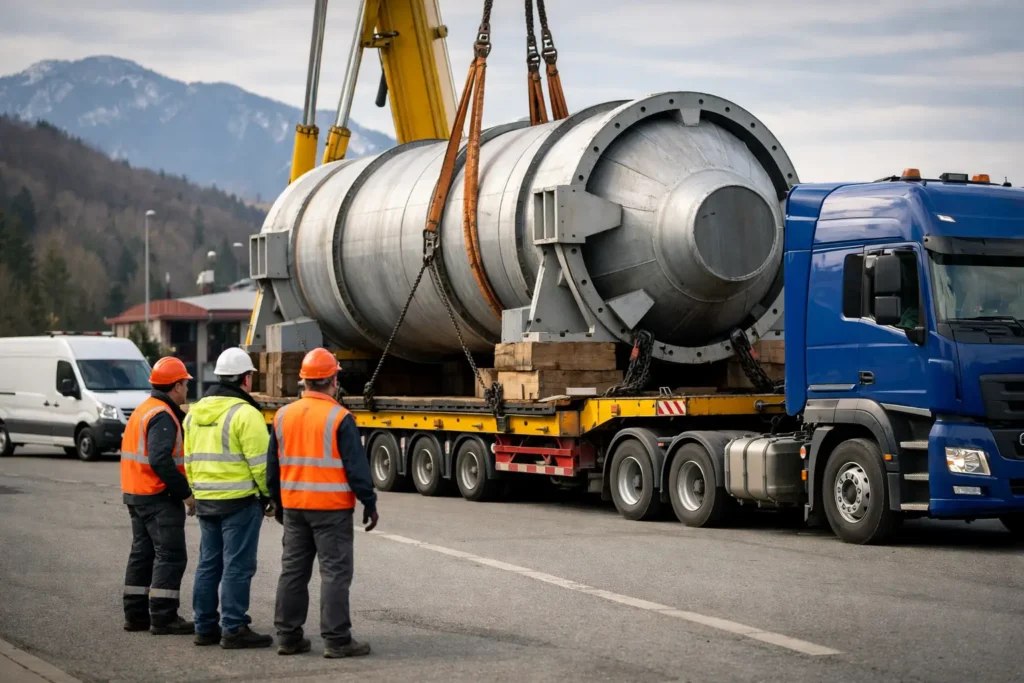
A production line waiting for a replacement press component, a wind-energy supplier moving a long fabricated section, or a contractor sending heavy equipment across a border all face the same problem: standard groupage rules do not apply. Specialist transport for non-standard loads is not simply a matter of booking a larger lorry. Dimensions, axle weight, loading method, permits, route restrictions and customs formalities can all change the viable plan. For supply chain managers, the priority is clear: prevent a shipment that looks manageable on paper from becoming a costly delay at a border, bridge, loading bay or delivery site.
When a load needs specialist transport
A load becomes non-standard when it cannot move safely, legally or efficiently within the usual vehicle dimensions, weight limits or handling processes. Oversize machinery, steel structures, industrial tanks, construction equipment and awkwardly shaped production parts are common examples. The challenge may be a single exceptional dimension rather than total weight. A long item can require just as much planning as a heavy one when it affects turning space, escort requirements or access to the consignee.
European road freight remains the main inland mode for industrial movements. Eurostat reports that road carries roughly three quarters of inland freight transport in the EU by tonne-kilometres. That scale makes road capacity valuable, but it also means restrictions around roadworks, tunnels, bridge limits and peak traffic can affect specialist movements quickly.
The first decision is not vehicle type. It is whether the shipment data is complete enough to assess the risk. A precise transport plan needs the actual loaded length, width, height and gross weight, alongside the centre of gravity, lifting points, packaging condition and loading-site constraints. Estimated dimensions are a common source of avoidable disruption.
Planning specialist transport for non-standard loads
Specialist planning starts before a vehicle is allocated. The transport provider must match the load to a suitable solution, which may include a flatbed, low-loader, extendable trailer or a dedicated vehicle with loading equipment. The correct choice depends on the item and the route, not simply on the largest available capacity.
For example, a metal manufacturer in northern Spain may need to move a 4.8-metre-long fabricated frame to a customer in Switzerland. If the load has unusual width and must arrive at a site with restricted unloading space, the planner must check the loading sequence, route suitability and delivery appointment before dispatch. Switzerland also requires careful customs preparation. A missing commodity code, inaccurate invoice or incomplete proof of origin can hold the vehicle at the border even when the physical transport has been perfectly organised.
A practical shipment brief should include at least these five details:
- Exact dimensions and gross weight after packing
- Origin and destination postcode, including site access notes
- Loading and unloading equipment available on site
- Required collection and delivery windows
- Commercial documents, customs status and commodity description
This information allows the provider to assess permits, transit time and operational risk before confirming the quote. It also avoids the false economy of choosing a lower initial rate that later requires re-planning or a second vehicle.
Permits and route checks protect the delivery date
For exceptional loads, the legal route may not be the shortest route. National and regional authorities can impose conditions based on dimensions, weight, time of travel and infrastructure. A bridge weight restriction, low underpass, narrow village section or temporary road closure can make a familiar route unusable.
Permit lead times vary by country and by load profile. That is why urgent transport must be treated realistically. A dedicated vehicle can collect within hours when the load and route are suitable, but a movement needing special authorisation cannot be accelerated by good intentions alone. The best operational response is early escalation: share the load information as soon as the dispatch requirement is known, then separate what can move immediately from what requires a permit-led timetable.
Route checks should also include the final kilometres. Industrial estates often have gates, parked vehicles, tight turning circles and limited unloading areas that do not appear in a standard route plan. For a long load, confirming whether the delivery site can accept the vehicle may prevent an expensive failed delivery and rebooking.
Customs can be the critical path on UK, Swiss and Turkish routes
Non-standard loads crossing the UK, Switzerland or Turkey carry two separate risks: physical transport complexity and border compliance. Customs delays are especially damaging for dedicated or escorted movements because vehicles, drivers and time slots are all committed to one consignment.
For a UK shipment, documentation must be aligned before collection, including the commercial invoice, packing details, customs declarations and any relevant transit procedure. The same principle applies in Switzerland, which sits outside the EU customs union. For Turkey and onward routes towards the Caucasus, document quality and multilingual coordination become even more important, particularly where delivery deadlines depend on a border crossing with variable processing times.
An operational insight often missed in procurement is that customs information should be checked against the physical load. If the invoice describes “machine parts” but the shipment consists of a large, individually identifiable industrial assembly, questions at the border are more likely. Clear descriptions, consistent values, correct origin information and properly prepared transport documents reduce avoidable intervention.
Managing cost without losing control of risk
Specialist transport is priced around more than kilometres. Vehicle availability, loading time, route constraints, permits, escorts, waiting time, border processes and delivery-site access all influence the final cost. The objective should not be to remove every contingency from a quote. It should be to understand which costs are fixed, which are conditional and what would trigger a change.
A reliable quote discussion should establish whether dimensions are final, whether loading is ready at collection, and whether the consignee can unload on arrival. If a crane is delayed for four hours or a shipment is not ready when a dedicated vehicle arrives, the effect is immediate. Clear responsibilities at both ends of the movement protect cost control.
For repeat flows, it is worth creating a standard operating brief. Record the approved vehicle configuration, loading photographs, preferred border process, document checklist, delivery contacts and known access restrictions. The first move may require detailed planning, but later shipments can be organised faster and with fewer surprises.
Choose a transport partner that stays accountable
Non-standard loads need more than a booking confirmation. They need a named operational contact, proactive updates and the ability to adjust when loading times, documentation or route conditions change. This matters most on complex cross-border movements, where a small issue can affect production schedules, installation teams or customer commitments.
MAP Transport has coordinated international road freight since 1985, including exceptional shipments that require tailored vehicle selection, route planning and ongoing follow-up. With coverage across 45 countries and extended routes into Turkey, Azerbaijan and Kazakhstan, the focus is on matching the transport plan to the real requirements of the load rather than forcing it into a standard service.
The most useful question to ask before dispatch is simple: what could stop this load from being delivered as planned? When dimensions, documents, route restrictions and site access are addressed early, specialist transport becomes a controlled operation rather than a last-minute recovery exercise.
Need support on your transport flows? Contact our team for a tailored solution.
Have a question or need a quote? Contact us at (+34) 943 62 95 77 (ask for Raquel) or by email at lo*******@**********rt.com