
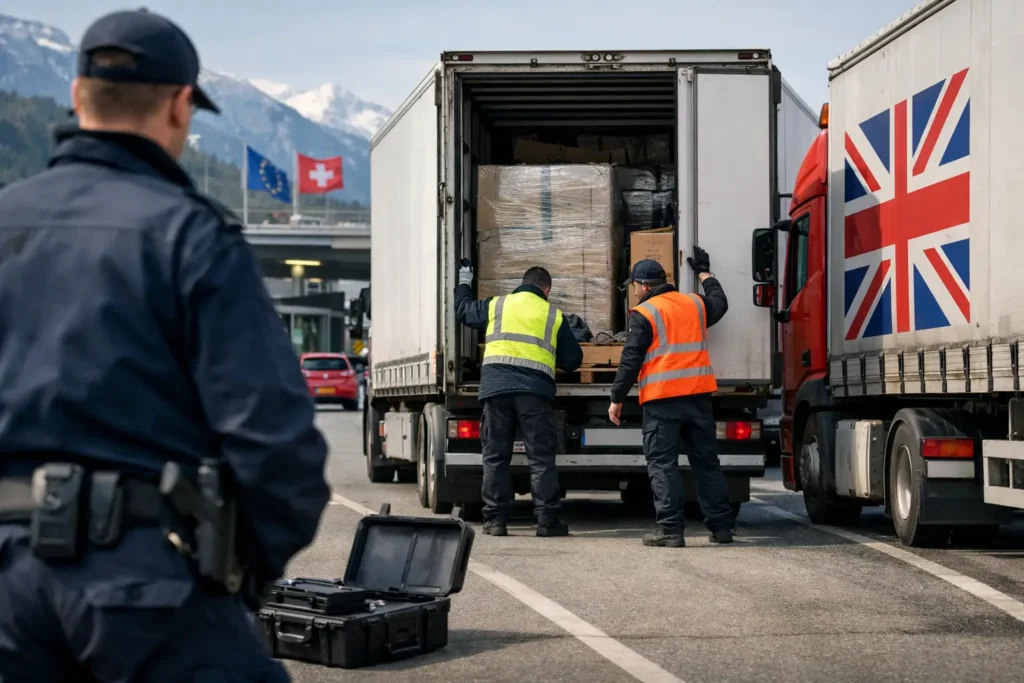
A late delivery on a cross-border route is rarely caused by one dramatic failure. More often, it starts with a missed document check, an unsuitable parking stop, an unverified collection point or an unclear escalation process after the lorry has crossed a border. The best practices for cross border freight security therefore go beyond locks, seals and tracking. They combine shipment planning, customs control, driver communication and fast decisions when conditions change. For supply chain managers moving industrial goods between Europe, the UK, Switzerland, Turkey or the Caucasus, this discipline protects delivery time, cargo value and customer confidence.
Best practices for cross border freight security start before collection
Freight security begins when the booking is accepted, not when the vehicle leaves the loading bay. The transport plan should match the actual risk profile of the shipment: commodity, value, route, delivery window, border crossings and the likelihood of extended stops.
A high-value pallet shipment from Germany to the UK needs a different plan from standard machinery components moving between Spain and France. The UK movement includes export and import formalities, possible inspection delays and more exposure to fraud around customs references or delivery instructions. An urgent shipment may need a dedicated van and a driver operating with fewer handovers. An oversized load may require a specialist vehicle, permits and controlled parking arrangements.
Before collection, confirm the collection and delivery addresses through known contacts, not solely through a late email instruction. Check the legal business name, opening hours, site access rules and named unloading contact. This simple control helps prevent misdirection fraud, where criminals attempt to divert freight by posing as a customer or consignee.
The operational brief should also record the vehicle type, loading method, number of packages, weights, dimensions and any special handling requirements. A discrepancy between booked and collected goods should trigger an immediate query. It is much easier to stop an unclear shipment at origin than to resolve a dispute after it has crossed two borders.
Build security into customs documentation and border planning
For routes involving the UK, Switzerland, Turkey and onward movements towards the Caucasus, customs documents are part of freight security. Incomplete, inconsistent or late paperwork creates a predictable vulnerability: the vehicle waits, the delivery slot is lost and the load may be held in an unsuitable location while teams search for answers.
Eurostat data shows that road freight accounts for roughly three quarters of inland freight transport in the EU. That concentration means border disruption can quickly affect capacity, secure parking availability and onward collection schedules. A customs hold is not only an administrative issue. It changes the security plan for the goods.
The key control is consistency. Commodity descriptions, package counts, weights, values, Incoterms, exporter and importer details must match across the commercial invoice, packing list, transport document and customs declaration. Vague descriptions such as “parts” or “samples” invite questions, particularly where goods could be subject to controls or require specific classification.
For a shipment from northern Italy to the UK, for example, the haulier should receive the customs references and document pack before collection wherever possible. If the vehicle reaches the port without a valid declaration or the importer’s details are incomplete, the shipment can miss its crossing and face an extended wait. For a production-critical component, that can turn a next-day requirement into a costly line stoppage.
Agree who owns each action before departure: the exporter, importer, customs agent and transport coordinator. There should be one named contact able to authorise a correction outside normal office hours. Security improves when no one has to guess who can resolve a border issue.
Control the handovers that create cargo risk
The greatest security exposure often sits at handover points: collection, cross-docking, driver change, ferry terminal, customs inspection and final delivery. Each transfer creates an opportunity for incorrect loading, unauthorised access or loss of visibility.
Use collection and delivery protocols that provide evidence without slowing the operation unnecessarily. At collection, record package count, visible condition, seal number where used and any loading observations. At delivery, obtain proof of delivery from an authorised recipient and escalate damaged packaging, quantity differences or refused goods immediately.
For higher-risk freight, consider a layered approach:
- Verify the identity and authority of collection and delivery contacts.
- Use numbered seals or other agreed tamper-evident controls where appropriate.
- Share vehicle and driver details only with authorised site contacts.
- Limit route and cargo information to people who need it to perform their role.
- Maintain a clear chain of custody during any intermediate handling.
The right level of control depends on the cargo. Sealing every standard load may add process without meaningful benefit, while pharmaceuticals, electronics, regulated materials or high-value industrial components may justify stricter procedures. The point is to apply proportionate controls, not to create paperwork for its own sake.
Plan secure stops and active journey monitoring
A GPS position alone does not make a shipment secure. Tracking tells you where a vehicle is. A security plan determines what should happen when it stops unexpectedly, deviates from the agreed route or faces a delay near a border.
Drivers need practical instructions on authorised stopping locations, check-in expectations and escalation contacts. This matters on long routes through multiple jurisdictions, where driving-time rules, ferry schedules, weather and border queues can force changes to the original plan. A driver who cannot reach a planned secure location should know who to call and what alternatives are approved.
Active monitoring is especially valuable for time-critical freight. Consider an urgent automotive component moving from Belgium to a plant in the Midlands. If a motorway closure threatens the delivery window, the transport team must assess the revised arrival time, customs status, fuel range, driver hours and alternative routing at once. Simply informing the customer after the deadline has passed is not operational control.
Set meaningful alert thresholds. A delayed position update may be normal in an area with poor coverage; an extended unplanned stop shortly after collection may require immediate contact. The escalation process should distinguish between safety incidents, potential theft, customs delays and routine traffic disruption. Different events need different responses.
Choose partners that can act, not just report
Freight security is a shared responsibility across shipper, carrier, driver, customs representatives and consignee. The weak point is often not a lack of technology but a lack of accountability when an exception occurs.
Ask practical questions before allocating a route. Who monitors the shipment outside standard hours? Who checks that customs documents are ready? How quickly can the provider source a replacement vehicle after a breakdown? Can they organise a dedicated express movement if a delayed standard load threatens production? Are multilingual contacts available when the consignee, driver and customs office operate in different languages?
The answers matter most on complex routes. A standard groupage model may suit predictable, low-risk freight, but it can introduce extra handling and less control over timing. A direct dedicated vehicle costs more, yet it may reduce handling points and provide the visibility needed for sensitive or urgent goods. Security and cost should be assessed together, alongside the consequence of a late or compromised delivery.
MAP Transport has managed international road freight since 1985, coordinating tailored vehicle solutions across 45 countries. For customers, the value is not a generic security promise. It is having a transport team that can match the service level to the cargo, route and deadline, then keep the right people informed throughout transit.
Turn incidents into stronger cross-border controls
No security process removes every risk. The objective is to contain the event, protect people and goods, and prevent the same failure from recurring. After a customs hold, missed delivery, seal discrepancy or suspicious instruction, conduct a short operational review while facts are fresh.
Look for the root cause. Was the commodity description incomplete? Did the delivery site change instructions without proper verification? Was the route plan unrealistic for the driver’s legal hours? Did the escalation contact fail to respond? The corrective action should be specific: amend the booking checklist, update approved contacts, set a document deadline or change the service type for future movements.
Security performance is strongest when it becomes routine. Review incident patterns by route, customer, commodity and handover point. A small number of recurring issues can reveal where a process needs attention before it becomes a major claim or a lost customer.
Security is a planned transport outcome
Cross-border freight security protects more than the cargo. It protects production schedules, contractual delivery dates and the confidence that your team can manage exceptions without losing control. The most effective approach is practical: validate the booking, prepare customs early, control handovers, monitor actively and use a transport partner able to make decisions under pressure.
For recurring flows or a one-off urgent movement, a tailored plan is often more valuable than a standard service with unclear ownership. Need support on your transport flows? Contact our team for a tailored solution.
Have a question or need a quote? Contact us at (+34) 943 62 95 77 (ask for Raquel) or by email at lo*******@**********rt.com