
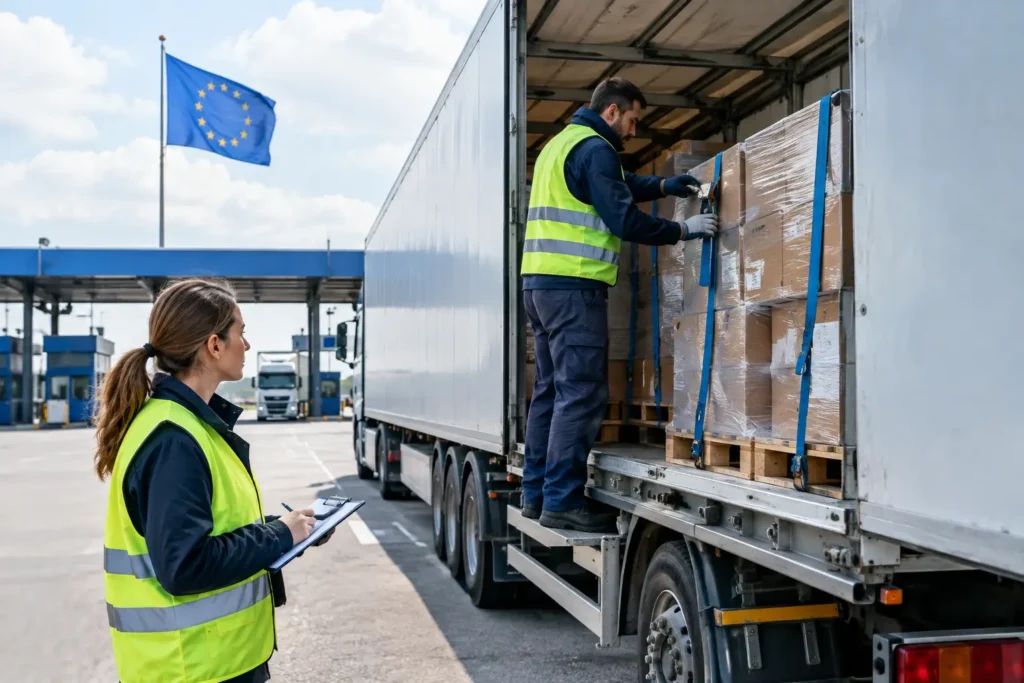
A damaged consignment at a border is rarely caused by one dramatic failure. More often, it starts with a pallet that was stable in the warehouse but not secured for repeated handling, a curtain-sided lorry chosen for sensitive goods, or customs paperwork that keeps freight stationary for hours. To prevent cross-border cargo damage, supply chain managers need to treat packaging, vehicle selection, documentation and communication as one controlled process. This matters most on routes involving the UK, Switzerland, Turkey and the Caucasus, where border formalities can turn a minor packing weakness into a costly delivery failure.
Start with the real risks on each route
Cargo protection should begin before a vehicle is booked. The same goods can face very different risks depending on whether they are moving from Spain to Germany under routine EU procedures or travelling through the UK border, Switzerland, Turkey or onward to Azerbaijan and Kazakhstan.
The issue is not simply distance. Border stops introduce waiting time, inspections, parking areas, transhipment requirements and more frequent door openings. A shipment that is secure for a direct 600-kilometre journey may not remain secure after an unexpected overnight stop, a customs examination or a long queue at a frontier crossing.
Route planning should therefore identify the points where goods are most exposed: collection, loading, border arrival, customs clearance, rest stops, inspection points and final delivery. For high-value machinery, metal components or fragile industrial equipment, these handovers deserve the same attention as transit itself.
A practical example is a manufacturer sending crated precision parts from northern Spain to a customer in the UK. If the crates are stacked close to the rear doors without restraint, a customs inspection can require unloading and reloading. The risk is not only impact damage. Poorly labelled crates, missing handling instructions or inaccessible documents can extend the stop and create unnecessary handling.
Prevent cross-border cargo damage through packing
Packaging must be designed for the journey actually planned, not only for storage or domestic collection. Export packing should tolerate vibration, braking, cornering, temperature changes and potential inspection. It must also make the load easy to identify and handle correctly when the original loading team is not present.
For palletised freight, the operational priority is load stability. Goods should not overhang the pallet, stretch wrap must hold the full load rather than only the top layers, and corner protection should be used where straps or wrapping could damage cartons. Heavier items belong at the base, while uneven or unstable cartons should be consolidated before collection.
For industrial goods, the protection required depends on the product. Metal parts may need moisture barriers and desiccants when travelling through variable conditions. Sensitive electronics require shock protection and clear orientation labels. Machinery with exposed components may need rigid crating rather than a standard pallet wrap.
There is a trade-off. Over-packing can increase volume, weight and freight cost, particularly on urgent van services where every cubic metre matters. Under-packing creates a far higher risk of claims, rejected deliveries and production disruption. The right approach is proportionate protection based on cargo value, fragility, route complexity and handling frequency.
Before dispatch, confirm four details with the transport partner: gross weight, dimensions, number of handling units and any restrictions on stacking, tilting or exposure to weather. These details affect both the vehicle choice and the securing method.
Match the vehicle and securing method to the load
A standard road freight vehicle is not automatically suitable for every cross-border consignment. Vehicle selection has a direct effect on damage risk, especially where goods are oversized, non-stackable, temperature-sensitive or required at a precise time.
A curtain-sided lorry may suit standard pallet freight that can be loaded from the side. A box vehicle provides greater protection for sensitive goods and reduces exposure during adverse weather. Vans can be effective for urgent, smaller shipments requiring delivery within hours, but they still need planned restraint points and sufficient internal protection. Exceptional loads require specialist equipment, route checks and securing plans tailored to the dimensions and centre of gravity.
The securing method should be agreed before loading, not improvised at collection. Ratchet straps, anti-slip mats, blocking, bracing and load bars all have a role, but only when used for the specific cargo and vehicle. A heavy machine secured only with straps can move if it is not blocked correctly. Conversely, excessive pressure from straps can damage cartons, casings or painted surfaces.
An operational insight often missed by shippers is that a lorry may be technically large enough but operationally wrong for the consignment. A vehicle with insufficient load-securing points, unsuitable access or inadequate internal height can force a rushed loading decision. Sending accurate dimensions and photographs when requesting a quote helps avoid this problem.
Keep customs delays from becoming cargo damage
Customs is a cargo-protection issue as well as a compliance issue. Where documents are incomplete, inconsistent or unavailable to the driver and customs agent, freight can remain stationary longer than planned. That affects delivery timing, but it can also increase theft, moisture and handling exposure.
For UK, Swiss and Turkish movements, document readiness should be checked before the vehicle arrives. Commercial invoices, packing lists, commodity descriptions, values, origin information and any required export or transit references must match the physical shipment. If a crate says one thing, the invoice says another and the driver has a third description, an inspection becomes more likely.
For regulated residues or goods with special requirements, the documentation review needs to happen even earlier. The carrier must understand what is being moved, which permits apply and whether the load needs dedicated handling. Trying to solve these questions after collection creates avoidable risk.
It is also sensible to place documents in a protected, clearly marked location and ensure digital copies are available to the relevant contacts. This reduces the chance of opening multiple packages merely to locate paperwork. For sensitive or high-value goods, agree in advance who can authorise customs queries and how quickly they can respond.
Build visibility and escalation into the transport plan
Damage prevention is strongest when exceptions are dealt with while there is still time to act. A late collection, border queue, damaged pallet corner or unexpected inspection should trigger a clear response, not a chain of unanswered calls.
Set expectations at booking stage. Define the collection window, delivery deadline, consignee contact, unloading requirements and escalation route. If the consignment is time-critical, specify whether a dedicated vehicle is required and whether the delivery can accept an out-of-hours arrival. These decisions prevent a vehicle from waiting at a closed site with valuable cargo on board.
For regular flows, record recurring issues by lane and customer site. If a particular delivery point repeatedly causes waiting, difficult access or loading damage, it should be treated as a transport-planning issue rather than a one-off complaint. Adjusting the vehicle, collection time or packaging specification can reduce repeated losses.
MAP Transport has coordinated international road freight since 1985 and supports more than 200 customers each year with standard, urgent and exceptional shipments. For complex cross-border movements, the value of a specialist partner is not just arranging a vehicle. It is having someone who checks the shipment detail, selects a suitable solution and keeps the right people informed throughout transit.
The most reliable way to protect cargo is to make prevention part of every booking decision, from the first dimensions supplied to the final unloading instruction. A tailored plan costs far less than a damaged delivery, a rejected consignment or a stopped production line.
Need support on your transport flows? Contact our team for a tailored solution.
Have a question or need a quote? Contact us at (+34) 943 62 95 77 (ask for Raquel) or by email at lo*******@**********rt.com