
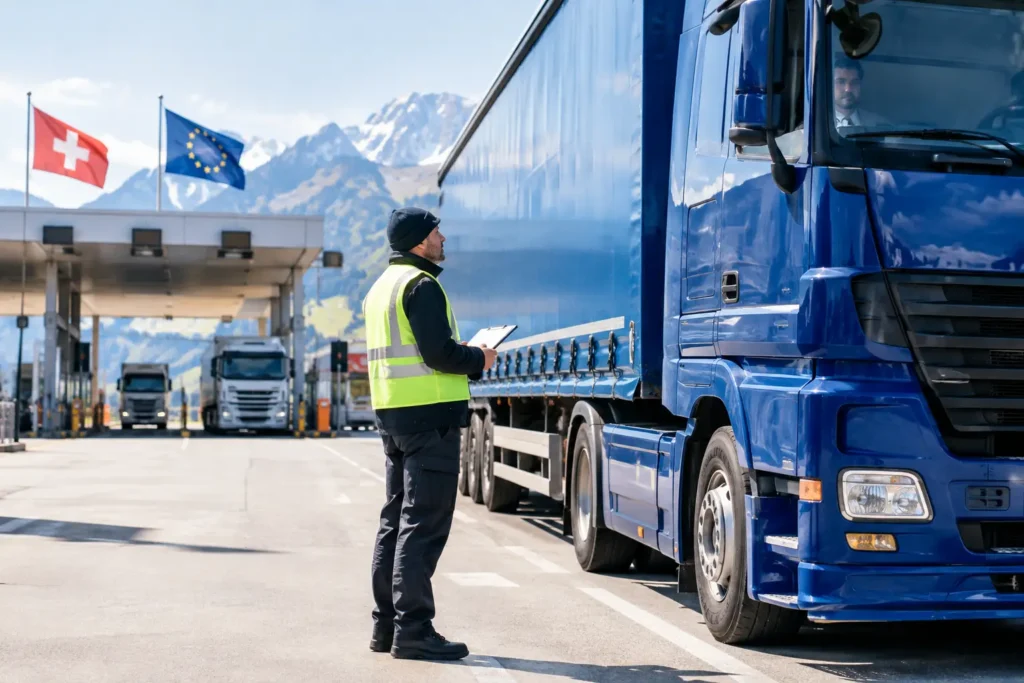
A loaded lorry can lose a full delivery day at the wrong border, even when the collection, vehicle and driver are all ready. This is particularly common on routes involving the UK, Turkey, the Caucasus or transit through several customs territories. The question of when to use TIR is therefore not a paperwork detail. It is a route-planning decision that affects border waiting time, security exposure, delivery commitments and the cost of missed production slots. For supply chain managers, TIR can be the right tool for a controlled cross-border movement, but only where the cargo, countries and customs procedure genuinely support it.
What TIR changes on a cross-border road movement
TIR is an international customs transit system used to move goods under customs control between participating countries. In practical terms, it allows a sealed load to travel through one or more transit countries with a TIR Carnet, rather than completing full import and export formalities at every border crossed.
The procedure is governed by the TIR Convention and operates across 78 contracting parties. Its value is greatest where a road movement starts outside a customs union, crosses several customs frontiers and must arrive with the goods still secured and documented as one controlled transit operation.
For a logistics manager, the operational benefit is straightforward: customs authorities can rely on approved vehicles or containers, a recognised guarantee system and customs seals. Border officers still have the right to inspect the load, but the process is designed to reduce repeated intervention where documents and seals are in order.
TIR does not remove customs requirements at origin or destination. Nor does it guarantee that a border will be free from queues. It provides a recognised framework that can reduce friction and improve control on eligible international road journeys.
When to use TIR on UK, Turkey and Caucasus routes
Use TIR when the consignment will cross multiple customs borders and the normal transit alternatives would create unnecessary declarations, guarantees or border uncertainty. This frequently applies to movements between the EU and Turkey, Turkey and the Caucasus, or the UK and destinations requiring onward transit outside the EU customs area.
A typical example is industrial machinery collected in northern Italy for delivery to Baku. The route may pass through Slovenia, Croatia, Serbia, Bulgaria, Turkey, Georgia and Azerbaijan. Each border introduces a potential delay, particularly if documents are incomplete, cargo descriptions do not match, or the transit process changes midway through the route. A correctly planned TIR movement keeps the customs status consistent through those transit territories until the goods reach their designated customs office of destination.
TIR can also be relevant for UK movements when goods are travelling onwards beyond the EU, or when the selected route includes countries where TIR offers a more practical transit solution than relying on separate national procedures. Since Brexit, UK-EU road freight requires customs preparation on both sides of the border. Adding onward transit to Turkey or the Caucasus makes document discipline even more important.
The best fit is usually a shipment with these characteristics:
- A high-value, security-sensitive or production-critical load travelling through several customs territories.
- A sealed full load where maintaining cargo integrity from collection to destination matters.
- A route through Turkey, the Western Balkans or the Caucasus where border processes can vary by crossing and day.
- A movement where the consignee needs predictable customs closure at destination rather than fragmented transit handling en route.
For a direct EU-to-EU movement, TIR will generally not be needed. For a standard UK-EU shipment, common transit may be the more proportionate option. The right choice depends on the full route, the customs status of the goods, the carrier’s authorisations and the destination procedure.
When use TIR instead of another transit procedure
The choice is not between “TIR is good” and “other transit is bad”. It is about using the procedure that gives the least operational risk for a specific shipment.
Common Transit Convention procedures are widely used for movements involving the EU, the UK, Switzerland, Norway, Turkey and other connected countries. They can be efficient on many European routes, especially where customs brokers and consignee processes are already set up for common transit. TIR becomes more attractive when the route extends through multiple non-EU territories or when the movement needs the practical advantages of a single internationally recognised road transit framework.
Consider a time-critical spare part leaving the UK for a manufacturing site in Turkey. If it is a small, urgent shipment moving in a van and requires delivery within 24 hours, the priority may be fast pre-lodgement, accurate commodity data and choosing a border crossing with manageable traffic. TIR may be appropriate, but it is not automatic. If the load is moving under an alternative valid transit procedure and the route is simple, adding TIR may create avoidable administration.
By contrast, a full articulated lorry carrying sensitive industrial components from Germany to Kazakhstan via Turkey and the Caucasus has a stronger case for TIR. The number of borders, the length of transit and the need for controlled cargo continuity make a well-managed TIR operation a sensible risk-control measure.
The practical question to ask is: will TIR reduce handovers, repeated guarantees or customs uncertainty enough to justify its preparation requirements? If the answer is yes, it is likely the better operational choice.
The conditions that can make or break a TIR movement
A TIR Carnet cannot correct weak shipment data. Most avoidable border delays come from inconsistencies between the commercial invoice, packing list, customs declaration, transport instruction and physical cargo.
Before collection, confirm the commodity description, tariff classification, gross and net weight, package count, origin, consignee details and intended customs office of destination. Describing a load as “machine parts” may be commercially convenient, but it is rarely sufficient for a customs-sensitive route. The documentation must clearly support what is actually loaded.
Cargo security matters too. The vehicle or load unit must be suitable for customs sealing, and the driver must understand the instruction not to break or interfere with seals unless authorised by customs. A seal discrepancy can trigger an inspection, delay clearance and create questions about liability.
There is also a timing issue. Customs offices do not operate at the same pace, and border pressure can change quickly due to weather, public holidays, infrastructure works or local controls. A departure plan that looks realistic on a map may fail if it assumes uninterrupted progress through several crossings.
Operational insight: schedule the customs handover as a critical milestone, not as an administrative task after the vehicle has departed. Confirm who will discharge the transit at destination, when they are available and what documents they require before the lorry reaches the final customs office.
How to plan a TIR shipment without losing time
The most reliable TIR movements are planned from the destination backwards. Start by confirming the importer’s customs process and the final office where the transit will be terminated. Then validate the route, border sequence, vehicle suitability and collection time.
For high-priority freight, give the transport partner the full shipment brief at the quote stage: collection and delivery addresses, ready date and time, cargo value, weight, dimensions, package count, commodity details, Incoterms and all relevant customs contacts. This makes it possible to assess not only the rate, but also whether a standard lorry, express van or specialist vehicle is appropriate.
A tailored plan should include realistic contingency. If a Turkish border crossing is congested, can the route be adjusted? If the consignee cannot receive the goods immediately, is there a secure holding option? If the production line cannot wait, can a separate urgent shipment carry the essential components while the main load follows under its planned transit procedure?
This is where experienced coordination adds value. A transport provider should monitor the journey, keep the shipper informed at key stages and escalate early if a customs issue threatens the delivery slot. MAP Transport has coordinated complex European and Eurasian road flows since 1985, matching the vehicle and customs plan to the actual shipment rather than forcing every load into the same service model.
TIR is a control tool, not a default setting
TIR is most useful when a shipment faces multiple borders, elevated customs risk or a long transit through Turkey and the Caucasus. It can protect the flow of goods, but it must be supported by accurate documents, a seal-ready vehicle and a destination customs process that is ready to close the movement.
For simpler routes, another transit procedure may be faster and more economical. For complex, high-value or delivery-critical loads, choosing TIR early can prevent the kind of border disruption that no last-minute phone call can solve. The practical priority is to make the customs route part of the transport plan from the first quote, not an issue discovered after the lorry is already on the road.
Need support on your transport flows? Contact our team for a tailored solution.
Have a question or need a quote? Contact us at (+34) 943 62 95 77 (ask for Raquel) or by email at lo*******@**********rt.com