
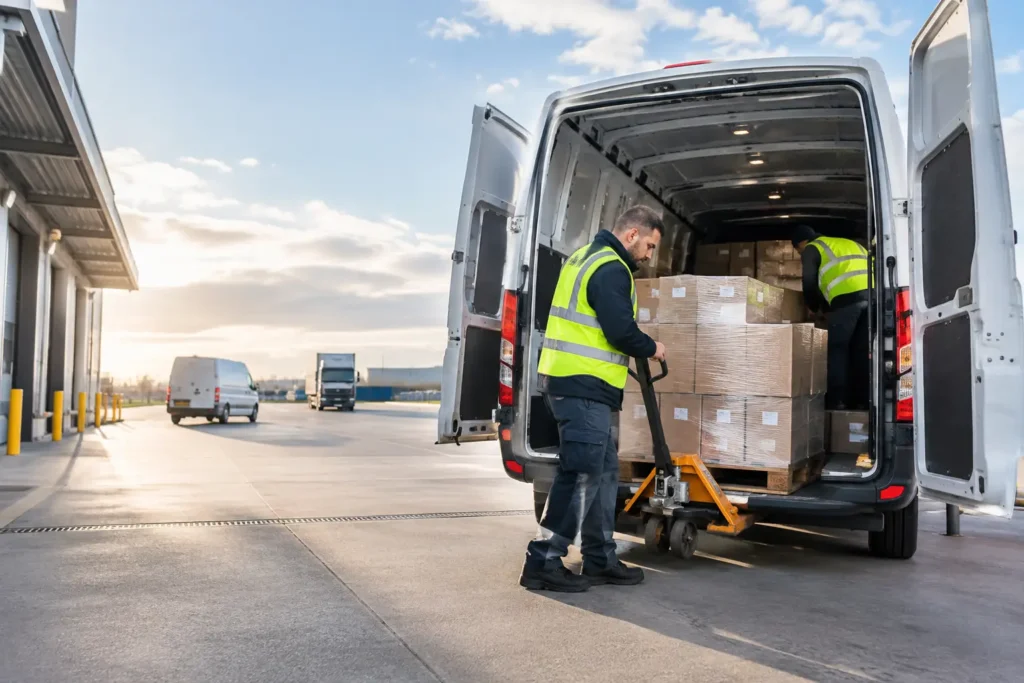
A production line is waiting for a replacement component in Birmingham. A customer in Switzerland needs samples before a tender deadline. A distributor has missed a collection slot and the next available groupage departure is tomorrow. In each case, the question is not simply whether a van is available. The real decision is how to select vans for urgent freight without creating a new problem around payload, loading access, customs paperwork or delivery certainty. For supply chain managers, the right vehicle choice protects service levels while keeping urgent transport costs proportionate to the actual risk.
When to Select Vans for Urgent Freight
A dedicated van is usually the right answer when time lost at consolidation points would cost more than direct transport. Unlike a standard part-load movement, an urgent van can collect quickly, travel directly and avoid terminal handling that may add hours or an overnight stop.
This matters because road freight remains the main inland mode for European trade. Around three quarters of inland freight transport in the EU is moved by road, which means congestion, border procedures and vehicle availability can quickly affect a critical shipment. For a small, high-value consignment, the speed and control of a dedicated vehicle often outweigh the lower unit cost of groupage.
The decision should be based on the consequence of delay, not only the shipment’s size. A box of machine parts may take up little space, yet stopping a customer’s production line for a shift can be far more expensive than an express van. Conversely, a non-critical pallet with a flexible delivery window may be better suited to a planned road freight service.
Urgent vans are particularly useful for shipments such as replacement industrial components, prototypes, tooling, documents accompanying a controlled load, samples, medical equipment and short-notice replenishment. They are also effective when the collection or delivery point has restricted access that makes a large articulated lorry impractical.
Start With the Load, Not the Vehicle
The fastest way to make a poor urgent transport decision is to book a van based on parcel count alone. Vehicle selection must begin with verified operational data: total weight, dimensions, packaging type, loading method and any restrictions at both ends.
A compact van may be suitable for cartons and cases, but not for a single crate that needs a forklift or has an awkward height. A long-wheelbase panel van provides more loading length, while a curtainsider or larger express vehicle may be needed for palletised freight, side loading or equipment that cannot be manoeuvred through rear doors.
Before requesting a quote, provide the following details as accurately as possible:
- collection and delivery postcodes, opening hours and named site contacts;
- number of pieces, total gross weight and dimensions of the largest item;
- whether the load is stackable, secured to pallets or requires special handling;
- loading and unloading equipment available at each location;
- the required delivery deadline, including whether it is a hard cut-off.
An operational insight that is often missed: usable volume is not the same as vehicle volume. A van may appear large enough in cubic metres, but the load can still be unsuitable because of its longest dimension, a fragile packaging requirement or the need to keep goods upright. Confirming this before dispatch prevents a vehicle arriving on site only to be rejected or partly loaded.
Match Van Capacity to the Delivery Risk
There is no single “express van” specification that fits every urgent load. The right option depends on the balance between payload, physical dimensions and the delivery commitment.
For small, lightweight consignments, a compact dedicated van can be economical and quick to position. For several pallets, crates or dense metal components, payload becomes decisive. A larger van may have the volume required but still be unable to carry the consignment safely within its legal weight limit. In those cases, a heavier express vehicle or lorry may be the more reliable choice, even if the shipment does not look large.
Consider a manufacturer in northern Spain sending a 900 kg replacement gearbox to a plant near Lyon. The part may fit inside a panel van, but its weight, securing needs and unloading arrangements must be checked before confirming the vehicle. If the receiving site only has a forklift available during specific hours, a direct van that arrives early but cannot unload has not solved the urgent requirement.
For critical freight, specify the service outcome rather than just requesting “a van”. State whether the shipment requires direct delivery, a dedicated vehicle, two-driver operation, monitored progress updates or delivery within a defined time window. This allows the transport planner to select capacity around the actual risk rather than defaulting to the smallest available vehicle.
Customs Can Change the Best Vehicle Choice
A direct van does not remove border formalities. On routes involving the UK, Switzerland, Turkey or the Caucasus, customs readiness can be more important than road speed. A vehicle that reaches the border without correct documentation can lose the advantage gained during collection and transit.
For UK movements, the commercial invoice, commodity information, value, origin and customs references must align before departure. Switzerland requires equally careful preparation despite its proximity to EU markets. Turkey and onward Caucasus routes can involve additional transit procedures, local requirements and longer border processing times.
A practical example is an urgent shipment of electrical components from France to the UK for next-morning installation. If the exporter has not confirmed the importer’s customs arrangements or supplied a clear goods description, the van may be held at the border. The transport plan should therefore include document validation before collection, realistic contingency time and a driver brief that reflects the declared load.
Do not treat customs as an administrative task added after booking. For urgent freight, it is part of vehicle selection and route planning. A smaller direct van may be ideal for city access, but a larger vehicle with the right operating plan may be better if it enables safer loading, correct transit documentation and fewer handling changes across a complex corridor.
Plan Collection and Delivery Around Reality
Urgent road transport is often won or lost before the wheels move. A precise collection time, immediate availability of goods and a person authorised to release the shipment are as important as selecting the right van.
Ask whether the shipper can load immediately, whether security clearance is needed, and whether the consignee will accept delivery outside normal hours. On industrial sites, gate access, booking references, forklift availability and personal protective equipment requirements can all add avoidable delay. A direct vehicle waiting 45 minutes for paperwork or a loading bay is no longer operating as a true express service.
It also helps to define what “urgent” means internally. Is delivery required before close of business, before a production start time, or within a fixed number of hours from collection? These are different service promises and may require different vehicles, driver arrangements and routes.
For a shipment from Germany to a Swiss production site, for example, the most reliable plan may involve an earlier collection and pre-cleared documents rather than a later departure with an unrealistic driving schedule. Speed without planning creates pressure. Planned urgency creates control.
Build a Repeatable Urgent Freight Process
One-off emergencies cannot always be avoided, but repeated urgent shipments often reveal a process gap. If the same spare parts regularly move at short notice, agree in advance which van type is suitable, what packaging standard applies, who approves costs and which documents must be ready for customs-sensitive destinations.
This gives procurement and operations teams a clearer escalation route. Instead of starting from scratch during a breakdown, they can submit the essential shipment data, confirm the deadline and receive a vehicle recommendation that reflects previous movements. It also makes cost control more realistic: the business can distinguish between a genuine production-critical emergency and an avoidable planning failure.
For companies managing frequent cross-border flows, personalised follow-up is valuable. Progress updates, named contacts and rapid intervention when a collection changes help protect the delivery commitment after the van has left site. MAP Transport has coordinated international road freight since 1985, matching express vehicles to the load, route and customs exposure rather than forcing urgent consignments into a standard solution.
The best urgent vehicle decision is rarely the smallest or the cheapest van available. It is the one that can collect without delay, carry the goods safely, clear the required border process and arrive within the time that matters to your customer or operation.
Need support on your transport flows? Contact our team for a tailored solution.
Have a question or need a quote? Contact us at (+34) 943 62 95 77 (ask for Raquel) or by email at lo*******@**********rt.com