
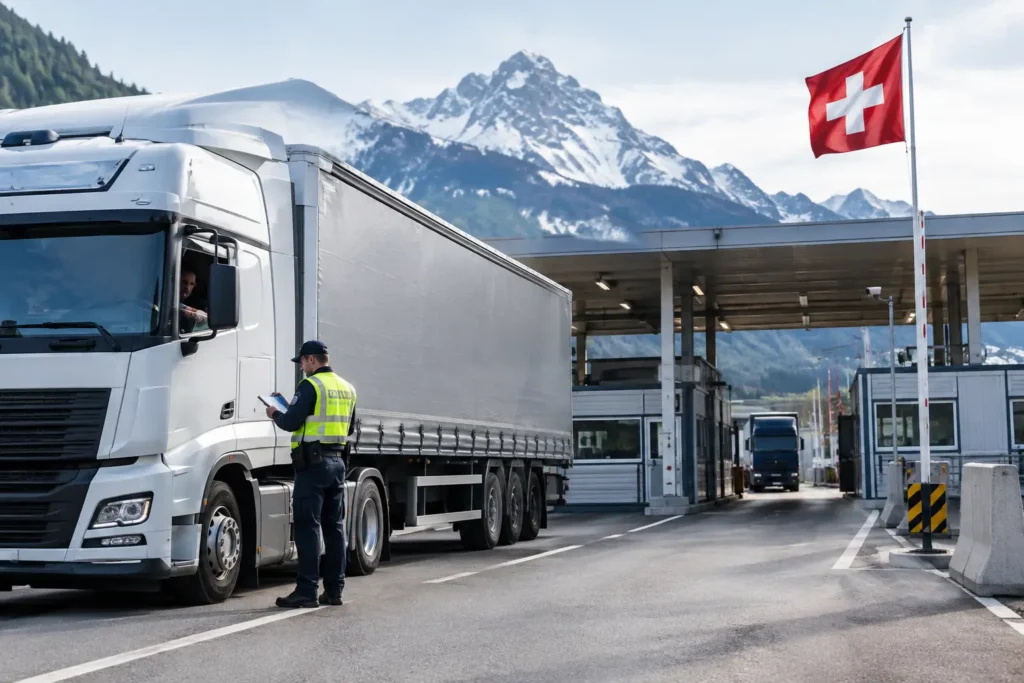
A lorry can arrive at the Swiss border exactly on schedule and still lose a working day because one document does not match the invoice, the customs procedure is unclear, or the consignee cannot release the goods. For supply chain managers, Swiss customs freight is not simply another European road movement. Switzerland sits outside the EU customs union, so every import and export flow requires disciplined preparation, clear responsibility and rapid action when an exception appears. The right transport plan protects delivery slots, production continuity and freight spend, particularly when an urgent shipment cannot wait for the next available departure.
Why Swiss customs freight needs a different plan
Switzerland is closely connected to European manufacturing and distribution networks, but its customs status changes the operational model. Goods moving from France, Germany, Italy, Austria or other EU countries into Switzerland require export formalities on the EU side and import clearance in Switzerland. The reverse applies for Swiss exports to the EU.
That creates two border-side processes, often involving different parties: exporter, importer, carrier, customs broker and consignee. If responsibilities are not agreed before collection, the carrier may be waiting while teams exchange emails to establish who holds the import power of attorney or who will pay duties and VAT.
The commercial stakes are significant. A missed delivery into a Swiss production site can stop a line, while a delay on temperature-sensitive, high-value or time-critical goods can quickly cost more than the transport itself. MAP Transport has managed international road freight since 1985 across 45 countries, where proactive coordination is more valuable than simply offering a vehicle at the lowest rate.
Documents that prevent customs holds
Most avoidable border delays begin before the lorry leaves the loading point. Customs authorities need consistent information across the commercial invoice, packing list, transport instruction and declaration. A product description such as “machine parts” may be too vague. Customs clearance works better when the description states what the item is, its material or function, the quantity, value and relevant commodity code.
For regular Swiss customs freight, the core document set usually includes a commercial invoice, packing list, transport document, export declaration and the Swiss import declaration arranged by the importer or its appointed agent. Depending on the goods, proof of preferential origin, licences, certificates or transit documents may also be needed.
Three checks should happen before collection: the legal exporter and importer details must be correct, values and quantities must match across documents, and the commodity code and origin claim must be defensible. Preferential origin can affect duty treatment, but it should never be assumed merely because goods are dispatched from the EU. Origin rules are product-specific and depend on where and how the goods were manufactured.
A practical example: a Spanish industrial supplier sends replacement steel components to a plant near Zurich after an equipment failure. The goods are ready at 14:00 and the customer needs them the following morning. An express van is available, but the invoice only lists a total value and “spares”. Before dispatch, the shipment must be clarified with individual item descriptions, quantities, tariff classification and the importer’s customs instructions. That short validation can prevent a night-time border hold that makes the express service pointless.
Select the customs procedure before booking transport
The fastest vehicle cannot correct the wrong customs procedure. Before requesting a quote, determine whether the goods are being permanently imported, temporarily admitted for repair or exhibition, returning after processing, or moving under transit to a customs office away from the border.
Permanent imports are normally the most straightforward when the Swiss importer is prepared to clear the goods on arrival. Temporary movements need more care because the documents must support the later re-export and prove that the goods have not been improperly placed on the Swiss market. For machinery sent for repair, trade fair equipment or reusable tools, choosing the appropriate procedure protects against unexpected duties, VAT exposure and administrative disputes.
Transit planning also matters. A shipment may need to cross several jurisdictions before reaching Switzerland, especially when routed from the UK, Turkey or the Caucasus. Each extra border increases the value of having one clear document owner and a transport partner who can monitor progress. Where freight is time-critical, customs readiness should be treated as a dispatch condition, not paperwork to complete once the vehicle is already loaded.
Match the vehicle and service level to the risk
The best option depends on cargo size, delivery deadline, loading constraints and the consequences of a delay. Standard groupage or full-load road freight can be cost-effective for planned flows, but urgent production-critical consignments may justify a dedicated van or direct lorry. The cost per pallet may be higher, yet the total cost can be lower if it avoids downtime, a missed installation or an emergency airfreight replacement.
For Swiss customs freight, the service level should include enough time for pre-clearance and border communication. A same-day collection does not automatically mean next-morning delivery if documentation is incomplete or customs offices have limited processing capacity. Supply chain teams should share the required delivery time, not only the collection date, so the transport plan can reflect the real operational deadline.
Vehicle selection should also reflect the consignment. A dedicated van can suit urgent cartons, prototypes and critical parts. A standard lorry is often appropriate for palletised industrial freight. Oversized machinery, heavy metalwork or non-standard dimensions require specialist routing, loading arrangements and customs details that accurately reflect the shipment.
The operational insight is simple: build the customs timeline into the transport timeline. Do not treat the border as a fixed number of driving hours. Allow for document validation, declaration acceptance, possible inspection and communication with the importer. This is especially important on Friday collections, holiday periods and flows where the consignee has restricted receiving hours.
Build a repeatable process for regular Swiss lanes
Companies with frequent movements to Switzerland should not solve the same customs questions shipment by shipment. A lane-specific operating procedure reduces errors and speeds up booking. It should set out the approved invoice format, commodity codes, origin wording, importer contacts, customs broker details, delivery restrictions and escalation contacts.
Use a short pre-dispatch checklist for every load:
- Confirm the exporter, importer and delivery party are correctly identified.
- Verify invoice values, currency, Incoterms and item-level descriptions.
- Confirm who is arranging Swiss import clearance and who may be contacted after hours.
- Share weight, dimensions, collection and delivery times before vehicle allocation.
- Flag urgent, regulated, high-value or exceptional cargo at quotation stage.
This discipline is particularly valuable for cross-border manufacturing flows. A distributor shipping planned replenishment stock may accept a standard delivery window. A manufacturer sending a failed-component replacement cannot. Both need compliant documents, but the second requires a direct service, confirmed customs readiness and active follow-up from collection to proof of delivery.
When an urgent Swiss shipment needs intervention
Urgent freight is where weak customs planning becomes most visible. If a consignee reports that a production line will stop without a component, every hour matters. Yet rushing a consignment to the border with incomplete data simply transfers the delay to a more expensive point in the journey.
A reliable escalation process starts by collecting the exact shipment facts: commodity, value, weight, dimensions, origin, destination, deadline and customs contact. The transport coordinator can then assess whether a dedicated express vehicle is appropriate, whether the importer can clear immediately and whether the route supports the required delivery time.
MAP Transport coordinates standard, express and exceptional road freight with personalised follow-up throughout transit. For Swiss flows, that means matching the vehicle and service to the shipment rather than forcing an urgent load into a standard schedule. The objective is not merely fast collection. It is delivery in a few hours or by the required deadline with customs arrangements that stand up at the border.
Make the border part of the delivery plan
Swiss freight performs best when customs information is treated with the same care as loading times and delivery appointments. Accurate documents, agreed import responsibility and a service level matched to the commercial risk turn a complex border into a manageable operating step. For regular lanes, a repeatable process creates predictability. For urgent movements, early intervention gives the shipment its best chance of arriving when production needs it.
Need support on your transport flows? Contact our team for a tailored solution.
Have a question or need a quote? Contact us at (+34) 943 62 95 77 (ask for Raquel) or by email at lo*******@**********rt.com