
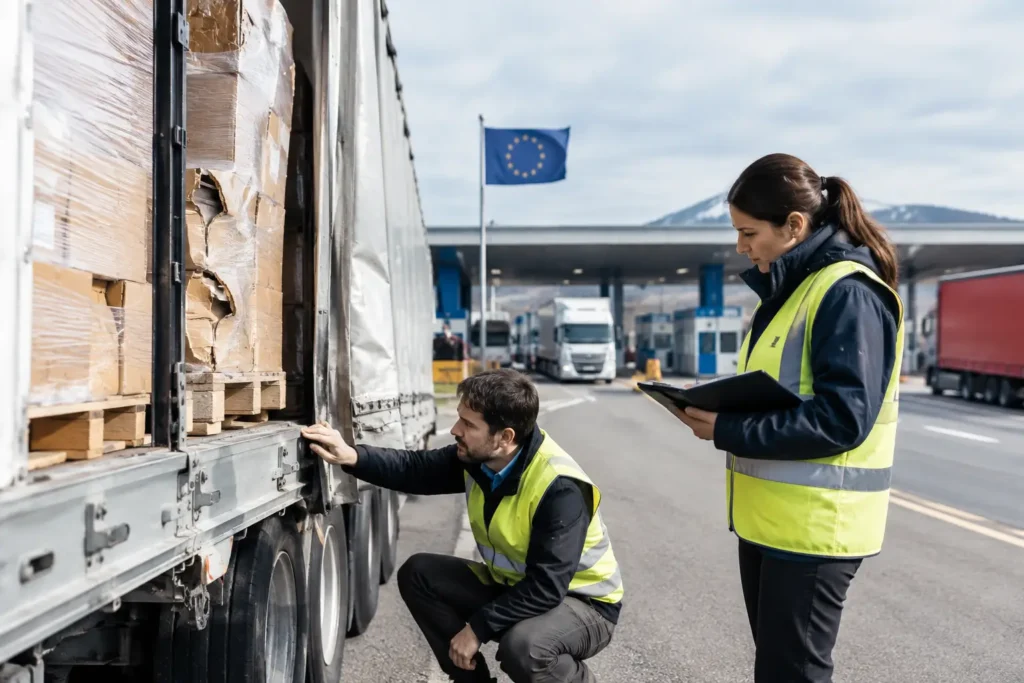
A damaged pallet arriving at a customer site can quickly become more than a quality issue. Production may stop, a retailer may reject the delivery, and finance may be asked to absorb a loss before anyone has established what happened. Freight damage liability is therefore a commercial issue as much as a legal one. For European road movements, especially across the UK, Switzerland, Turkey and other customs-sensitive routes, the answer to “who pays?” depends on the transport contract, the evidence available and the timing of each action.
When does freight damage liability pass to the carrier?
The starting point is the condition of the goods when they are handed over and when they are delivered. Under the CMR Convention, which governs many international road freight movements, a carrier can be liable for loss or damage occurring between taking over the goods and delivery. That does not mean every damaged shipment results in full reimbursement.
The carrier may avoid liability if it can show that the damage arose from circumstances it could not avoid, such as inadequate packing by the sender, an inherent defect in the goods, or specific risks accepted by the shipper. This is why a vague collection note and a signed delivery document with no comments can turn a valid claim into an expensive dispute.
CMR also limits compensation in many cases to 8.33 Special Drawing Rights per kilogram of gross weight lost or damaged. For high-value components, medical equipment or precision industrial goods, this amount can be far below the invoice value. A 200 kg crate of specialised parts may be worth €40,000, yet the CMR limit may produce a much lower recoverable amount.
The practical point is clear: carrier liability is not the same as cargo insurance. Liability responds only where the carrier is legally responsible, and usually up to a defined limit. Insurance can be arranged to protect the declared value of the goods, subject to its own terms and exclusions.
Freight damage liability starts with the transport instructions
Many claims are won or lost before the vehicle arrives. A transport order should tell the carrier what is being moved, how it is packed, whether it can be stacked, which side must remain upright and whether handling equipment is needed at either end. For an oversized or sensitive shipment, dimensions and loading constraints are as relevant as weight.
Consider a manufacturer sending painted metal panels from northern Spain to a customer in Switzerland. The panels are placed on standard pallets without edge protection, then loaded with mixed freight. At delivery, several corners are scratched. If the transport instruction did not state that the panels could not be stacked or required protective separators, the carrier may argue that the packaging was insufficient for normal road transport.
A stronger instruction would record the packaging method, loading restrictions and any agreed handling requirements. Collection photographs add another useful layer of evidence. They do not replace proper packing, but they can show whether the goods were visibly sound at handover.
For urgent movements, pressure often creates gaps in the paperwork. An Xpress or UltraExpress vehicle may be the right solution when a production line needs a replacement part within hours, but speed should not mean incomplete instructions. The shipment still needs a clear description, correct value information and packaging suitable for direct road transit.
Evidence at collection and delivery decides most claims
The most valuable operational habit is simple: inspect, record and react immediately. Damage noted only after a pallet has been moved into a warehouse, unpacked or partially used is harder to attribute to the transport operation.
At collection, the driver and shipper should identify visible defects, damaged wrapping, wet packaging, unstable pallets or missing packages. Any reservations should be written clearly on the CMR consignment note. Generic wording such as “unchecked” may offer limited protection; a specific observation is far more useful.
At delivery, the consignee should inspect the external condition before signing. If damage is visible, the delivery receipt should state what was found, for example: “Two cartons crushed on upper right corner, shrink-wrap torn, contents subject to inspection.” Take dated photographs before unloading is completed where possible.
For concealed damage, time limits matter. Under CMR, reservations for damage not apparent at delivery generally need to be made in writing within seven days of delivery, excluding Sundays and public holidays. Delay claims have different rules. Supply chain teams should agree an internal process so receiving teams know who to notify and how quickly.
A useful incident file normally includes:
- The transport order, CMR note and delivery receipt
- Collection and delivery photographs
- Packing specification and goods value evidence
- A description of the damage, quantities affected and mitigation actions
- Correspondence showing when the carrier was notified
This level of evidence also helps separate transport damage from manufacturing defects, warehouse handling issues or customer-side unloading damage.
Customs routes create extra exposure, not automatic liability
Routes involving the UK, Switzerland, Turkey or the Caucasus require closer control because a border delay can lead to extra handling, temporary storage or inspection. Each touchpoint increases the possibility of damage, but it does not automatically make the road carrier liable.
Take an urgent machine spare part travelling from Germany to the UK. If the commercial invoice, commodity code or customs data is incomplete, the vehicle may be held at the border. The shipment could be unloaded for inspection or remain in a controlled area longer than planned. If moisture then affects inadequately protected packaging, the cause may involve packing, documentation and handling conditions rather than a single carrier failure.
This is where one accountable transport partner matters. Customs documents should be checked before departure, not when the vehicle reaches the frontier. The party arranging the transport should also know whether the goods need temperature protection, security measures, non-stack handling or a dedicated vehicle. A low rate that ignores these requirements can become costly very quickly.
Reduce disputes with the right liability and insurance approach
There is no single cover arrangement that suits every shipment. The right approach depends on product value, fragility, route, packing quality, customer commitments and the cost of a delayed replacement.
For standard, low-to-medium value freight, CMR liability and disciplined evidence procedures may provide an acceptable level of protection. For higher-value goods, urgent production-critical parts or exceptional shipments, it is sensible to consider declared value arrangements and cargo insurance before collection. The objective is not to over-insure every consignment. It is to avoid discovering after a loss that the available recovery bears little relation to the commercial exposure.
Procurement teams should also check the transport provider’s terms rather than assuming that a quote includes full-value cover. Ask what convention applies, what limits apply, whether subcontractors are used, and who is responsible for loading, securing and customs coordination. These details are especially relevant for non-standard loads, where loading plans and specialist equipment can determine whether damage occurs at all.
A practical response when damage is discovered
When damage is found, protect the evidence and the goods first. Do not dispose of packaging, repair the product or return it without recording the original condition. Notify the carrier or transport coordinator promptly in writing, state the reservation on the delivery document where possible, and request instructions before arranging surveys or salvage.
At the same time, mitigate the commercial impact. Can undamaged units be released? Can a replacement be sent by express vehicle? Can the customer accept a partial delivery while the issue is assessed? A measured response protects both the claim position and the customer relationship.
After the immediate issue is contained, review the root cause with the transport partner. If the incident came from weak packaging, update the specification. If it followed unnecessary cross-docking, consider a direct vehicle next time. If customs holds created avoidable handling, strengthen the pre-departure document check. The best freight damage liability process is one that reduces repeat incidents, rather than merely assigning cost after the fact.
MAP Transport has coordinated European road freight since 1985, matching standard, urgent and exceptional movements to the handling and route requirements of each shipment. Clear instructions, informed progress updates and early intervention give supply chain teams more control when the stakes are high.
Need support on your transport flows? Contact our team for a tailored solution.
Have a question or need a quote? Contact us at (+34) 943 62 95 77 (ask for Raquel) or by email at lo*******@**********rt.com