
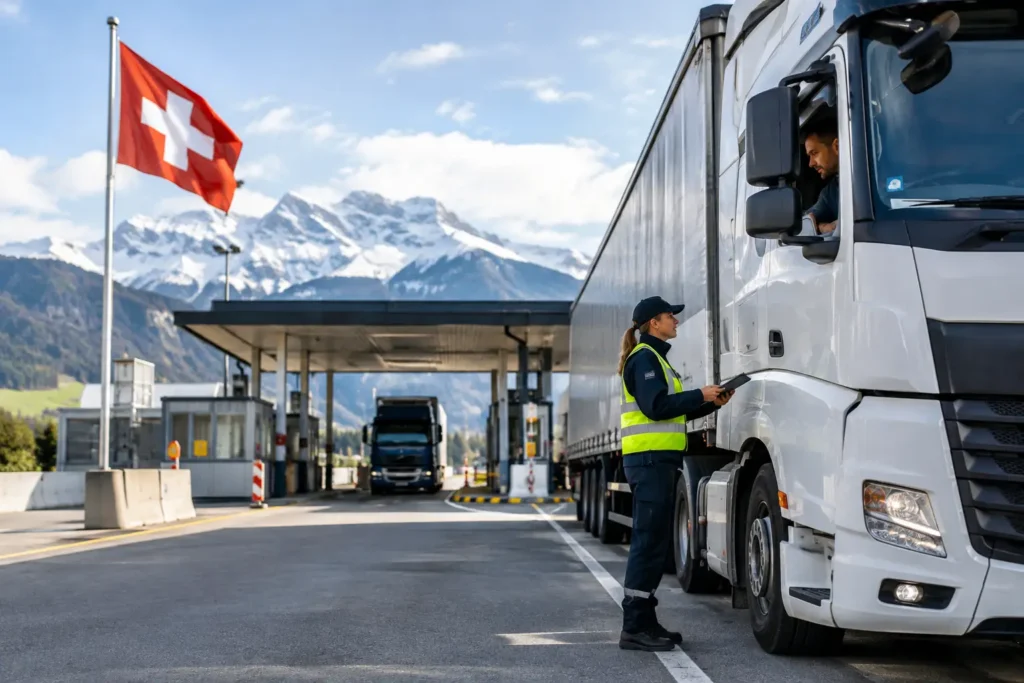
A lorry can arrive at the Swiss border on schedule and still lose a working day because one document does not match the goods on board. For manufacturers and distributors moving parts, machinery, metal products or urgent replacements, that delay can stop a production line or miss a customer delivery slot. A well-managed Swiss clearance case reduces this risk by bringing the transport, commercial and customs information into one verified operational file before collection. The objective is not paperwork for its own sake. It is to give the customs declarant, driver, exporter and importer the same accurate data when timing matters.
What a Swiss clearance case means in road freight
In practical road-freight terms, a Swiss clearance case is the complete set of instructions and evidence needed to move a specific consignment across the EU-Switzerland border and release it correctly. It is not a formal customs regime with one fixed template. It is an operational case file that allows the relevant customs declarations to be prepared, checked and closed without improvisation at the border.
This distinction matters because Switzerland is not part of the EU customs union. Even where a shipment travels only a short distance from France, Germany, Italy or Austria, it is an import or export movement for customs purposes. A carrier cannot treat it like an intra-EU delivery simply because the route is European.
A usable clearance case normally connects the commercial invoice and packing details with the transport plan, commodity information, customs procedure, customs representation instructions and the correct parties of record. Depending on the movement, it may also need proof of origin, licences, preference documentation or evidence linked to returned goods.
The key operational question is simple: can every party describe the same goods, value, quantities and route without contradiction? If the answer is no, the risk is already present before the vehicle leaves.
Why Swiss border delays are rarely caused by the border
Border queues can affect transit time, especially around peak periods, weekends and major Alpine routes. Yet many avoidable delays begin much earlier. The most common causes are a missing tariff classification, an invoice value that does not reflect the shipment, unclear Incoterms, an incomplete consignee address or a mismatch between the packing list and the number of packages loaded.
Swiss import VAT is another reason accuracy matters. Switzerland’s standard VAT rate is 8.1%, so the importer, declarant and commercial team need clarity on the customs value and who is responsible for the charges. A poorly prepared declaration can create queries, corrections and unplanned administration after delivery, not just a hold-up at the frontier.
Consider an urgent shipment of replacement machine components from northern Italy to a production site near Zurich. The goods are loaded at 15:00 for next-morning delivery. The invoice describes “industrial components”, while the packing list shows several product references and the customs instruction gives no commodity codes. The vehicle may physically reach the border overnight, but the clearance cannot be completed confidently. The time-critical service loses its advantage because the customs file was not ready when the transport plan needed it.
For urgent transport, the clearance process must be prepared before the vehicle is dispatched. Sending documents to the driver after collection is not a control method. It is a contingency that often increases risk.
Building a Swiss clearance case before collection
The strongest cases are built from verified shipment data, not copied from a previous movement. Regular lanes can create false confidence: similar goods do not always have the same value, origin, classification, recipient or customs treatment.
Before collection, the shipper should confirm the following information with the importer and customs representative:
- the legal exporter, importer and delivery party, including the correct customs and VAT identifiers where applicable;
- a clear commercial description, commodity codes, quantities, net and gross weight, country of origin and invoice value;
- the agreed Incoterms and who will act as importer of record or bear duty and tax liabilities;
- the transport reference, collection and delivery addresses, vehicle requirements, and whether the goods will move under a transit procedure;
- any product-specific evidence, such as preference documents, licences, declarations of conformity or supporting records for returned goods.
This does not mean every consignment needs the same level of documentation. A standard palletised spare-parts movement has different needs from a high-value machine, a regulated industrial residue or an oversized production unit. The principle is to match the clearance case to the goods and the route, rather than applying a one-size-fits-all checklist.
An operational insight often missed by procurement teams is that the commercial invoice is a customs document as much as a finance document. Vague descriptions such as “samples”, “parts” or “equipment” leave too much room for interpretation. A concise but specific description saves time: what the item is, what it is used for and how it is identified in the seller’s product data.
Choosing the right transport plan for Switzerland
Customs preparation and vehicle selection should be planned together. A groupage movement may be cost-efficient for flexible delivery dates, but it introduces extra handovers and can be less suitable where documents are still being finalised. A dedicated lorry or van gives tighter control over collection, direct routing and document timing, particularly for urgent or high-value consignments.
For time-critical freight, a dedicated express vehicle can collect after a production release and travel directly towards the Swiss delivery point while the pre-agreed clearance process is activated. This can be the right choice for a line-down part, but only if the case file is complete. Express transport cannot compensate for a missing import instruction or an unresolved value discrepancy.
Exceptional shipments require even earlier coordination. An oversized industrial unit may need route permits, loading plans, specialist equipment and customs entries that reflect the actual nature of the goods. If the shipment is split across vehicles or moves under special handling conditions, every reference in the transport and customs records must remain aligned.
The best option depends on delivery urgency, cargo value, shipment dimensions and the customer’s tolerance for handling points. Lowest transport price and lowest supply-chain cost are not always the same thing. A cheaper service that creates a border delay may cost far more in lost production or missed contractual delivery windows.
Who should own the clearance process?
The exporter owns the accuracy of the commercial information. The importer must provide clear instructions on import clearance, tax responsibility and any local requirements. The transport partner coordinates vehicle timing, document handover and status updates. The customs representative submits declarations according to the information and authority granted.
Problems arise when each party assumes somebody else has checked the file. A single named operational contact for each shipment prevents gaps, particularly when a consignment is collected late in the day or crosses the border outside standard office hours.
A practical escalation process should answer three questions before dispatch: who can approve a correction, who can supply missing documents, and how quickly can they respond? This matters on complex routes where a load starts in the UK, transits through the EU and enters Switzerland, or where goods originate in Turkey and move through several customs territories. Each additional customs boundary increases the value of disciplined document control.
For recurring traffic, create a lane-specific clearance profile. Record the usual commodity codes, importer details, preferred border process, document formats and contacts, then review it whenever the goods, supplier or commercial terms change. It speeds up planning without relying on assumptions.
A final check that protects delivery performance
The most useful final check is not “have the documents been sent?” It is “can this consignment be cleared with the information available now?” That question exposes gaps before they become a driver’s problem at the border.
MAP Transport has coordinated European road freight since 1985 and can align collection timing, vehicle type and customs-ready documentation for standard, urgent and exceptional Swiss movements. A clear clearance case gives every party more control, and gives the shipment its best chance of arriving when the customer needs it.
Need support on your transport flows? Contact our team for a tailored solution.
Have a question or need a quote? Contact us at (+34) 943 62 95 77 (ask for Raquel) or by email at lo*******@**********rt.com