
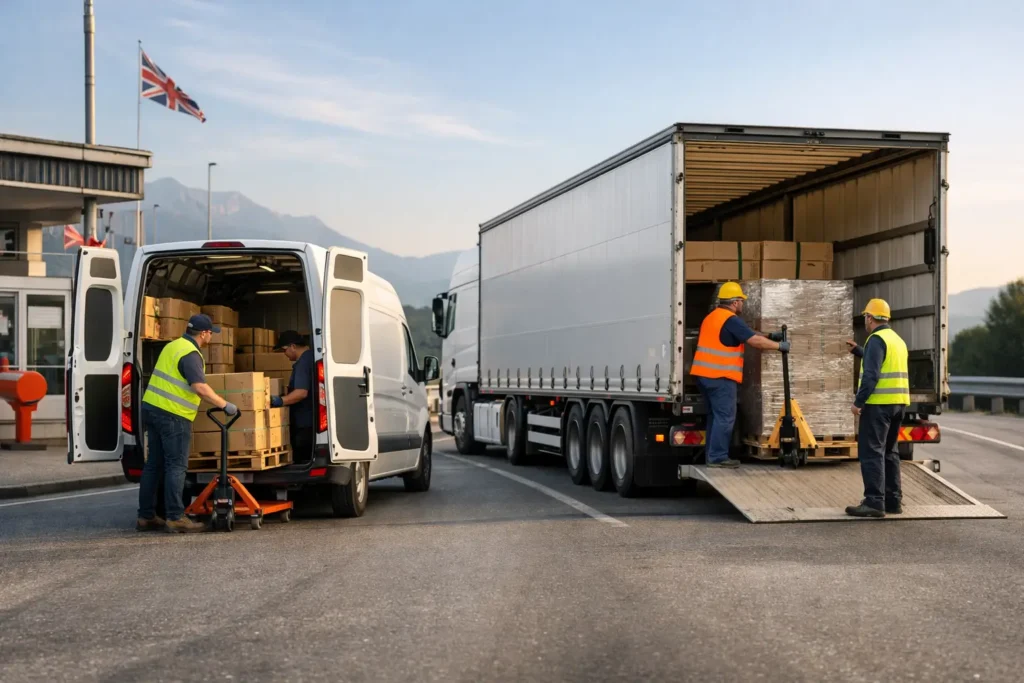
A production line is waiting on one pallet. A customer in Switzerland has booked a delivery slot you cannot miss. A supplier in Germany confirms the goods are ready six hours later than planned. That is where the choice between express freight vs standard road haulage stops being a pricing exercise and becomes an operational decision. For supply chain managers, the real question is not which option is better in theory. It is which service protects delivery performance, cost control and customer commitments on a specific lane, at a specific moment, with the least risk.
When express freight is the right call
Express freight is built for time-critical movements where delay costs more than premium transport. That usually means direct loading, a dedicated vehicle, tighter transit control and less handling on the way. In practical terms, the shipment moves because it must, not because it can wait for network consolidation.
This matters most when the goods are linked to production continuity, shutdown avoidance, urgent export commitments or high-value orders. If a component needed in northern France misses a manufacturing window by half a day, the transport saving from standard haulage can disappear very quickly. According to the European Commission, road freight still carries the majority of inland freight in the EU, which is one reason availability and timing on critical routes directly affect industrial performance rather than just transport budgets. EU road transport data gives useful context on how central road remains to European supply chains.
A typical example is an automotive supplier in northern Spain shipping replacement parts to a plant in Belgium after a machining issue delayed production. With standard groupage or scheduled full-load planning, the earliest departure might be the following day. With express freight, a van or dedicated lorry can collect as soon as the goods are released and drive direct, often cutting a full day from lead time.
That said, speed alone is not the only value. Express freight also reduces touchpoints. Fewer depots, fewer cross-docks and fewer transfers usually mean lower damage risk and better visibility during transit.
If your team regularly handles urgent loads, it helps to work with a specialist in express transport across Europe rather than trying to force emergency shipments into a standard planning model.
Where standard road haulage makes more sense
Standard road haulage is usually the right option when the shipment is predictable, the delivery window is reasonable and transport cost per unit matters more than shaving hours off transit time. It is the backbone of regular import and export flows because it balances service reliability with cost efficiency.
For routine replenishment, supplier schedules and recurring customer deliveries, standard haulage often gives better value. It allows for route planning, load optimisation and vehicle matching that keep spend under control without creating unnecessary urgency. If your consignee can receive on a fixed date rather than at the earliest possible hour, standard service is normally the smarter choice.
This is especially true on stable European corridors where lead times are well understood. A manufacturer sending weekly palletised goods from Italy to the Benelux region does not usually need a dedicated urgent vehicle unless something in the chain has already gone wrong. In that case, paying express rates every time would simply mask planning problems upstream.
There is another point that matters to procurement teams. Standard haulage can support better transport forecasting. With recurring lanes, you can compare actual performance, identify seasonal bottlenecks and align order cut-offs with realistic transit times. That kind of control is harder to build if every difficult shipment becomes an express movement.
For planned international flows, a provider offering tailored road freight services can match the service level to the load rather than pushing every movement into the same solution.
Express freight vs standard road haulage on cost, risk and service
The real comparison between express freight vs standard road haulage comes down to trade-offs.
Express freight is faster, but it costs more because you are paying for immediacy, vehicle availability and direct movement. Standard haulage is cheaper per shipment in many cases, but it usually comes with wider delivery windows and more dependence on planning cut-offs, routing structures and available capacity.
The risk profile is different too. Standard transport may involve transhipment, waiting time or consolidation, which can be perfectly acceptable for many loads but less suitable for fragile, urgent or high-priority goods. Express freight reduces those variables, yet it is not immune to external factors such as border formalities, driver hours rules or weather disruption.
A useful way to assess the right option is to measure the cost of failure, not just the cost of freight. Ask three questions:
- What is the financial impact if the goods arrive one day late?
- Can the consignee accept a delivery range, or do they require a precise slot?
- Will customs, route restrictions or special handling erase the time saved by an urgent dispatch?
If a late arrival triggers production stoppage, contractual penalties or lost sales, express transport is often the lower-cost decision overall. If the shipment is routine and the consequences of a short delay are limited, standard haulage usually wins.
Cross-border routes change the decision
For European shippers, the service choice becomes more complex on routes involving the UK, Switzerland or Turkey. On these lanes, transport speed is only one part of the equation. Documentation quality, customs timing and border coordination can be just as decisive.
Take an urgent shipment from France to the UK. A dedicated vehicle may leave within an hour, but if export and import paperwork are incomplete, the load can still lose precious time at the border. The same applies to Swiss routes, where customs discipline matters even for experienced exporters. On Turkey lanes, transit planning, border waiting times and document checks can significantly affect lead time.
This is why urgent freight needs operational preparation, not just a fast vehicle. The International Road Transport Union regularly highlights how border friction and documentation quality affect transit efficiency on international corridors. IRU provides useful industry context, and for UK movements the latest UK customs guidance remains essential for checking current requirements.
Operationally, one of the most common mistakes is booking express freight before confirming whether the commercial invoice, customs codes and consignee instructions are ready. If the paperwork trails behind the vehicle, urgency is lost before the shipment reaches the frontier.
How to choose the right service for each shipment
A practical decision model works better than a blanket rule. Start with the delivery promise, then work backwards through the operational constraints.
If the shipment supports a line-down event, a missed vessel cut-off, a shutdown or a customer emergency, express freight is usually justified. If it is part of a recurring lane with stable lead times and no severe consequence for a short delay, standard road haulage is likely the better fit.
Then check the variables that often change the answer. Weight and dimensions matter, but so do collection readiness, border formalities, unloading restrictions and whether the consignee can receive outside normal hours. A 300 kg urgent consignment to southern Germany may be ideal for a direct van. A heavier load moving to Turkey may still require urgent treatment, but planning must account for customs and route realities.
The best transport partners will ask for the same details your own team uses to assess risk: origin, destination, dimensions, weight, goods description, collection deadline and required delivery time. That is not admin for its own sake. It is how service level is matched to the actual job.
If you are reviewing flows regularly, it is worth separating shipments into three categories: routine, priority and critical. Routine goes standard. Critical goes express. Priority is where experience matters most, because that is where the trade-off between cost and risk is often hardest to judge.
For companies shipping across complex European routes, speaking to a team that can assess the transport plan before problems escalate can save both time and budget. You can contact a freight specialist when a lane needs a more tailored answer than a standard rate card can provide.
Choosing between express and standard transport is rarely about speed alone. It is about protecting service where it matters, avoiding premium costs where they do not, and making sure the shipment strategy matches the operational reality on the ground. That is where an experienced road freight partner adds value – not by selling urgency, but by knowing when urgency is truly needed.
Need support on your transport flows? Contact our team for a tailored solution.
Have a question or need a quote? Contact us at (+34) 943 62 95 77 (ask for Raquel) or by email at lo*******@**********rt.com