
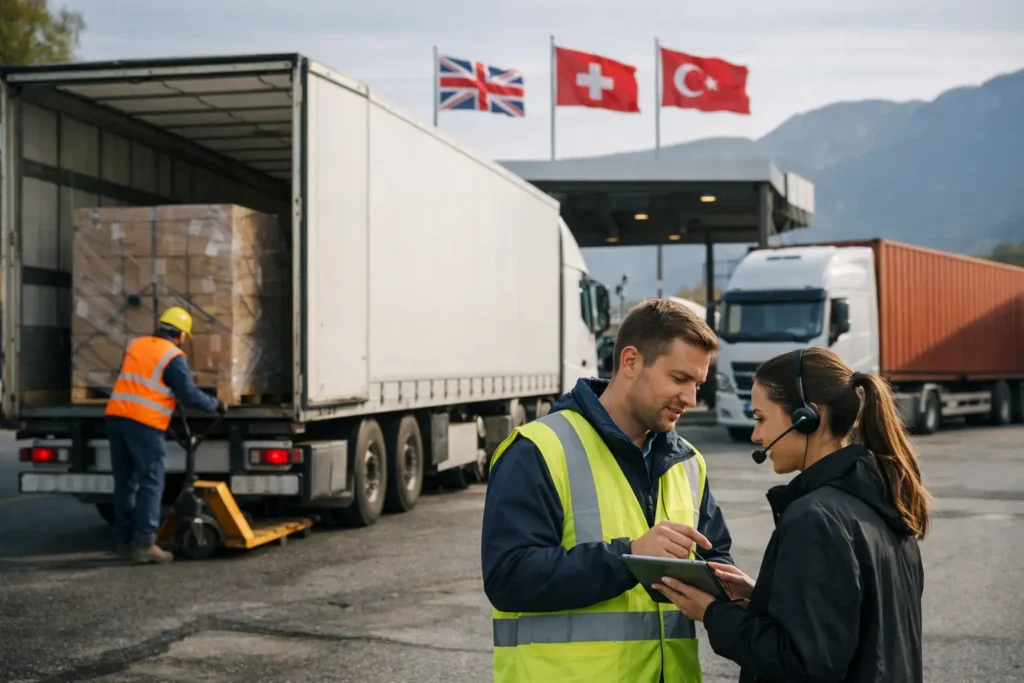
A late Friday collection from northern Spain to Turkey sounds manageable until the paperwork starts arriving in three languages, the consignee changes the unloading slot twice, and customs queries appear after the lorry has already reached the border. For supply chain managers, this is where export transport often stops being a capacity issue and becomes a coordination issue. This case study multilingual freight coordination for exports looks at how one industrial shipment flow reduced delay risk by treating language management as an operational control, not an administrative extra.
The export problem was not capacity – it was communication
The shipper in this case was a mid-sized industrial manufacturer moving palletised components from Spain to a customer site in western Turkey. Volumes were regular but not fixed, with a mix of standard weekly departures and urgent replenishment orders when production plans shifted. On paper, the route was straightforward. In practice, it involved several pressure points: export documentation in Spanish, consignee instructions in Turkish, transit coordination in English, and customs exchanges that could switch between local language and standardised trade terminology.
The business had already experienced the kind of problems many exporters know well. A reference number translated incorrectly on a commercial invoice had triggered a customs check. On another movement, the unloading contact named on the transport instruction was not the same person available on arrival, which left the driver waiting for hours. According to European Commission data, administrative inefficiency remains a material drag on cross-border trade performance, especially where customs and documentary compliance are involved. In road freight, those hours quickly become cost, missed slots, and strained customer relationships.
What mattered here was not simply finding a haulier with route coverage. It was creating one control point that could handle shipper, consignee, customs broker and driver communication without messages being diluted at each handover.
Case study multilingual freight coordination for exports on a Spain-Turkey route
The shipment profile included 14 euro pallets of industrial parts, just under 9 tonnes, moving from the Basque Country to a customer near Istanbul. Delivery was time-sensitive because the consignee had a narrow production window and limited buffer stock. Missing the unloading day would have pushed delivery into the following week.
A standard road freight setup could have moved the goods, but the route required tighter coordination than a simple collection-and-delivery brief. The transport plan had to cover export papers, transit updates, border status, consignee booking, and direct communication with all parties in language they could use confidently. That is where multilingual coordination changed the result.
The operational setup worked in three layers. First, the shipper sent transport and goods data in its preferred language, including commodity description, packing list and invoice details. Secondly, the transport coordinator standardised the information into a single working instruction for the movement. Thirdly, delivery instructions, customs support and progress updates were communicated to each stakeholder in the most practical language for that stage.
This reduced one of the most common export risks: everybody thinks they have understood the same thing, but each party is acting on a slightly different version.
What changed operationally when multilingual control was built in
The biggest improvement was speed of clarification. Instead of forwarding emails from one party to another and waiting for responses to be interpreted informally, the transport team resolved questions at source. When the consignee requested a revised delivery window, the instruction did not pass through three internal departments before reaching the planner. It was checked, translated into action, and confirmed quickly enough to protect the schedule.
That sounds minor until you look at how delays usually build. A border crossing is missed because one reference is unclear. An unloading slot is lost because the local contact does not understand the estimated arrival time. A driver waits because site rules were sent in a language he could not use. None of these failures looks dramatic on its own. Together, they can turn a two-day delay into a customer service problem.
In this case, the shipment reached the delivery area on time, but a customs-side question appeared on the commodity description. Because the transport coordinator could address the issue directly with the exporter and broker, the clarification was issued within the same control window rather than the following day. That kept the consignment moving and avoided storage and standing time charges.
There is a wider lesson here. IRU has repeatedly highlighted that border and documentary friction remain major causes of avoidable delay in international road transport. Language is not the only issue, but it often decides how fast a problem is solved once it appears.
Why this matters for urgent and complex export flows
For routine exports, poor communication is expensive. For urgent transport, it is often decisive. If a manufacturer needs delivery in under 24 hours across part of Europe, or a fast direct vehicle to prevent line stoppage, there is no spare time for message relay and interpretation errors.
The same applies on more complex corridors such as the UK, Switzerland or Turkey, where customs and border formalities create more points of failure than a standard intra-EU run. A missed detail can affect not only transit time but also vehicle utilisation, booking availability and final transport cost. This is why multilingual coordination should be viewed as part of risk management.
A useful operational insight from this case is that language capability works best when it sits close to execution, not as a separate support function. If the person updating the shipment can also understand the commercial context, customs sensitivity and delivery urgency, decisions happen faster. If language support is detached from operations, you gain translation but lose momentum.
That distinction matters for supply chain managers comparing offers. A lower rate may look attractive, but if communication failures add a day at the border or create avoidable waiting time at destination, the real cost picture changes quickly.
The measurable impact of multilingual freight coordination
The shipment in this case moved without delivery-day slippage despite a mid-transit documentation query and a late consignee instruction change. More importantly, the shipper used the same model for subsequent export flows because it reduced internal workload. Their team spent less time chasing updates, rechecking consignee details and correcting document mismatches.
The practical gains were clear:
- Faster resolution of customs and document questions
- Lower risk of misunderstanding between exporter, broker and consignee
- Better protection of unloading appointments
- Fewer internal emails and less reactive escalation
For many businesses, that last point is underestimated. Transport performance is not measured only by whether the lorry arrives. It is also measured by how much management attention the shipment consumes while in transit. A transport flow that constantly needs intervention is already costing more than it appears on the rate sheet.
This is particularly relevant for exporters serving customers across several European markets, where one order may involve French-speaking site contacts, Spanish shipping teams, English-speaking planners and Turkish consignees. The freight itself may be standard. The coordination is not.
What supply chain managers should test in their own export setup
If your export flows involve customs formalities, urgent delivery windows or multiple stakeholder languages, the first question is not whether your carrier can cover the route. It is whether they can control information with the same discipline they apply to vehicle planning.
Start by looking at where errors actually occur. If most issues appear around commercial invoices, consignee instructions, booking confirmations or border communication, you are dealing with a coordination gap. If your team is repeatedly stepping in to explain basic shipment facts to different parties, your transport process is relying too heavily on internal firefighting.
A stronger setup usually includes one accountable contact, clearly standardised shipment data before departure, and proactive updates during transit in language the receiving party can act on. On urgent movements, that becomes even more important because there is less tolerance for ambiguity.
For exporters working across Europe and into Turkey or other customs-sensitive corridors, this is one of the clearest areas where a specialist road freight partner adds value. The right support does not just move the load. It reduces the number of points where delay, cost and confusion can enter the shipment.
That is often the difference between a transport supplier and a transport partner. After 40 years of handling international road freight, including urgent and complex export routes, MAP Transport understands that communication discipline is part of delivery performance. Need support on your transport flows? Contact our team for a tailored solution.
Have a question or need a quote? Contact us at (+34) 943 62 95 77 (ask for Raquel) or by email at lo*******@**********rt.com