
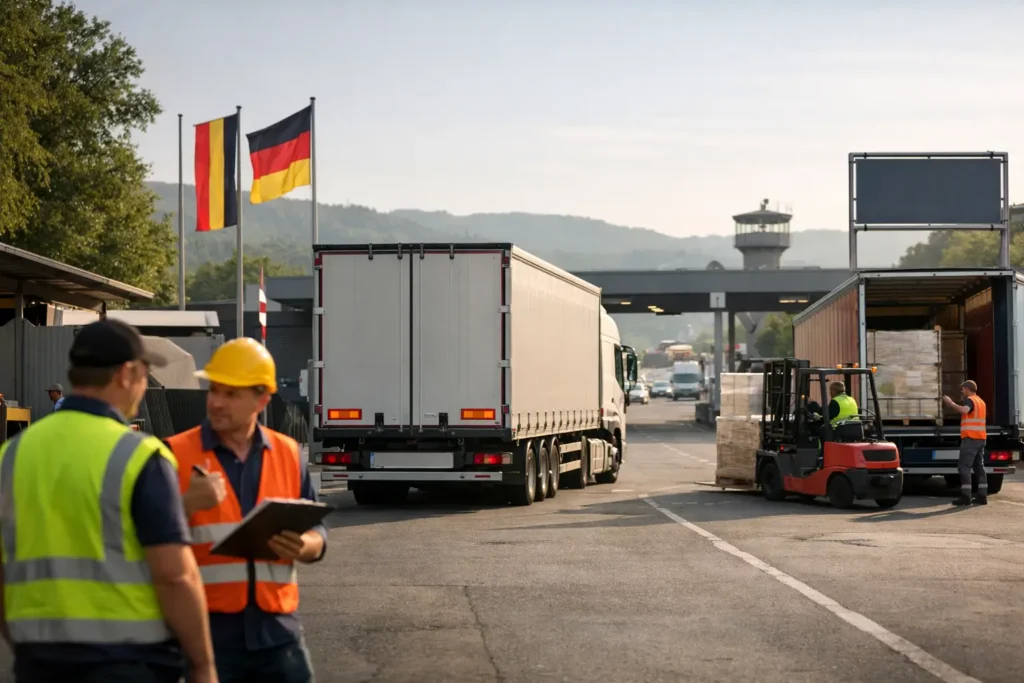
When a delivery slot in Stuttgart is missed, the problem rarely stays in transport. Production plans shift, unloading windows disappear, and urgent replacement moves start eating into margin. That is why road freight to Germany needs more than a rate and a vehicle. It needs planning that reflects German delivery discipline, regional restrictions, customs requirements where relevant, and the real cost of delay. For supply chain managers moving industrial goods, components or urgent replenishment loads, Germany is a high-opportunity market – but also one where weak execution is noticed quickly.
Why road freight to Germany demands tighter planning
Germany sits at the centre of European manufacturing and distribution. That creates volume, but it also creates pressure. Motorway congestion around major industrial corridors, stricter delivery booking systems, environmental zones in urban areas and plant-specific receiving rules all affect transit reliability.
According to the European Commission, Germany remains one of the EU’s largest trading economies, which helps explain why capacity can tighten quickly on key lanes. In practice, this means a shipment from Spain, France, Benelux or Italy may look simple on paper, yet still run into avoidable delay if the collection timing, route plan or unloading conditions are not checked in detail.
A common example is a standard palletised industrial shipment booked on a broad delivery day rather than a fixed unloading slot. If the consignee operates a strict booking system and the lorry arrives outside the accepted window, the load may wait until the next available slot. The transport itself was completed, but the delivery performance still failed.
This is where operational discipline matters. Before dispatch, it helps to confirm not only the address, but also the consignee’s unloading hours, site access limits, equipment requirements and whether the reference numbers on the CMR and booking match the warehouse system.
The main risks in road freight to Germany
The biggest risks are rarely dramatic. More often, they are small planning gaps that build into a missed delivery.
Congestion is an obvious issue, especially around the Ruhr, Frankfurt, Hamburg, Munich and the approach routes from neighbouring countries. Driver hours and weekend restrictions also affect timing. If a shipment is planned too tightly, there is little room to recover once the route starts slipping.
Documentation is another pressure point. For intra-EU flows, paperwork is lighter than on customs-controlled routes, but that does not mean it is casual. Incorrect references, vague goods descriptions or missing delivery instructions can still slow down receipt. For movements involving the UK, Switzerland or Turkey before final delivery into Germany, customs quality becomes even more critical. One weak handover at the border can affect the whole downstream schedule.
There is also the issue of cargo fit. A general trailer may be fine for routine freight, but not every shipment should move the same way. Urgent spare parts, high-value goods, oversized industrial items and sensitive materials each require different planning logic. Using the wrong vehicle type or service level often looks cheaper at booking stage and more expensive by delivery day.
One operational insight that experienced shippers already know: the cheapest route is not always the lowest-cost move. If a load needs a timed delivery to avoid production downtime, paying for express road transport is often more economical than absorbing a line stoppage.
Choosing the right service level for Germany-bound shipments
A standard road service works well for many recurring flows into Germany, especially when lead times are realistic and the consignee has flexibility. For routine exports of industrial products, components or packed goods, the focus should be on reliable departure planning, shipment visibility and clear milestone communication.
Urgent freight is different. If a supplier misses a production release on Thursday and the German plant needs the parts on Friday morning, standard groupage logic will not solve the problem. This is where dedicated express transport becomes valuable. A van or direct lorry movement can reduce handling points and shorten decision time. In some cases, delivery within hours is the difference between a controlled recovery and a costly shutdown.
Then there are exceptional shipments. Heavy, oversized or non-standard goods moving into Germany often involve route checks, permit planning, loading constraints and consignee-specific handling rules. These jobs cannot be treated as a larger version of a standard shipment. They need separate preparation from the start.
At MAP Transport, this service logic is built around the shipment rather than forcing every load into the same model. A standard consignment, a time-critical part and a complex out-of-gauge movement should not be planned in the same way because the risk profile is different.
Customs and compliance – especially on complex routes
If your goods move directly from one EU country into Germany, customs may not be the central issue. But many supply chains are not that straightforward. Goods can originate in the UK, pass through Switzerland, or come via Turkey before continuing by road into Germany. That changes the operational picture.
For these routes, border planning is part of delivery planning. Commercial invoices, origin data, commodity codes, transit documents and consignee details must align. If they do not, the lorry may be physically ready to continue while the paperwork is not.
The German customs framework itself is clear, but the challenge is often upstream. Errors made at origin usually appear at the border. HMRC, Swiss customs procedures and the EU customs environment all need to be considered when freight is moving on multi-country corridors. For operators shipping regulated, sensitive or high-value goods, confidentiality and document accuracy become even more important.
A concrete example: a supplier in the UK sends urgently needed machine components to southern Germany. The collection is on time, but the export data and invoice wording do not fully match the goods description. The vehicle reaches the border and waits while clarification is requested. The road leg was fast, yet the total lead time still fails because customs preparation was weak.
This is why experienced freight partners check documents before the vehicle starts moving, not halfway through the route.
Practical ways to reduce delays and protect margin
The most effective improvements are usually operational, not theoretical. Start by matching lead time promises to the actual route. If the consignee requires a morning booking in Bavaria, build in enough margin for traffic, legal driving limits and unloading formalities rather than planning to the last hour.
Next, verify site conditions early. Germany has many industrial sites with strict receiving processes. Check whether the delivery requires side unloading, a tail lift, specific PPE, pre-booking, named references or vehicle size limits. A lorry that cannot access the site is not a transport success, even if it reached the postcode.
Shipment data quality also matters more than many teams expect. Weight, dimensions, packaging type and goods description should be accurate at quote stage. This supports correct vehicle allocation and reduces last-minute changes. It is especially important for exceptional loads and urgent shipments where there is little time to correct errors once the vehicle is dispatched.
Finally, establish a clear escalation path. If timing starts slipping, the consignee and shipper need fast, precise updates. Silence creates more disruption than bad news delivered early. Supply chain teams can often reorganise labour or unloading capacity if they know the real ETA in time.
What good execution looks like on Germany lanes
Good execution is not just on-time delivery. It is control from quotation to receipt. That means a quick response at booking stage, realistic transit advice, suitable vehicle selection, document checks, active monitoring and communication that tells the customer what matters – not just that the vehicle has departed.
For a logistics manager, the real test is whether the transport partner reduces workload or adds to it. If your team has to chase updates, correct paperwork, re-explain the consignee’s rules and manage every deviation alone, the transport is not being managed properly.
Germany rewards consistency. Buyers and plants expect precise information, dependable timing and professional handover. That applies whether the freight is a routine industrial flow into Nordrhein-Westfalen, an urgent delivery to a production site near Munich, or a specialist movement arriving from Turkey through a customs-controlled route.
After 40 years in European road transport, MAP Transport has seen that the strongest freight plans are usually the clearest ones: right service level, right vehicle, right documents and informed at any time of the progress. That is what keeps road freight to Germany commercially efficient, not just physically moving.
If your Germany-bound flows involve time pressure, customs exposure or non-standard cargo, it pays to resolve those risks before dispatch rather than explain them after a missed slot.
Need support on your transport flows? Contact our team for a tailored solution.
Have a question or need a quote? Contact us at (+34) 943 62 95 77 (ask for Raquel) or by email at lo*******@**********rt.com