
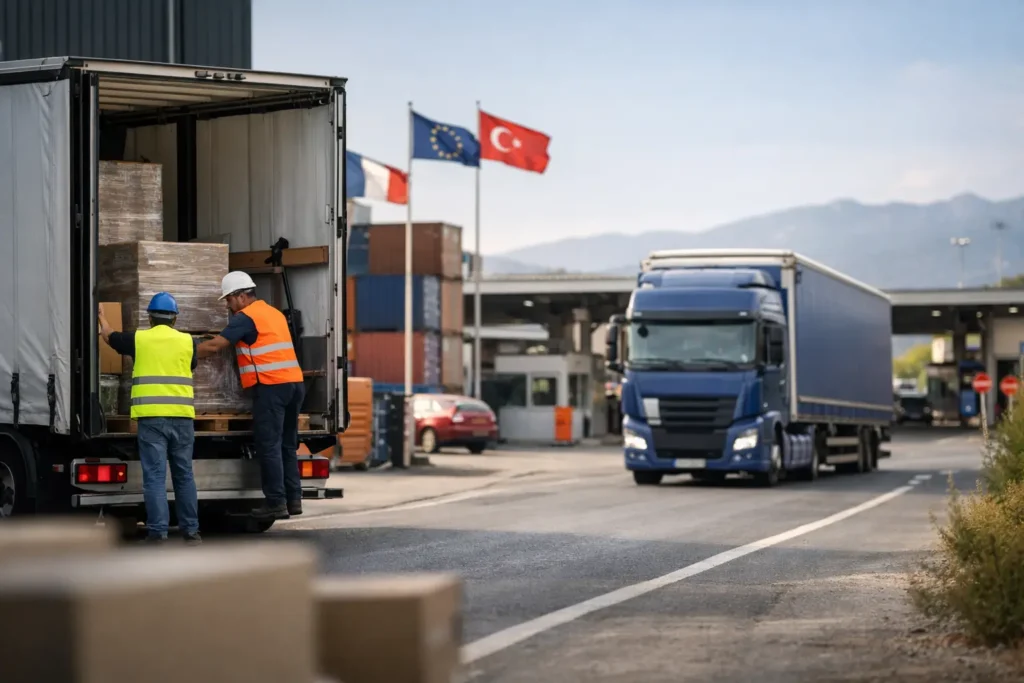
A production line rarely stops because of one dramatic failure. More often, it slows down through small transport misses – a late customs document, the wrong vehicle type, a missed delivery slot, or a carrier that cannot react when a shipment suddenly becomes urgent. That is where industrial supply chain transport is won or lost. For supply chain managers moving metal parts, industrial components, machinery or regulated goods across Europe, the challenge is not simply getting freight from A to B. It is keeping service levels intact while routes, lead times and border conditions keep changing.
Why industrial supply chain transport breaks under pressure
Industrial freight has very little tolerance for vague planning. If a supplier in northern Italy misses a plant delivery in Belgium by half a day, the cost is rarely limited to the freight itself. It can affect assembly sequencing, subcontractor schedules and customer commitments further down the line.
The pressure is even higher on cross-border flows with customs or route constraints. UK traffic still demands close attention to documentation and timing. Switzerland adds its own compliance considerations outside the EU customs framework. Turkey can be highly efficient when managed properly, but only when documentation, transit planning and communication are aligned from the start. On these lanes, transport performance depends less on headline transit time and more on how well the movement is prepared.
According to the European Commission, road freight remains the dominant inland freight mode in Europe by volume, which means congestion, driver availability, border queues and local restrictions continue to shape delivery performance. In industrial environments, these variables matter because transport is part of production continuity, not just distribution.
The real cost of poor fit in industrial supply chain transport
One of the most common problems in industrial supply chain transport is using a standard service for a non-standard requirement. That sounds obvious, yet it happens constantly. A shipment may be too urgent for a conventional grouped movement, too sensitive for loose handling, or too awkward in size for a generic loading plan.
The result is not always visible on day one. Sometimes the load moves, but with extra handling, more waiting time or greater damage risk. In other cases, planners discover too late that the collection point has specific loading constraints, or that the consignee requires precise delivery timing and pre-alerts.
A practical example: a manufacturer shipping replacement machine components from Spain to southern Germany may initially book a standard road movement. If the parts are needed to restart production after an equipment failure, standard timing is no longer the right choice. The right move is an urgent dedicated vehicle with direct routing, active follow-up and contingency planning. Paying more for the transport can save far more in avoided downtime.
This is where vehicle choice matters. Vans, dedicated lorries and specialist equipment should be matched to the cargo and timing requirement, not selected on habit. The cheapest line on a rate sheet can become the most expensive decision once delays, failed deliveries or rehandling are added.
How to build resilience into transport flows
Supply chain managers do not need abstract resilience plans. They need transport flows that cope with change without creating fresh problems. In practice, that starts with visibility before the load even moves.
Collection and delivery requirements should be confirmed in operational detail: weight, dimensions, loading method, packaging condition, access restrictions, customs status and delivery deadline. This sounds basic, but many transport failures begin with incomplete booking data. A quote that arrives quickly has value only if it reflects the real shipment conditions.
The next step is mode and service alignment. Standard road freight works well for repeatable flows with stable lead times. Urgent shipments need a different operating model – direct transport, tighter tracking and immediate response if something changes en route. Oversized or heavy industrial freight requires route checks, permit planning and loading control long before departure.
There is also a communication point that gets underestimated. Industrial customers do not just want tracking data. They want accountability. If a delay risk appears at the border or on a long-haul route, the useful response is not silence followed by a late arrival. It is early escalation, a revised ETA and a clear corrective plan.
Customs and border friction on industrial routes
For many European manufacturers and distributors, the hardest transport flows are not the longest ones. They are the ones with customs exposure. Industrial supply chain transport across the UK, Switzerland and Turkey demands clean paperwork and disciplined coordination.
On UK traffic, even minor document errors can create queue time, storage charges or rejected entries. On Switzerland lanes, shipments need to be structured around non-EU customs formalities, with attention to invoice data and commodity details. Turkey adds another layer where transit planning and border processing can directly affect lead-time reliability.
The International Road Transport Union has repeatedly highlighted how administrative friction and border inefficiency can disrupt road freight performance. For an industrial shipper, the operational lesson is straightforward: customs is not a paperwork afterthought. It is a transport planning issue.
A useful approach is to review border-sensitive shipments against three questions before booking. Is the commercial documentation complete and consistent? Is the service selected realistic for the route and border crossing? Is there a named operational contact following the movement from loading through to delivery? If any one of those is weak, the risk of delay rises quickly.
When urgent transport becomes the least costly option
Some procurement teams still treat urgent transport as a last resort that signals planning failure. Sometimes that is fair. But in industrial operations, urgent transport is often the correct commercial decision.
If a plant is waiting on a critical component, if a customer delivery must be protected, or if a line stoppage costs thousands per hour, speed changes the cost equation. A dedicated express vehicle moving a pallet overnight from France to the Netherlands may look expensive in isolation. Compared with lost production, penalty charges or damaged customer confidence, it may be the cheapest option available.
This is especially true for cross-border movements where handovers increase risk. Direct transport reduces touchpoints, shortens decision chains and gives operations teams a clearer picture of what is happening. It also allows faster intervention if route conditions change.
An operational insight here is that urgency should be defined by business impact, not by emotion. Not every late order needs an express vehicle. But every shipment linked to production continuity deserves a proper escalation rule. The companies that manage this well separate genuine critical freight from routine pressure and then assign the right service accordingly.
What dependable transport partners do differently
Industrial shippers usually do not need more promises. They need fewer surprises. A dependable road freight partner helps by making the planning stage more precise and the execution stage more visible.
That means asking the right questions early, giving a realistic quote, selecting the right vehicle, and staying involved during transit. It also means understanding the routes where problems are most likely – border crossings, difficult delivery sites, remote industrial areas, ferry-dependent corridors and lanes with recurring customs friction.
For companies moving freight across Europe and into Turkey or the Caucasus, that practical experience matters. A standard movement to a major hub and a specialist delivery to a more complex destination should not be managed in the same way. Tailored service is not a marketing phrase in industrial transport. It is often the difference between a clean delivery and a costly exception.
MAP Transport has built its work around that principle since 1985, supporting industrial customers with standard road freight, time-critical movements and exceptional shipments where dimensions, urgency or route complexity require closer control. For supply chain managers, the value is simple: faster decisions, clearer follow-up and transport that fits the shipment instead of forcing the shipment into a standard model.
The strongest transport flows are rarely the cheapest on paper or the most elaborate in theory. They are the ones that keep production moving, reduce avoidable risk and give your team a reliable answer when timing suddenly matters. Need support on your transport flows? Contact our team for a tailored solution.
Have a question or need a quote? Contact us at (+34) 943 62 95 77 (ask for Raquel) or by email at lo*******@**********rt.com