
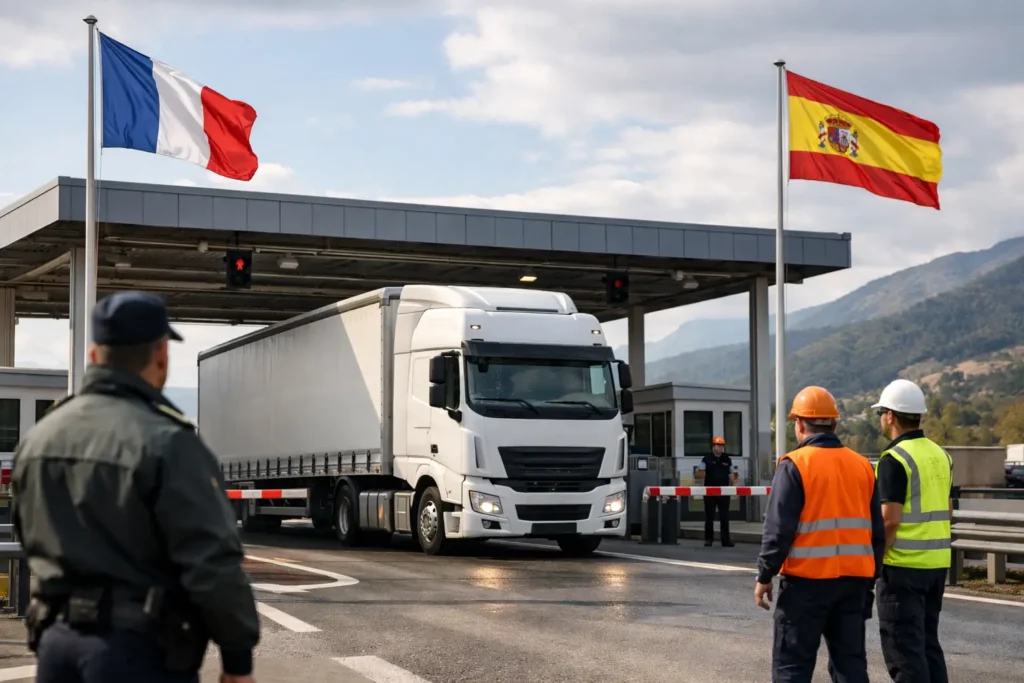
A pallet missing its delivery slot in Barcelona can stop a production line just as quickly as a customs hold-up on a UK route. That is why France-Spain freight transport is rarely just a mileage question. For supply chain teams, the real issue is keeping lead times predictable while managing driver hours, border corridor pressure, seasonal peaks and the right vehicle for the load. If you move industrial goods between France and Spain regularly, small planning errors can turn into missed appointments, extra storage costs or urgent premium shipments that should have been avoided.
Why France-Spain freight transport looks simple on paper
On paper, this is one of the more straightforward European road corridors. France and Spain are connected by mature motorway networks, high freight volumes and established crossing points through the Pyrenees. There is no external customs border between the two countries, which removes one major source of delay found on routes involving the UK, Switzerland or Turkey.
But operationally, the lane can still become unstable. Congestion around key transit points, weekend traffic restrictions, port-related overflow, regional strikes and weather disruption in mountain areas can all affect delivery windows. If your consignee books narrow unloading slots, a delay of three hours is not minor. It can mean rebooking, additional handling or a full-day slip.
This matters because Spain is one of the EU’s largest trading partners for France. According to Eurostat, Spain and France remain among each other’s most important intra-EU goods markets, which means the corridor is busy by default, not just at peak season. High volume is good for capacity access, but it also means the best transport plans are the ones built around timing discipline rather than optimistic transit assumptions.
The route choices that affect cost and delivery performance
Most France-Spain freight transport movements run through the eastern or western Pyrenean corridors, depending on origin, destination and load type. A shipment from Lyon to Zaragoza does not need the same routing logic as a consignment from Lille to Madrid. Treating both with the same planning model is where unnecessary cost begins.
The eastern corridor often supports faster access for flows linked to Perpignan, Barcelona and wider Mediterranean destinations. The western option may make more sense for freight moving towards Bilbao, Burgos or northern Portugal connections. The right choice depends on delivery slot, road restrictions, toll exposure and where the vehicle needs to be next.
There is also a trade-off between direct dedicated transport and grouped freight. If the load is urgent, high value or tied to production continuity, a dedicated van or full-load vehicle can reduce handling risk and improve control. If the freight is stable, less time-sensitive and moves on repeat schedules, a more cost-led approach may work. The mistake is choosing the cheapest structure first and then trying to manage service risk afterwards.
A practical example: an industrial supplier shipping replacement machine parts from Toulouse to Valencia may save little by consolidating if the consignee needs unloading before midday next day. In that case, the real cost metric is not transport alone. It is transport plus the commercial impact of downtime.
Urgent freight between France and Spain needs a different model
Urgent shipments on this corridor are common, especially for automotive, industrial, food-adjacent packaging and manufacturing support flows. When a component is missing, the question is not whether express transport costs more. It is whether the load arrives in time to prevent a much bigger operational loss.
This is where vehicle selection matters. A dedicated van is often the right answer for smaller, time-critical loads because it reduces waiting time, transhipment risk and route deviation. For larger urgent consignments, a direct full-load solution can still be faster overall than trying to force the freight into a standard network.
The operational insight here is simple: urgency should be assessed against the consignee’s real cut-off, not the shipper’s warehouse readiness. A collection at 16:00 only works if the route, legal driving time and unloading plan support the promised arrival. Experienced transport partners build backwards from the delivery commitment, not forwards from collection convenience.
For companies that move critical freight across Europe, this is why tailored services matter. A standard movement, an express run and an exceptional load should not be managed as if they carry the same risk profile. On MAP Transport’s express transport service, the model is designed for time-critical deliveries within hours or under 24 hours where feasible, which is a very different operational promise from regular planned traffic.
Where delays really happen in France-Spain freight transport
Because there is no customs clearance between France and Spain for standard intra-EU movements, many buyers focus only on linehaul time. In reality, delays often happen at the points surrounding the journey rather than at the border itself.
Collection readiness is one of the biggest issues. Freight that is not labelled correctly, dimensions that differ from the booking, or loading bays that are not ready can remove the margin needed for on-time delivery. Delivery-side constraints are equally common. Many Spanish and French sites work with strict appointment systems, limited unloading windows or site-specific access rules for industrial estates.
There are also cases where customs still becomes relevant indirectly. If the goods are entering France or Spain from outside the EU before onward road delivery, or if the shipment includes documents linked to regulated materials, returns or temporary movements, paperwork discipline remains critical. For current EU customs guidance, the European Commission’s customs resources are one of the most reliable references for compliance checks before dispatch.
A useful rule for supply chain managers is to treat documentation as part of transit time, not as an admin afterthought. If the transport order lacks accurate weight, dimensions, commodity detail or delivery contact information, the risk does not disappear because the route is intra-EU. It simply appears later as a preventable delay.
Matching the vehicle to the load reduces hidden cost
A recurring issue on this lane is poor fit between shipment profile and vehicle choice. Too much capacity increases cost. Too little capacity creates compliance and handling risk. The right answer usually sits in the middle and depends on pallet count, dimensions, fragility, urgency and unloading conditions.
For standard industrial freight, a classic road freight set-up is usually the most efficient option when lead times are realistic and volume is stable. For high-priority parts or sample shipments, a van-based express solution can protect delivery windows better than a larger vehicle with intermediate stops. For oversized machinery, long steel pieces or non-standard units, the transport plan needs specialist handling from the start, not a standard booking with exceptions added later.
This is where many procurement teams save money over time rather than on a single move. A tailored transport plan avoids repeated surcharges, failed collections and damage claims. It also improves communication because everyone is working from the same shipment reality.
If your flows include standard, urgent and difficult cargo across Europe, it helps to work with one partner that can switch service model without losing visibility. MAP Transport structures this through classic, express and exceptional shipment services, allowing the vehicle and service level to fit the job rather than forcing every load into the same template.
What supply chain managers should check before booking
The most effective France-Spain freight transport bookings are usually the most disciplined ones. Not complicated, just precise. Before confirming a movement, it is worth checking four points that have a direct effect on service quality:
- the exact collection and delivery windows, not just the dates
- the real shipment dimensions and weight, including any overhang or irregular packaging
- whether the consignee requires booking references, PPE rules or site access instructions
- whether the shipment is standard, urgent or exceptional in operational terms
This level of detail is especially useful when requesting a quote. It helps the carrier select the right vehicle quickly and avoids revisions later. If your team needs a no-obligation quote for European road freight, providing these shipment fields upfront usually leads to faster planning and fewer surprises.
For wider market context on driver shortages and pressure on road freight operations, IRU’s industry reporting remains a strong benchmark. It reinforces a point that logistics teams already feel in practice: capacity exists, but dependable capacity goes to the best-prepared shipments first.
A final point worth keeping in mind is communication. On a corridor as active as France-Spain, silence creates risk. Proactive updates matter more than polished dashboards when an unloading slot is approaching. Buyers want to know if the load is on time, what changed if it is not, and what the recovery plan looks like.
Strong France-Spain freight transport is built on realistic planning, quick reaction and the discipline to match service level to shipment risk. That is where an experienced road freight partner adds value, especially when routine traffic suddenly becomes urgent or non-standard. Need support on your transport flows? Contact our team for a tailored solution.
Have a question or need a quote? Contact us at (+34) 943 62 95 77 (ask for Raquel) or by email at lo*******@**********rt.com