
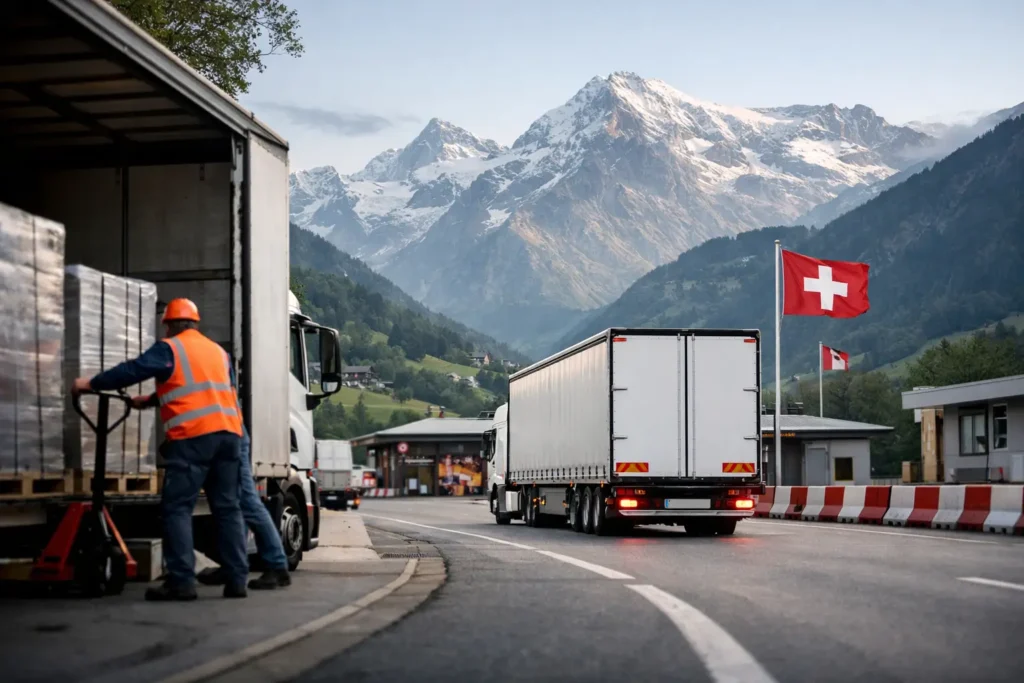
A lorry can cover the final kilometres to Basel on schedule and still lose half a day at the border because one document does not match the goods on board. That is the reality of road freight to Switzerland. For supply chain managers, the issue is rarely the driving time alone. The real pressure sits in customs clearance, vehicle planning, delivery slot accuracy and what happens when a shipment is urgent, high value or awkward to handle. If the route is treated like a standard intra-EU move, delays and avoidable cost usually follow.
Why road freight to Switzerland needs tighter planning
Switzerland is one of Europe’s most reliable trading partners, but from a transport perspective it is not a simple extension of the EU network. It sits at the centre of major European road corridors, yet every cross-border movement requires proper customs handling. That changes how you plan lead times, paperwork and handover responsibilities.
For a logistics manager, the risk is not theoretical. A missing tariff code, an incorrect invoice value or unclear description of goods can stop a vehicle at the border and affect production, customer delivery windows or downstream distribution. According to the European Commission, Switzerland remains among the EU’s largest trading partners, which means border flows are significant and congestion or control issues can have a real operational effect when documentation is weak.
The practical point is simple: road freight to Switzerland works best when customs and transport are planned together, not as separate tasks. Vehicle dispatch, document review and delivery booking need to sit in the same timeline.
Customs is usually the point of failure
Most delays on Swiss routes do not start on the road. They start in the office, before collection. Switzerland is outside the EU customs union, so standard commercial documents must be precise and consistent. That includes the commercial invoice, packing list, commodity descriptions, weights, values and consignee details. Depending on the shipment, transit formalities and supporting certificates may also be needed.
This is where experienced operators reduce risk. A good freight partner checks whether the paperwork matches the cargo reality before the vehicle reaches the border. That sounds basic, but it is often where time is won or lost.
A common example is industrial goods moving from northern Spain to a consignee near Zurich. The collection can be completed on time, the route through France can be smooth, and yet the shipment still stalls if the declared goods description is too generic or the invoice does not align with the packing details. In practice, even a few hours of delay can create missed unloading slots, overnight parking cost or disruption to a production line waiting for components.
For current customs guidance and trade formalities, operators should work from official sources such as the Swiss Federal Office for Customs and Border Security and the European Commission trade pages. Those frameworks matter because border compliance is not something you can fix reliably once the vehicle is already queuing.
The right service level matters more than the lowest rate
Not every shipment to Switzerland should move the same way. Cost matters, but service fit matters more when the route involves customs and strict delivery expectations. A standard full load, a palletised urgent shipment and an oversized industrial unit each create different planning demands.
For routine flows, a classic road freight setup is often the right balance. It gives enough structure for document checks, route planning and controlled delivery timing. For urgent cargo, the logic changes. If a production site is short of a critical part, sending a dedicated van or direct vehicle can protect far more value than the transport price alone. In those cases, the discussion should focus on downtime avoided, not just freight spend.
There is also the issue of exceptional shipments. Large, heavy or non-standard goods moving into Switzerland may need permits, specialist loading arrangements or route validation. Treating that kind of move like ordinary groupage is where projects go off course.
This is why tailored service design matters. The vehicle should fit the shipment, not the other way round. A partner used to handling both standard and urgent cross-border work can make that call quickly, based on dimensions, loading constraints, delivery deadline and customs profile.
Transit time is only one part of delivery performance
Buyers often ask first about transit time. Fair enough. But on Swiss routes, delivery performance depends on four linked factors: collection discipline, border readiness, route timing and consignee coordination. If one of those slips, the promised transit time becomes irrelevant.
An operational insight that often gets overlooked is delivery slot management. Some Swiss consignees run tight booking systems and limited unloading windows. If the haulier arrives after a border delay and misses the slot, the shipment can roll into the next available window rather than unloading immediately. That can turn a manageable customs issue into a full-day service failure.
Road freight to Switzerland therefore needs active milestone control. The transport team should know when the goods are collected, whether customs documentation has been validated, when the vehicle is approaching the border and whether the consignee is still ready to receive. The International Road Transport Union has repeatedly highlighted how border procedures and waiting times affect road freight efficiency across Europe. That is not abstract policy – it directly affects inventory availability and customer commitments.
For urgent movements, real-time communication becomes even more valuable. If a vehicle is carrying a replacement machine part to Geneva for next-morning delivery, the consignee needs updates early enough to adjust labour or unloading plans if timing changes.
Common mistakes that add cost on Swiss routes
Some problems appear again and again in road freight to Switzerland. The first is assuming EU habits still apply. They do not. Customs changes the process. The second is booking too late for the complexity of the move. When paperwork, collection and delivery constraints are compressed into a narrow window, error rates go up.
The third mistake is poor shipment data at quotation stage. If the carrier receives incomplete weights, dimensions or goods descriptions, the wrong vehicle can be assigned or the customs preparation can start from weak information. That creates rework, and rework costs money.
The fourth is underestimating urgency. If a shipment is genuinely time-critical, it should be planned as such from the beginning. Trying to rescue an urgent order inside a standard transport setup usually ends up being slower and more expensive than arranging a dedicated express solution from the start.
A useful working checklist includes these points:
- Confirm exact goods description, values and weights before collection.
- Check whether the consignee has fixed delivery slots or site restrictions.
- Match the vehicle type to the shipment profile and urgency.
- Build customs clearance into the lead time, not after it.
- Escalate time-critical loads early so the transport plan reflects the real business risk.
What a reliable Swiss freight setup looks like
The strongest transport flows into Switzerland tend to share the same characteristics. Shipment data is complete from the start. Customs documents are checked before dispatch. Communication is handled by people who can react quickly if the border situation changes. And the customer is informed at each stage, rather than chasing for updates.
That matters for both recurring and one-off traffic. A manufacturer shipping regular industrial loads to Swiss customers needs consistency and low exception rates. A distributor moving an urgent spare part needs speed and accountability. In both cases, confidence comes from operational control, not sales language.
Since 1985, MAP Transport has built its work around that kind of control – selecting the right vehicle, coordinating documents, managing urgent movements and keeping customers informed throughout the journey. For companies moving goods into Switzerland, that is often the difference between a transport supplier and a true freight partner.
Road freight to Switzerland rewards preparation. When customs, timing and service level are aligned, the route is efficient and dependable. When they are not, even a short delay can spread quickly across purchasing, production and customer delivery plans.
If your Swiss flows involve tight deadlines, complex goods or pressure on cost and reliability, it pays to review the setup before the next shipment leaves the loading bay. Need support on your transport flows? Contact our team for a tailored solution.
Have a question or need a quote? Contact us at (+34) 943 62 95 77 (ask for Raquel) or by email at lo*******@**********rt.com