
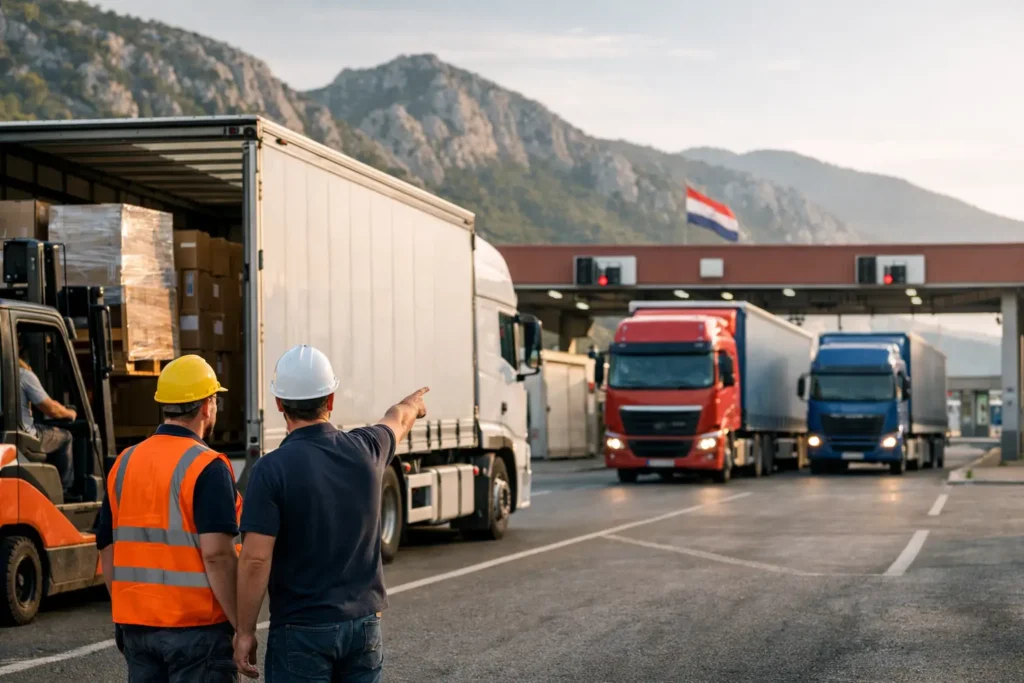
A late delivery into Zagreb or a missed collection from Rijeka rarely comes down to one big failure. More often, it is a chain of smaller issues – the wrong vehicle booked, border formalities underestimated, delivery slots not aligned, or an urgent shipment treated like standard freight. That is why Croatia freight transport needs more than route coverage. It needs operational judgement. For supply chain managers moving goods between Croatia and the rest of Europe, the real challenge is keeping lead times predictable while controlling cost, especially when customs, urgent orders or specialist loads are involved.
Why Croatia freight transport needs careful planning
Croatia sits in a strategically useful position for European road freight, linking Central Europe, the Balkans and Adriatic port flows. That creates opportunity, but it also means transport planning can become complicated quickly. A shipment moving from northern Italy to Croatia may be straightforward. A movement from Spain, France or Benelux into Croatia is different – longer mileage, tighter delivery windows and a greater chance that one small disruption affects the whole schedule.
Road freight remains the practical choice for many industrial flows because it offers direct control over transit time, routing and vehicle allocation. Yet control only exists if the shipment is planned around the real conditions on the ground. According to Eurostat, road carries the vast majority of inland freight in the EU, which tells you something important: when networks are busy, capacity decisions matter. If your transport partner reacts slowly or assigns the wrong equipment, delays are rarely recovered later in the journey.
This is especially relevant for manufacturers, distributors and procurement teams working with fixed production schedules. If components arrive half a day late, the transport cost is not the main issue anymore. The real cost is downtime, customer service pressure and emergency replanning.
The main pressure points on Croatia routes
Croatia freight transport often looks simple on paper, but several operational variables can turn a routine movement into an expensive one.
Border and customs formalities still matter
Croatia is in the EU and the Schengen Area, which has simplified many flows within the Union. But not every route touching Croatia is an intra-EU movement. If your freight comes via Turkey, Serbia, Bosnia and Herzegovina, Switzerland or the UK before reaching Croatia, documentation quality becomes critical. Errors in commercial invoices, commodity descriptions or supporting papers can hold a lorry far longer than the driving time lost in traffic.
For companies moving goods on mixed corridors, the mistake is assuming all Croatia-bound freight should be treated the same way. It should not. A load from Germany to Split is not managed like a load from the UK to Osijek. The customs exposure, lead time risk and document checks are different from the outset.
Seasonal traffic and port-related congestion
Croatia’s geography brings another layer of planning complexity. Coastal areas can face seasonal pressure, especially when freight movements overlap with tourism peaks and port activity. Collection and delivery windows may tighten, and transit reliability can vary by region. A route into inland industrial zones will not behave in the same way as a time-sensitive delivery closer to the coast.
Vehicle fit matters more than many buyers expect
One common source of avoidable cost is booking a full-sized vehicle for freight that would move faster and more economically in a van, or trying to place a difficult load into standard service when it actually needs specialist equipment. The shipment profile should decide the vehicle, not the other way round. That sounds obvious, but it is still where many disruptions begin.
Choosing the right service level for Croatia shipments
Not every load into or out of Croatia needs the same transport model. The right answer depends on the commercial consequence of delay.
For routine industrial freight, standard road transport is often the most balanced option. It gives you controlled cost and stable planning if lead times are realistic and booking is made early enough. This works well for replenishment flows, finished goods distribution and recurring import movements.
Urgent shipments are different. If a production line is waiting for parts, or a customer order has moved from important to critical, a standard groupage or scheduled linehaul approach may simply be too slow. In those cases, dedicated express road transport can protect far greater downstream value than its rate suggests. Delivery within hours, or in under 24 hours on selected European lanes, changes the decision framework. The question is no longer “what is the cheapest rate?” but “what is the cost of not recovering the delay?”
Then there are oversized or non-standard loads. Machinery, industrial components and heavy equipment moving to Croatian sites often require route checks, special handling and more coordination with loading and unloading points. Treating those shipments as ordinary road freight is where compliance and timing risks start to multiply.
A practical example: when urgency changes the transport plan
Consider a manufacturer in northern Spain shipping a replacement industrial component to a production site near Zagreb. The original plan may have been a standard road movement, but the receiving plant reports that downtime costs several thousand euros per hour. At that point, the transport brief changes completely.
Instead of waiting for a standard consolidation cycle, the shipment may need a dedicated vehicle collected within hours, with direct transit and live follow-up from collection to delivery. If dimensions are manageable, a smaller dedicated vehicle can often save time on positioning and route flexibility. If the freight is larger or requires special securing, the planning team needs to balance speed against load safety and legal constraints.
The operational insight here is simple: urgency is not just about driving faster. It is about cutting idle time before departure, reducing handovers and matching the vehicle to the shipment from the start. That is where experienced road freight coordination makes a measurable difference.
How to reduce cost and delay risk on Croatia freight transport
The most effective way to improve Croatia freight transport performance is not to chase one perfect route. It is to remove preventable friction before the lorry leaves.
First, give complete shipment data at quotation stage. Weight, dimensions, loading method, goods description, origin, destination and required delivery time are not administrative details. They determine whether the quote reflects the real job or creates problems later.
Second, separate urgent freight from standard freight early. Many delays happen because a genuinely time-critical shipment is still handled under routine decision rules for too long. If the commercial impact of lateness is high, escalate the service level immediately.
Third, review customs and compliance exposure on any route that is not purely intra-EU. Even one border crossing outside standard EU movement can change the paperwork requirement and lead time risk. Guidance from the European Commission and IRU consistently shows that document accuracy remains one of the biggest controllable factors in cross-border road transport performance.
Fourth, account for regional delivery realities. Industrial sites, urban restrictions, coastal timing pressures and limited unloading resources can all affect last-mile execution in Croatia. A realistic ETA is better than a theoretical one that fails on the day.
What experienced shippers look for in a Croatia transport partner
For supply chain managers, the real test is not whether a provider can quote a Croatia lane. Many can. The test is whether they can manage exceptions without losing control of cost, communication or delivery time.
That usually means three things. First, fast and accurate response at booking stage. If a quote arrives quickly but misses a key transport constraint, it is not really fast. Second, proactive follow-up during transit, especially for urgent or cross-border movements. Third, the flexibility to handle standard loads, express shipments and exceptional freight under one operational structure.
This is where a specialist road freight partner adds value. Since 1985, MAP Transport S.A. has managed European freight flows with exactly that service logic – matching the transport solution to the shipment rather than forcing the shipment into a fixed model. For companies shipping to or from Croatia, that matters most when time is tight, the route is mixed, or the load is not straightforward.
Croatia freight transport works best when planning is realistic, communication is direct and the service level fits the business impact of the shipment. If your flows include urgent deliveries, customs-sensitive corridors or non-standard loads, the safest option is usually the one that is managed closely from the first call, not the one that only looks cheaper at quotation stage.
Need support on your transport flows? Contact our team for a tailored solution.
Have a question or need a quote? Contact us at (+34) 943 62 95 77 (ask for Raquel) or by email at lo*******@**********rt.com