
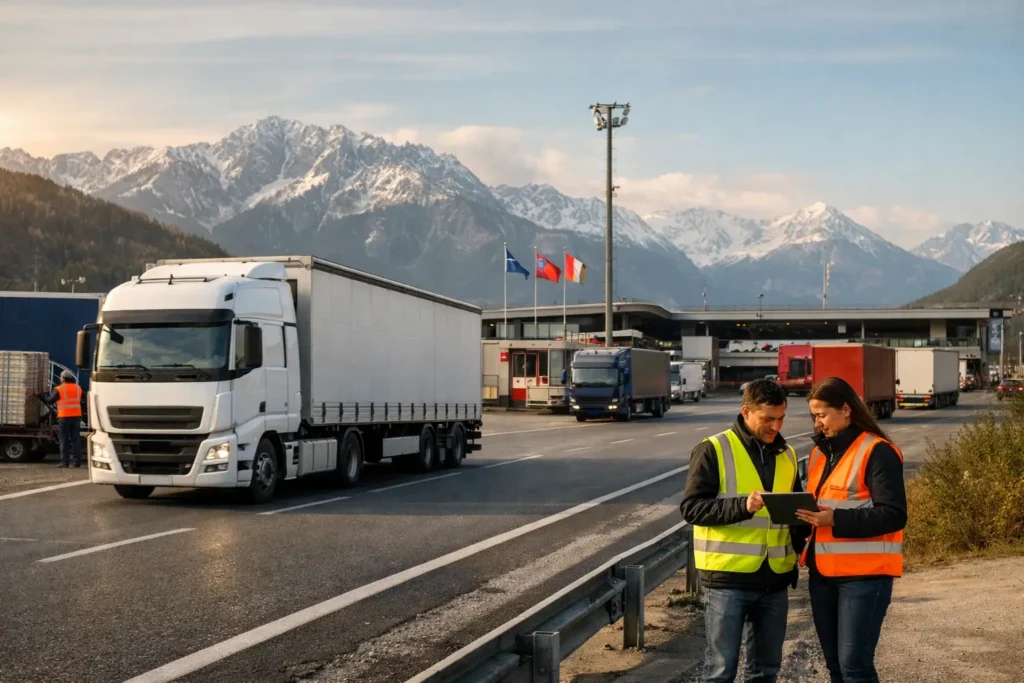
A late collection from northern Italy can still reach Germany the next day. The same shipment can lose two days if its paperwork is incomplete at the UK border or if a carrier cannot secure the right vehicle at short notice. That is the practical context behind road freight trends 2026. For supply chain managers, the issue is not simply finding a lower rate. It is protecting delivery dates, production schedules and customer commitments while capacity, border procedures and route risks continue to change.
Capacity will remain selective, not simply scarce
The road haulage market is unlikely to become uniformly tight or uniformly available in 2026. Capacity will vary sharply by corridor, equipment type, collection day and required transit time. A standard groupage movement may be easy to arrange on one lane, while a dedicated lorry for an urgent collection from Spain to Switzerland is difficult to source within the same afternoon.
Driver availability remains a structural constraint. IRU has reported a shortage of more than 400,000 lorry drivers across Europe, and the issue is not resolved by a slower industrial cycle. An ageing workforce, uneven recruitment and restrictions around rest periods continue to affect the real availability of experienced drivers. The consequence for shippers is operational: the most reliable capacity will increasingly be booked by businesses that provide clear information and predictable loading requirements.
This does not mean every load should be planned weeks ahead. It means transport planning should distinguish between routine lanes and critical lanes. A manufacturer shipping palletised components weekly from France to the UK can use a scheduled plan. A machine supplier facing a line stoppage in Belgium needs a pre-agreed escalation route for a dedicated van or express lorry.
The most useful question for 2026 is not, “What is the cheapest rate?” It is, “What capacity is genuinely available for this shipment profile, and what happens if the first plan fails?”
Road freight trends 2026 put border readiness first
Customs remains one of the largest sources of avoidable delay on European road movements. This is particularly true on UK, Swiss and Turkish routes, where a vehicle can be physically ready to move but unable to clear a border because a document, commodity detail or customs reference is missing.
In 2026, border performance will depend increasingly on the quality of shipment data provided before collection. Product descriptions that say only “parts” or “samples” create unnecessary questions. Incorrect values, incomplete Incoterms details, missing importer references and poorly aligned commercial invoices can stop a vehicle at exactly the point when a consignee expects delivery.
Consider an urgent shipment of replacement industrial parts from the Midlands to a production site near Zurich. The vehicle may cover the driving distance comfortably within the required time window. But if the invoice does not clearly identify the goods, value, origin and responsible customs party, the transport becomes a border-management problem rather than an express delivery.
Supply chain teams should review the handover between sales, finance, customs and transport. In many businesses, the delay does not start with the carrier. It starts when shipment-critical information is requested after the vehicle has already been booked.
For regular non-EU flows, create a shipment data standard that includes commodity description, tariff classification where applicable, gross weight, package count, value, Incoterms, exporter and importer details, and the relevant customs references. It should be checked before collection, not while the lorry is approaching the border.
Urgent transport will be judged by control, not speed alone
Urgent freight is growing more specialised. The expectation is no longer merely that a vehicle leaves quickly. Customers want to know which vehicle has been assigned, whether it is direct, what border process applies and when they will receive a meaningful progress update.
That raises the standard for Xpress and UltraExpress movements. A dedicated van can be the right choice for a small, high-value consignment that must arrive within hours. A lorry may be more appropriate for heavier equipment or a larger number of pallets, even where the delivery is time-critical. The right answer depends on dimensions, loading access, customs requirements and the cost of delay at the destination.
An operational insight worth applying: do not classify a shipment as urgent only by its requested delivery time. Classify it by the consequence of failure. A load that is needed to restart a production line deserves direct transport, proactive monitoring and a named escalation contact. A shipment needed for a customer launch may require the same treatment, even if the journey itself is not exceptionally long.
In 2026, the strongest urgent transport plans will include a realistic cut-off time, an agreed documentation owner and a contingency option if the collection point is delayed. Speed without control is simply expensive uncertainty.
The 2026 road freight trends that affect cost planning
Road freight costs will continue to be shaped by more than diesel prices. Tolls, wage pressure, equipment positioning, compliance costs and waiting time all influence the final cost of a route. This is why two apparently similar quotes can carry very different operational assumptions.
For procurement teams, the practical response is to compare service scope as well as headline price. Does the quotation include a dedicated vehicle or a consolidated movement? What transit time is being promised? Is customs coordination included for a UK, Swiss or Turkish movement? Are loading restrictions, booking slots and delivery conditions known? A lower price can be valid, but only when the underlying service matches the shipment’s risk profile.
Carbon reporting will also become more visible in transport decisions. Many industrial shippers are already being asked to provide emissions information to their customers or internal sustainability teams. For road freight, this should encourage better consolidation and fewer avoidable empty kilometres, but it should not lead to unrealistic routing choices. Combining shipments can reduce cost and emissions on a stable lane. It can also create a serious commercial risk if it compromises a production-critical delivery date.
The trade-off is straightforward: optimise routine freight for utilisation, and protect critical freight for certainty. Treating both in the same way usually increases either cost or delay.
Four actions to take before peak demand arrives
The most effective preparation is specific enough to be used by the people booking freight every day. Before 2026 demand peaks, review the following areas with your transport partners:
- Map your critical lanes. Identify routes where a missed delivery affects production, contractual penalties or a major customer. Include non-EU movements such as the UK, Switzerland and Turkey, where border processes add time and risk.
- Set shipment-data ownership. Confirm who supplies invoices, customs references, loading details and contact numbers. If responsibility is unclear, it will become clear only when something goes wrong.
- Define an express escalation process. Agree the information required for an urgent quote: collection and delivery postcodes, ready time, weight, dimensions, goods description, customs status and delivery deadline.
- Review exceptional-load requirements early. Oversized, heavy or non-standard shipments may need permits, specialist equipment, route checks or loading plans. They should not be treated as standard freight with a larger vehicle.
These actions improve more than transport performance. They give purchasing and operations teams a clearer basis for deciding when a standard service is sufficient and when the cost of a tailored solution is justified.
Build transport plans around exceptions, not averages
Average transit times can be useful for budgeting, but exceptions are where supply chains lose money. A Friday collection, a border inspection, a late loading slot or an incorrectly declared shipment can turn an apparently simple movement into a costly recovery exercise.
For companies moving goods across Europe, the better model is to pair routine planning with responsive support for the loads that do not fit the routine. That may mean a standard road freight plan for regular volumes, direct express transport for a breakdown-critical consignment, or specialist coordination for exceptional dimensions. MAP Transport has worked with these different shipment profiles since 1985, coordinating tailored road movements across 45 countries and on more complex routes beyond the EU.
The useful closing thought for 2026 is this: resilience is not paying for premium transport on every shipment. It is knowing which loads cannot absorb delay, preparing their information properly and having a transport partner ready to act when the plan changes.
Have a question or need a quote? Contact us at (+34) 943 62 95 77 (ask for Raquel) or by email at lo*******@**********rt.com
Need support on your transport flows? Contact our team for a tailored solution.