
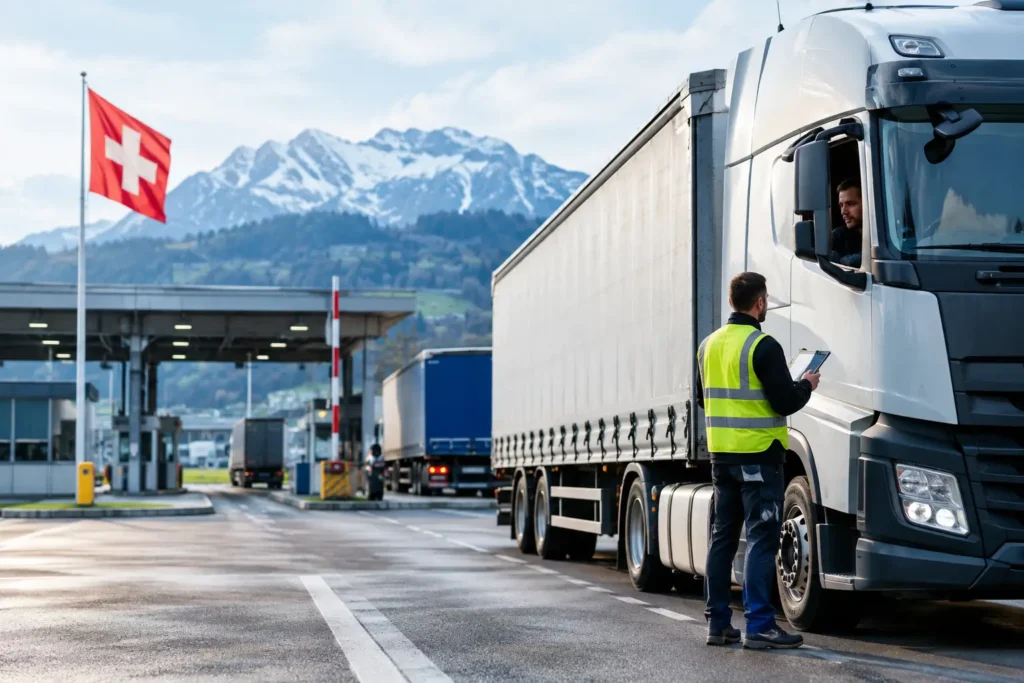
A guide to Incoterms for road transport becomes valuable when a lorry is booked, the goods are ready, and nobody can clearly answer who pays for customs clearance, import duty or unloading. On straightforward EU movements, that uncertainty may be resolved quickly. On UK, Swiss or Turkish routes, it can stop a shipment at the border, create unplanned charges and put a delivery slot at risk. Incoterms do not replace a transport plan, but they establish the commercial responsibilities that make that plan workable. For supply chain managers, selecting the right rule is a practical decision about cost exposure, control and delivery-time certainty.
Why Incoterms matter on road freight routes
Incoterms are International Chamber of Commerce trade rules that define the respective responsibilities of seller and buyer in a sales contract. The current Incoterms 2020 set contains 11 rules. Seven can apply to any transport mode, including road freight, while four are designed only for sea and inland waterway transport.
For international road transport, the most relevant question is not simply who pays the freight charge. The chosen term determines where risk transfers, who arranges export and import formalities, and which party must provide particular documents or information.
This distinction matters most where customs borders are involved. A movement from France to Germany does not normally require import customs clearance. A movement from Spain to the UK, Switzerland or Turkey does. If the contract says one thing, the customs declaration says another and the carrier receives incomplete instructions, the consignment may be held while parties decide who is the importer of record or who must settle duties and VAT.
Operationally, Incoterms should be agreed before the transport quote is requested. A freight partner needs the rule, named place, commodity, value, weight, dimensions and customs status to plan the right vehicle, transit timing and border process.
The Incoterms most used for road transport
EXW: low seller involvement, high buyer risk
Under Ex Works, the seller makes goods available at its premises or another named location. The buyer takes on almost all subsequent cost and risk, including loading in many cases, export formalities and transport.
EXW can look attractive to a seller because it limits responsibility. In cross-border road freight, however, it often creates avoidable problems. The buyer may not be well placed to complete export declarations in the seller’s country, particularly where local tax or customs representation is needed. The seller also has less visibility over whether goods have genuinely left the country, which can complicate VAT evidence.
For a UK-bound shipment from a German manufacturer, EXW may work where the buyer has established customs processes and a trusted freight partner. It is less suitable when the buyer cannot manage export formalities from Germany or expects the seller to load and release the goods for collection.
FCA: often the stronger option for collections
Free Carrier is frequently more practical than EXW for road freight. The seller delivers goods, cleared for export where required, to the carrier or another party nominated by the buyer at the named place. If that place is the seller’s premises, the seller loads the vehicle.
That makes FCA a sensible choice for regular export flows into the UK, Switzerland or Turkey. The buyer can retain control of main-carriage costs and the onward transport provider, while the seller handles the export process within its own jurisdiction. The named place must be precise: “FCA seller’s warehouse, Bilbao, Spain, Incoterms 2020” is operationally clearer than simply “FCA Bilbao”.
CPT and CIP: seller pays carriage, risk transfers earlier
Carriage Paid To means the seller arranges and pays transport to a named destination, but risk transfers when goods are handed to the first carrier. CIP follows the same structure, with the seller also arranging insurance at the specified level.
These terms can be misunderstood because the seller pays for transport beyond the point where risk has transferred. They work well when the seller can negotiate reliable freight capacity but the buyer accepts transit risk after collection. For urgent production parts, the arrangement should be made explicit: who authorises an express van if a delay threatens a line stoppage, and who bears the incremental cost?
DAP and DPU: delivery responsibility without import duties
Delivered at Place places transport and delivery responsibility on the seller until the goods reach the agreed destination, ready for unloading. The buyer manages import clearance and pays import duties and taxes. Under Delivered at Place Unloaded, the seller is also responsible for unloading.
DAP is commonly suitable for road deliveries into the UK or Switzerland where the buyer is established to import goods and has its own duty and VAT arrangements. It gives the seller control of the transport chain while avoiding the need to act as importer in the destination country.
DPU requires careful planning. A standard curtain-sided lorry is not automatically equipped to unload a heavy machine, industrial coil or oversized component. If unloading equipment, site access or a specialist vehicle is needed, the responsibility must be reflected in both the Incoterm and the transport instructions.
DDP: maximum seller responsibility, not always the best service
Delivered Duty Paid puts the greatest responsibility on the seller. The seller arranges delivery, import clearance and payment of duty and taxes at the destination. It can provide a simple buying experience, but it requires the seller to have a viable customs and tax structure in the importing country.
DDP should never be selected merely because it sounds customer-friendly. On routes into the UK, Switzerland and Turkey, an unprepared seller may struggle to act as importer of record, recover VAT or meet local registration requirements. In many cases, DAP is the safer commercial solution because the consignee clears the import while the seller still controls the transport to site.
Using Incoterms on complex customs routes
The term alone does not clear a border. Customs declarations still need accurate commercial data, commodity classification, origin, value, invoices and transport references. The Incoterm tells each party what it is expected to arrange, but it does not cure missing or inconsistent documentation.
Consider a Spanish industrial supplier delivering replacement equipment to a production site near Birmingham. The sale is agreed as DAP, the buyer is the UK importer, and an urgent van is booked because downtime is costing the site money. Before collection, the parties need to confirm that the buyer’s import instructions are ready, the invoice shows the correct Incoterm and named place, and the carrier has the documentation needed for the UK border process. If that is only checked after the vehicle has departed, the speed of the transport service is largely wasted.
Turkey adds another layer of attention. Customs formalities, transit arrangements and consignee readiness need to be planned around the actual route and cargo. For movements through Scandinavia, timing also depends on ferry connections, border timings and the availability of the right vehicle. The commercial term should support those realities, not sit separately from them in a purchase order.
How to choose the right rule before requesting a quote
Start with control. If the buyer wants to nominate the carrier and manage the freight contract, FCA is usually more workable than EXW for international collections. If the seller needs to protect a committed delivery date and control the transport from collection to site, DAP may be more appropriate, provided the buyer is ready to import.
Then assess customs capability. The party taking import responsibility must be able to provide importer details, customs instructions and a method for paying duty and VAT. A DDP commitment without that structure creates risk for both the commercial relationship and the vehicle at the border.
Finally, define the delivery point in operational terms. A postcode alone is not enough for high-value, time-critical or exceptional freight. State whether the site can accept an articulated lorry, the available delivery hours, unloading arrangements, contact details and any security restrictions. This avoids a common failure point: a correctly cleared shipment arriving at a site that cannot receive it.
A practical handover to your freight provider should include:
- the agreed Incoterm and exact named place;
- collection and delivery addresses, opening times and site constraints;
- commodity, packing, weight, dimensions and cargo value;
- customs contacts, importer details and document status; and
- the required delivery date, including whether an express contingency is authorised.
Incoterms guide for road transport: common errors to avoid
The most expensive mistakes are usually small wording errors made early in the order process. Naming a city rather than a delivery point leaves room for dispute. Using EXW when the seller is actually loading and managing export clearance creates a mismatch between the contract and the operation. Choosing DDP without confirming tax and import arrangements can leave goods waiting at destination customs.
Another frequent error is assuming that risk, cost and control all transfer at the same point. They do not always. Under CPT, for example, the seller pays for carriage to the agreed destination but risk transfers at handover to the first carrier. Procurement teams should reflect this in insurance, claims procedures and communications with the consignee.
For exceptional shipments, the issue is even more specific. A DPU delivery may require lifting equipment, permits, timed access or an escorted movement. The transport plan must establish these points before a vehicle is allocated, rather than treating unloading as a site matter to be resolved on arrival.
Make Incoterms part of the transport plan
The right Incoterm reduces arguments. The right transport plan prevents delays. Both are needed when freight is moving through customs borders, serving a fixed production slot or carrying a load that cannot simply be rebooked for the following day.
With 40 years of international road freight experience, MAP Transport helps shippers align collection, customs coordination, vehicle selection and delivery requirements across complex European routes. The useful question is not which Incoterm is most familiar, but which one gives each party a realistic and accountable role in the shipment.
Need support on your transport flows? Contact our team for a tailored solution.
Have a question or need a quote? Contact us at (+34) 943 62 95 77 (ask for Raquel) or by email at lo*******@**********rt.com