
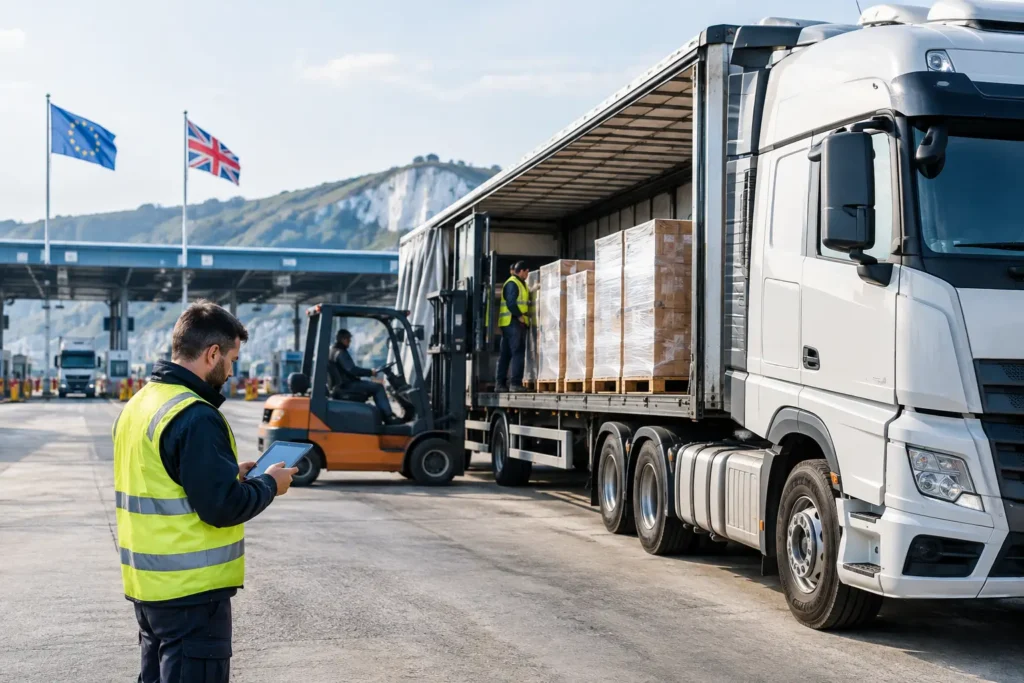
A lorry returning without freight is not simply an inefficient journey. It is a cost exposure that can quickly affect the rate on the outbound movement, particularly when capacity is tight, border processes are unpredictable or delivery windows leave little room for planning. To optimise return-load transport costs, supply chain teams need to look beyond a single shipment price and manage the full lane: collection timing, equipment choice, customs readiness and the probability of securing compatible freight for the return leg. This matters most on cross-border routes where a missed collection or document error can remove the margin from an otherwise well-priced load.
Start with lane-level visibility, not individual rates
A return-load strategy works when it is built around repeatable flows. Reviewing each transport request in isolation makes it difficult to see where vehicles are consistently returning empty, waiting too long after delivery, or being used for freight that does not fit the lane economically.
Begin by mapping regular outbound and inbound movements by origin, destination, frequency, weight, loading metres, pallet count and required delivery date. Then identify whether the transport is truly balanced. A manufacturer sending full loads from northern Spain to the UK twice a week, for example, may have an opportunity to move components, packaging or finished goods back into France, Spain or Portugal. But this only works if the return collection window is realistic after customs clearance and delivery.
Eurostat has consistently reported that around one fifth of road freight vehicle-kilometres in the EU are run empty. That figure shows the scale of the issue, but it should not lead to a simplistic target of filling every return journey. A low-value backload that causes a missed onward collection, excessive detention or a customs delay can cost more than an empty repositioning.
The useful measure is contribution per lane, not whether every kilometre carries freight. Review the following operational indicators together: loaded versus empty kilometres, waiting time after delivery, quote acceptance by route, accessorial charges, border delay and on-time delivery performance. This gives procurement and transport teams a clearer basis for deciding where a return-load programme will genuinely reduce spend.
Optimise return-load transport costs through better timing
The most economical return load is often lost before a quote is requested. Late shipment information limits vehicle options and forces the planner to accept whatever capacity is available after delivery. This is especially relevant for urgent production movements, where the pressure to deliver in a few hours can outweigh any chance of coordinating the return.
A practical approach is to provide a forward view of likely collections, even where final quantities are not yet confirmed. A weekly forecast with provisional collection dates lets a transport partner position suitable capacity around the outbound delivery. Final weights and dimensions can follow once production is complete.
Consider a machinery supplier delivering a 13.6-metre trailer from Belgium to Birmingham on a Thursday morning. If the next UK collection is only released after unloading, the driver may face an unproductive wait or return empty. If a compatible collection from the Midlands to Benelux is visible two or three days earlier, the planner can schedule delivery, customs formalities and collection slots around the same vehicle. The result is not just a lower return cost. It is better asset use without compromising the customer delivery.
Timing is more complex for the UK, Switzerland and Turkey because the return movement may depend on export declarations, transit documents, commercial invoices and proof of origin. Build document cut-off times into the plan. A vehicle ready at the loading bay but waiting for corrected paperwork is no longer a flexible return-load option.
Match the vehicle to the freight and the return lane
Using the largest available vehicle can appear economical when the outbound shipment fills it. Yet the same equipment may be unsuitable for the return market. A full trailer dispatched for a heavy industrial consignment may have few compatible backload opportunities if the return area mainly offers small, time-sensitive shipments. Conversely, a van or dedicated express vehicle can be the right commercial decision when production downtime costs more than a conventional groupage solution.
Vehicle selection should therefore consider both legs before booking. The relevant question is not only, “What can carry this shipment?” It is, “What equipment can serve this movement while retaining useful options after delivery?”
This is particularly important for exceptional shipments. An oversized load may require specialist permits, routing and escort arrangements. Trying to attach a standard return-load expectation to that operation can create false savings and unnecessary risk. The focus should instead be on minimising positioning distance, coordinating specialist equipment availability and securing confirmed loading dates.
For standard freight, flexibility can improve the result. If the freight can travel as palletised groupage rather than occupying a dedicated trailer, it may fit a return movement already planned for the lane. If a delivery slot can move by several hours, capacity matching becomes easier. These choices should be agreed internally before the transport tender is issued, rather than negotiated at the point of collection.
Protect savings with customs and border discipline
Return-load transport costs rise quickly when a vehicle becomes stuck at a border or cannot be loaded because the documents do not match the goods. For movements involving the UK, Switzerland, Turkey or the Caucasus, customs planning is part of cost control, not an administrative afterthought.
The risk is often greatest on the return leg. Teams may prepare carefully for an export from the EU, then treat the inbound movement as routine. Differences in commodity codes, invoice values, consignee details, licences or transit requirements can create delays that affect the next scheduled collection.
Use a pre-departure control process that confirms the commercial invoice, packing list, EORI details, customs representation instructions and any route-specific requirements. For regulated goods or industrial residues, verify that the correct supporting documentation is available before the vehicle is assigned. This is a small discipline with a large operational effect: a lorry released on time remains usable capacity; a lorry held at the border becomes an unplanned cost.
It also pays to separate urgent transport from standard return-load planning. An UltraExpress movement may need to depart immediately to prevent a production line stoppage. Attempting to wait for a return match would be the wrong decision. The cost should be assessed against the value of preventing downtime, while the next regular lane movement can be planned to restore balance.
Build return-load rules into procurement and daily operations
Return-load optimisation is not a one-off sourcing exercise. It requires clear rules between procurement, production planning, loading teams and the transport provider. Without those rules, a low rate can be undermined by late loading, changed dimensions, unbooked customs activity or detention at the delivery point.
Set practical thresholds for when the team should seek a dedicated vehicle, groupage capacity or an express solution. Agree how much flexibility exists around collection and delivery windows, and make sure loading instructions include accurate weight, dimensions and handling constraints. For regular lanes, review performance monthly and challenge recurring empty repositioning or waiting time.
A transport partner should also provide clear communication when a proposed return load introduces a trade-off. A lower rate may require a wider collection window. A faster delivery may require dedicated capacity. A complex route into Turkey or Switzerland may need more document lead time. The right answer depends on the shipment’s commercial priority, not on a generic promise of savings.
MAP Transport has coordinated European road freight since 1985, including standard, urgent and exceptional shipments where vehicle matching and cross-border control are central to delivery performance. With shipment details available early – origin, destination, weight, dimensions, dates and customs status – a tailored plan can reduce avoidable empty kilometres without putting service reliability at risk.
Make each return journey a controlled decision
The aim is not to force freight onto every returning vehicle. It is to know which lanes can support a return load, when the time window is commercially viable and where border or service risks outweigh the saving. That approach turns return transport from a reactive rate discussion into a disciplined part of lane management.
Better forecasts, accurate shipment data and early customs checks give planners more choices. More choices usually mean a stronger balance between cost, delivery certainty and capacity availability – especially on the routes where a single delay can disrupt the next day’s production plan.
Need support on your transport flows? Contact our team for a tailored solution.
Have a question or need a quote? Contact us at (+34) 943 62 95 77 (ask for Raquel) or by email at lo*******@**********rt.com