
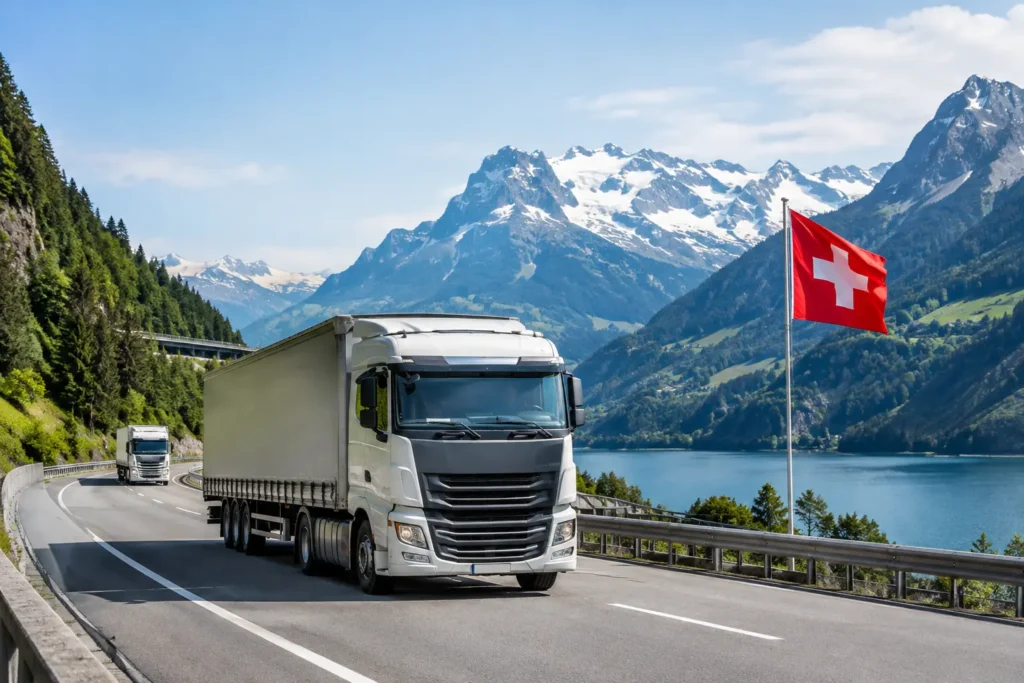
A lorry can leave northern Italy with a booked delivery slot in Basel and still lose a working day before reaching the consignee. The issue is rarely the driving distance. Switzerland sits outside the EU customs union, so every road movement needs the right customs status, data and release sequence. This Swiss transit guide focuses on the decisions that protect delivery performance: choosing the correct procedure, preparing documents before collection and building contingency into time-critical transport. For supply chain managers, the objective is not simply to cross the border. It is to keep production, customer deliveries and transport costs under control when a border process changes the route’s risk profile.
Why Swiss road freight needs a different plan
Switzerland is deeply connected to European manufacturing and distribution networks, but it is not part of the EU customs union. That distinction affects shipments moving from the EU into Switzerland, from Switzerland into the EU, and goods travelling through Swiss territory to another destination.
The practical consequence is that a standard EU road freight plan is not enough. The haulier, exporter, importer and customs representative must agree who files which declaration, which party holds the import responsibility, and when the goods can move on from the border. A missing commodity code, inconsistent invoice value or unclear Incoterm can stop an otherwise straightforward pallet shipment.
Swiss VAT is currently 8.1%, which matters when calculating landed cost and deciding who is responsible for import charges. It also reinforces a broader operational point: customs is not an administrative afterthought. It is part of the commercial design of the shipment.
Consider a manufacturer sending urgent replacement machine parts from Stuttgart to a production site near Lausanne. If the importer has not confirmed its customs representation and import data before collection, an express vehicle may arrive at the border with no valid release path. The premium paid for urgent transport is then wasted. For critical parts, documentation readiness should be checked before the vehicle is allocated, not while it is en route.
Swiss transit guide: choose the right customs movement
“Transit” is often used loosely, but the correct procedure depends on where the goods start, where they will be cleared and whether Switzerland is the destination or simply part of the route.
For goods entering Switzerland for a Swiss consignee, an import declaration is normally required. For goods that remain under customs control while travelling through Switzerland to another country, a transit procedure may be needed. Switzerland participates in the Common Transit Convention, allowing movements to be managed through the New Computerised Transit System. The exact arrangement depends on the goods’ customs status, origin, destination and the parties authorised to make declarations.
Do not assume that a previous shipment used the right model for the next one. The same lane can require a different approach when the delivery terms change, goods are non-Union, or customs clearance moves from the border to an inland location.
Before confirming collection, establish these points in writing:
- the exporter and importer of record;
- the agreed Incoterm and party responsible for duties, VAT and clearance costs;
- the commodity codes, goods description, origin and customs value;
- whether a transit declaration, import declaration or both are required;
- the nominated customs agent and its out-of-hours contact details.
This is particularly important for consolidated loads. A groupage vehicle may contain shipments for several consignees, each with different clearance instructions. One incomplete entry can affect the vehicle’s border process and, in some cases, the delivery timing of other freight on board.
Documentation errors that cause avoidable border delays
The commercial invoice, packing list and transport document must describe the same shipment. That sounds basic, yet mismatches remain one of the most common sources of clarification requests. Customs authorities need a credible picture of what is being moved, by whom, at what value and for what purpose.
A generic description such as “industrial parts” is rarely sufficient for a complex shipment. It creates questions about classification, value and potential controls. A more useful description identifies the item, intended use, quantity and relevant part number, supported by the correct commodity code. If goods are returned after repair, samples, temporary exports or equipment for a project, the paperwork needs to reflect that specific customs scenario rather than being treated as a standard sale.
Operational insight: assign one person internally to approve the customs data pack before collection. That owner should compare the purchase order, invoice, packing list and delivery instructions, then confirm that the broker has received the final version. This simple control prevents last-minute revisions being sent to the driver after the vehicle has already departed.
For controlled, regulated or high-value goods, add another layer of review. Product compliance documents, licences, serial numbers and proof of origin may all be relevant. The correct requirements depend on the commodity, so the customs representative should validate the file before dispatch.
Plan the route around border timing, not just kilometres
A route through Switzerland can save mileage between key European industrial regions, but the shortest road route is not automatically the fastest delivery option. Border operating hours, congestion, customs processing, weather and driving-time rules all influence the real transit time.
For planned full loads, build an arrival window that avoids placing a driver at the border shortly before a weekend, public holiday or restricted operating period. If a declaration requires correction, the available response time matters as much as the paperwork itself. A lorry arriving at 16:30 on a Friday without a completed clearance instruction faces a very different risk from one crossing early on a Tuesday morning.
For urgent road transport, the planning threshold should be higher. A dedicated van or express lorry may reduce transport time dramatically, but only if customs data, consignee availability and border instructions are ready before loading. MAP Transport’s Xpress and UltraExpress options are designed for time-critical European movements, but the vehicle choice should follow the shipment’s real constraints: weight, dimensions, delivery deadline and border process.
A useful rule is to treat customs lead time as part of the transit time quoted to the customer. Do not present a direct driving estimate as the delivery commitment when the shipment still needs import release.
Build contingency into Swiss-bound supply chains
Switzerland can be a dependable lane when responsibilities are clear and exceptions are managed early. The strongest transport plans include a defined escalation process rather than relying on drivers to solve documentation issues at the border.
For regular flows, review performance monthly. Track not only collection and delivery punctuality, but also customs-related waiting time, document correction frequency and the reason for each delay. If the same issue occurs repeatedly, such as late invoice approval or an incorrect consignee reference, it is a process problem rather than a transport problem.
For exceptional shipments, such as heavy industrial equipment or non-standard dimensions, customs planning must sit alongside route permits, loading arrangements and delivery-site restrictions. A specialist vehicle cannot compensate for a clearance plan that has not been agreed. The same applies to urgent replacement parts: speed comes from preparation, direct communication and a transport partner able to coordinate the movement from quote to proof of delivery.
The most effective Swiss flows are not necessarily the cheapest on paper. They balance transport cost against the far greater cost of a stopped production line, a missed installation slot or an unplanned overnight hold. Since 1985, MAP Transport has supported European road freight movements with tailored vehicle allocation, multilingual coordination and progress updates throughout transit.
A reliable Swiss route starts before the vehicle is loaded: confirm the customs path, validate the data, nominate accountable contacts and give urgent shipments the operational attention their deadline demands.
Need support on your transport flows? Contact our team for a tailored solution.
Have a question or need a quote? Contact us at (+34) 943 62 95 77 (ask for Raquel) or by email at lo*******@**********rt.com