
A transformer that is two centimetres over bridge clearance, a production line module held at a border because paperwork does not match the load, or a crane component arriving late enough to stop a site handover – this is where heavy haulage stops being a transport task and becomes an operational risk.
For manufacturers, industrial suppliers and project teams, heavy haulage road transport Europe is not simply a matter of booking a larger vehicle. It requires route engineering, permit planning, vehicle selection, loading control and constant coordination across countries that apply different rules to the same movement. When the load is oversized, overweight or non-standard, small errors become expensive very quickly.
What heavy haulage road transport Europe really involves
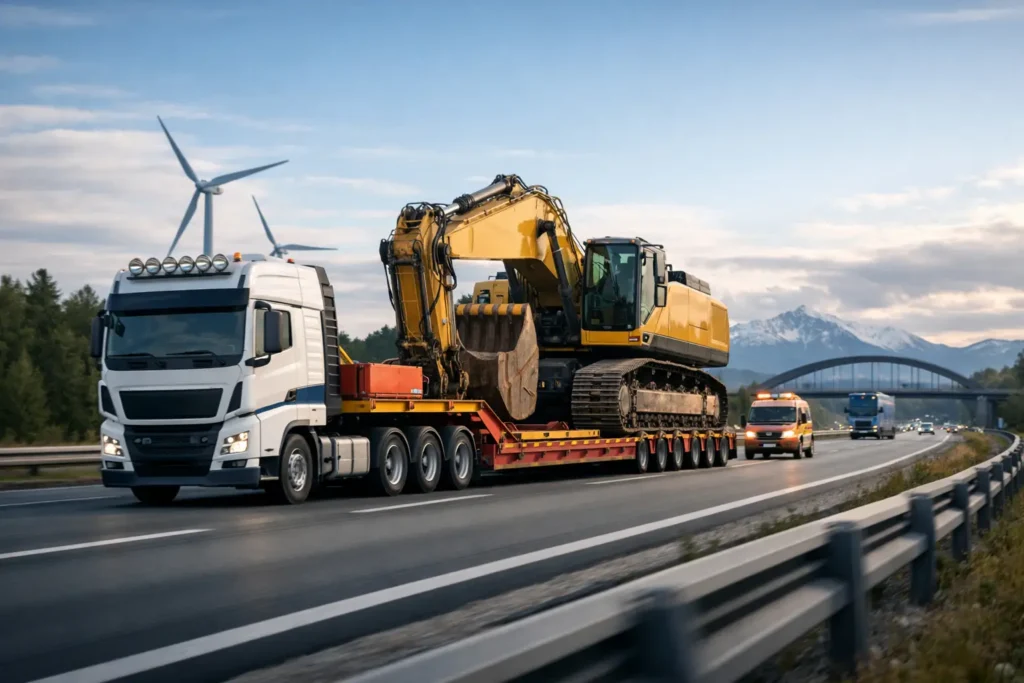
In practical terms, heavy haulage road transport Europe covers road movements of cargo that exceeds standard dimensions, axle loads or gross vehicle weights. That can include machinery, steel structures, plant equipment, tanks, prefabricated sections, transformers and other industrial units that cannot move on a conventional tautliner or standard platform.
The complexity starts with the load profile. Length, width, height, weight distribution and lifting points all affect the transport plan. A 20-tonne machine is not necessarily harder to move than a 12-tonne unit if the lighter cargo is top-heavy, over-width or awkward to secure. That is why experienced shippers focus less on headline weight and more on the exact shipment data from the outset.
Across Europe, heavy haulage also means adapting to national and regional restrictions. Night driving may be required on some routes. Escort vehicles may be mandatory in one country but not the next. Certain bridges, tunnels and urban approaches may be excluded altogether. If a shipment is moving beyond the EU into markets such as Turkey, Azerbaijan or Kazakhstan, the documentation and transit planning become more demanding again.
Why planning matters more than price alone
Procurement teams are right to compare rates, but exceptional loads are rarely won or lost on linehaul price alone. The larger cost sits in delay, failed delivery windows, site disruption and compliance issues. A lower quote can become the more expensive option if it excludes permit lead times, escort requirements, route surveys or reloading risks.
This is where heavy haulage road transport Europe differs from standard freight. The transport partner needs to validate whether the shipment is feasible before committing to timing. If that validation is skipped, the customer carries the exposure. A realistic plan with a clear scope is worth more than an optimistic promise that cannot survive first contact with the route.
At MAP Transport, this principle sits behind its exceptional shipments approach – matching the vehicle and operating plan to the actual cargo rather than forcing a one-size-fits-all solution. For logistics managers, that means fewer assumptions and better control before the load starts moving.
The four variables that shape every heavy move
Dimensions and weight distribution
The first requirement is accurate cargo information. Overall weight matters, but so do axle concentrations, centre of gravity, packing method and whether the load can be disassembled. If dimensions are estimated rather than confirmed, permit applications and route planning can be built on the wrong base.
For that reason, the most efficient projects usually begin with precise details: length, width, height, weight, collection point, delivery address, loading method and any handling restrictions. This is also why fast quoting should still be disciplined quoting. A response within 48 hours is useful only if the operational assumptions are sound.
Route constraints
The shortest route is often not the right route. Low bridges, roundabouts, roadworks, weight-restricted structures and urban delivery points can all change the plan. Some shipments require a pre-check or route survey, especially when final delivery involves industrial estates, ports, plants or construction sites with limited turning space.
A realistic route also considers timing. Weekend rules, public holiday bans and local authority restrictions can all affect transit. For urgent projects, speed is possible, but only if route feasibility supports it.
Permits and escorts
Permit rules vary by country and by load profile. Some permissions can be obtained relatively quickly. Others take days or longer, particularly where police escorts or official convoy arrangements are required. If a shipment crosses several borders, permit timing must be aligned so the load does not sit idle between jurisdictions.
Escort planning is equally important. Over-width and over-length movements may need pilot vehicles, and in some territories the escort standard is prescribed. This is not an administrative detail. It directly affects cost, transit time and delivery reliability.
Loading and unloading conditions
A heavy movement can fail at the first or last mile. Collection and delivery sites need to be checked for crane access, forklift capacity, ground conditions, loading bay clearance and safe manoeuvring space. It is common for the road plan to be sound while the site plan is weak.
That is why operational ownership matters. If one team is coordinating the movement from quotation to delivery, the risk of misalignment is lower. Customers should be informed at any time of the progress, not only when something goes wrong.
Choosing the right equipment for exceptional loads
No serious heavy haulage provider starts with a vehicle and then tries to make the cargo fit. The cargo determines the solution. Depending on the shipment, that may involve a flatbed, low loader, extendable trailer or another specialist arrangement designed around weight, height and loading constraints.
The trade-off is straightforward. A lower deck height may solve a bridge-clearance problem but introduce route limitations elsewhere. An extendable trailer may suit long cargo, but turning radius and site access become more sensitive. Sometimes splitting the load is the best answer. Sometimes it is not possible due to engineering, warranty or installation constraints.
For buyers managing industrial freight across multiple lanes, this is where a specialist partner adds value. The point is not to offer every vehicle type for its own sake. The point is to select the most suitable option for the actual movement and explain the operational consequences clearly.
Cross-border control is what protects the schedule
European heavy haulage is rarely a single-country exercise. Even straightforward west-east or north-south movements can involve multiple permit authorities, language requirements and compliance checks. If there is weak handover between planners, drivers, subcontractors and local agents, the delivery schedule becomes fragile.
That is why communication standards matter as much as transport assets. A multilingual operations team, live follow-up and clear shipment ownership reduce avoidable delays. They also help when circumstances change – road closures, customer-side delivery amendments or revised unloading windows are common enough in project logistics.
Companies shipping these loads regularly should also distinguish between standard freight urgency and heavy haulage urgency. An express van can move within hours. An oversized machine cannot ignore permit law just because the site is urgent. Good operators will move quickly where they can, and say so plainly where they cannot.
When to involve a specialist partner
If the cargo is over standard dimensions, unusually heavy, difficult to secure or moving to a site with restricted access, specialist input should come in early. The same applies when the load crosses several countries or needs timed delivery into a production stop, installation window or construction sequence.
In those cases, using a provider that already manages road freight transport in Europe, exceptional shipments and express transport solutions under one operational structure can simplify the process. It reduces the number of handovers and makes it easier to align standard support vehicles, urgent parts and the heavy movement itself when a project requires all three.
A useful starting point is simple: provide the exact dimensions, weight, origin, destination, target dates and any site restrictions, then request a no-obligation quote. That gives the planner enough to assess feasibility, not just price.
What good heavy haulage looks like in practice
Good heavy haulage road transport Europe is measured by control. The load is assessed properly. The route is checked. Permits are managed against realistic lead times. The right lorry and trailer are assigned. The customer receives clear updates, and the delivery happens in line with the agreed operating window.
That may sound straightforward, but in exceptional transport, straightforward is usually the result of disciplined preparation. Since 1985, MAP Transport has built its role around that kind of execution – helping businesses move standard, urgent and exceptional freight across 45 countries with the same focus on reliability, security and accountability.
If your next shipment cannot fit into a standard transport plan, treat it as an engineering and coordination job from day one. That is usually the difference between a difficult load and a delayed one.