
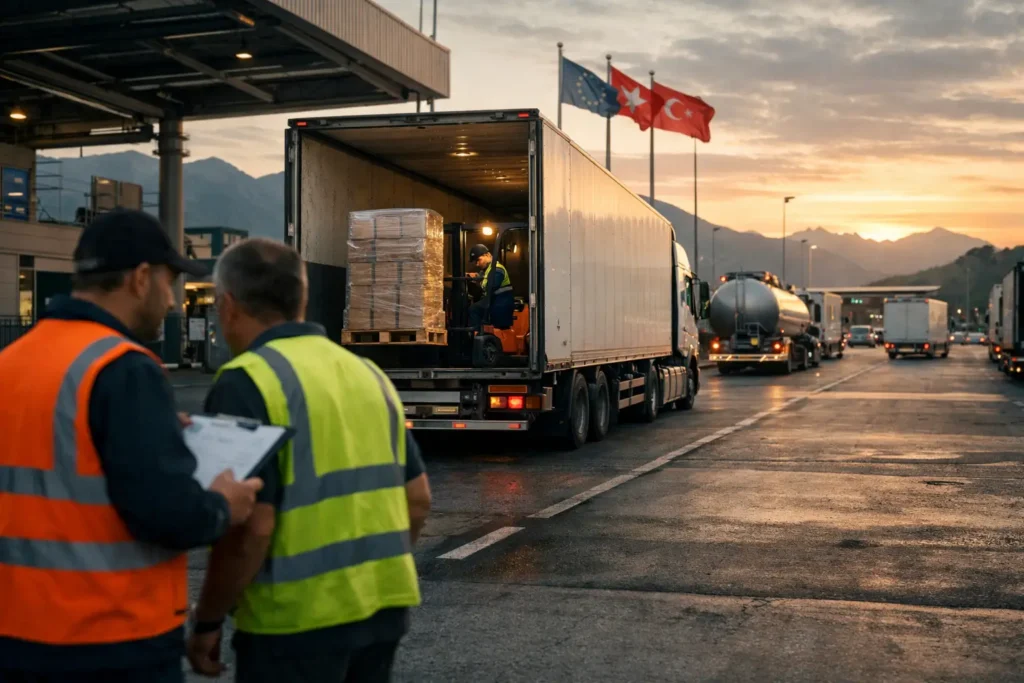
A diesel spike in Germany, congestion at Alpine crossings, tighter driving schedules, and an urgent delivery to Turkey that still has to arrive on time – this is where the energy crisis in transport stops being a headline and starts affecting service levels. For supply chain managers, the issue is not abstract. It shows up in freight rates, route planning, carrier capacity, customs timing and the margin for error on critical shipments. If your business depends on stable road freight across Europe, the real question is not whether the pressure is easing. It is how to keep transport reliable while energy remains volatile.
Why the energy crisis in transport still matters in road freight
Energy prices have always influenced road transport, but recent volatility has made the impact sharper and harder to absorb. Fuel remains one of the most significant variable costs in international road freight. When diesel prices rise quickly, transport budgets do not just increase – they become less predictable. According to the European Commission, energy price shocks have had a direct effect on operating costs across EU industry and logistics networks. That matters when you are planning regular imports from Italy, exports to the UK, or urgent replenishment into Scandinavia.
The challenge is wider than pump prices. High energy costs affect ferry services, toll structures, subcontractor pricing and even warehouse handover times when networks are under pressure. In practice, this means lead times can become less stable even when the route itself has not changed. A lane from northern Spain to Switzerland may still be technically feasible in the same time window, but the cost base and risk profile are different.
For companies moving goods into customs-sensitive markets such as the UK, Switzerland or Turkey, the problem is amplified. If a shipment misses a booked crossing or arrives outside a customs processing window, the knock-on cost can exceed the fuel surcharge itself.
Where costs rise first – and where delays follow
The most visible effect of the energy crisis in transport is rate pressure. Carriers have to account for fuel fluctuations quickly, especially on long-distance and time-critical routes. Yet the less visible cost is often operational disruption.
When energy prices remain high, some operators reduce flexibility. They may consolidate loads more aggressively, avoid lower-margin lanes, or limit capacity on routes that involve empty mileage, border waiting time or difficult backhaul. That can make it harder to secure the right vehicle at short notice, particularly for urgent freight or non-standard consignments.
There is also a staffing angle. Higher operating costs put pressure on smaller transport providers, which can reduce available capacity in the market. The result for shippers is familiar: fewer options, later collection windows and more last-minute repricing.
A practical example: imagine a manufacturer in France needing an urgent palletised shipment delivered to Birmingham after a production delay. Under stable market conditions, an express van can be assigned quickly and the route planned around ferry capacity and customs timing. Under energy-driven pressure, the available vehicle may be further away, the rate will likely move, and any delay at the port becomes more expensive because there is less slack in the plan.
This is why procurement teams should not assess transport costs in isolation. The cheaper option on paper can become the more expensive one if it introduces missed delivery slots, production downtime or customer penalties.
How route complexity makes the problem worse
Not all European road freight lanes are equally exposed. Complex routes are more sensitive to energy volatility because they involve more variables: tolls, mountain crossings, ferry links, border controls, and longer transit distances with limited recovery options.
UK flows are a clear example. Energy pressure raises base transport costs, but the bigger issue is that delays are harder to absorb once customs formalities, driver hours and port schedules are involved. The same applies to Switzerland, where border formalities require tighter timing, and to Turkey, where long-distance planning, transit documentation and border queues already make transport execution more exposed.
For supply chain managers, the lesson is straightforward. The more complex the route, the less useful a purely rate-led buying decision becomes. What matters is whether the transport plan has enough operational control built in.
This includes choosing the right vehicle for the job. A standard full load and an urgent dedicated van do not solve the same problem. Nor should an oversized shipment be managed with the same assumptions as regular pallet freight. During an energy crisis, matching service type to shipment priority becomes even more important because inefficiency is punished faster.
What good transport planning looks like under energy pressure
There is no single fix, but there are practical ways to reduce exposure. The first is to treat transport planning as a risk decision, not only a buying exercise. If a route is critical to production or customer service, resilience should be priced in from the start.
That usually means working with more precise shipment data. Weight, dimensions, loading constraints, required delivery time and customs status all matter. The better the brief, the easier it is to assign the right vehicle, avoid wasted mileage and prevent costly corrections later.
The second priority is route realism. A transport plan should reflect current market conditions, not last year’s assumptions. If a lane to Scandinavia is facing capacity pressure, or if a UK movement has narrow customs timing, that must be built into collection planning. Overpromising on transit time does not save money. It shifts cost into exceptions.
The third priority is communication. In volatile conditions, silence creates risk. Shippers need updates early enough to make decisions, whether that means adjusting unloading slots, informing a customer, or switching from standard service to urgent delivery. This is especially important for high-value goods, industrial materials and any shipment where a missed delivery triggers wider disruption.
According to IRU reporting on the European road freight sector, cost inflation, driver shortages and operational constraints continue to weigh on transport reliability. That combination is exactly why proactive coordination matters more than ever.
Practical actions for shippers facing the energy crisis in transport
A few operational adjustments can make a measurable difference. Review your most exposed lanes first, especially cross-border routes involving the UK, Switzerland and Turkey. These are often the shipments where delay costs rise faster than the freight rate itself.
Then separate your flows by priority. Not every shipment needs the same service level. Standard freight can often be planned with more flexibility, while plant-critical or customer-critical deliveries may justify a dedicated express solution. This sounds obvious, but many businesses still apply one transport model to every movement and absorb the inefficiency.
It also helps to challenge false savings. A lower initial quote may not include the practical realities of the route, especially where customs, border waiting or specialist handling are involved. Ask what assumptions sit behind the rate. Is the vehicle dedicated? Is customs timing considered? What happens if collection slips by two hours? These questions tend to reveal whether a transport plan is resilient or merely optimistic.
Finally, build relationships with partners who can adapt service type to the job. In unstable energy conditions, flexibility is not a nice extra. It is part of cost control. A provider that can move from standard road freight to urgent delivery in a few hours, or organise exceptional transport for non-standard cargo, gives procurement teams more room to protect service continuity.
A useful operational insight here is that speed and cost are not always opposites. On some disrupted routes, paying for a dedicated urgent movement can be cheaper overall than absorbing the consequences of a delayed standard load.
Reliability becomes the real cost advantage
When energy markets are unstable, transport buying becomes more strategic. The companies that cope best are not always those with the lowest nominal freight rates. They are the ones that understand where volatility creates operational exposure and act early to reduce it.
That means looking beyond surcharge discussions and focusing on execution: realistic planning, route-specific expertise, customs awareness, and access to the right vehicle at the right time. For businesses moving goods across Europe and into more complex corridors, reliability is what protects margin.
Since 1985, MAP Transport has supported companies that need road freight managed with that level of control, whether the requirement is standard distribution, urgent delivery within hours, or specialist handling for exceptional loads. Need support on your transport flows? Contact our team for a tailored solution.
Have a question or need a quote? Contact us at (+34) 943 62 95 77 (ask for Raquel) or by email at lo*******@**********rt.com
https://shorturl.fm/AsKjY