
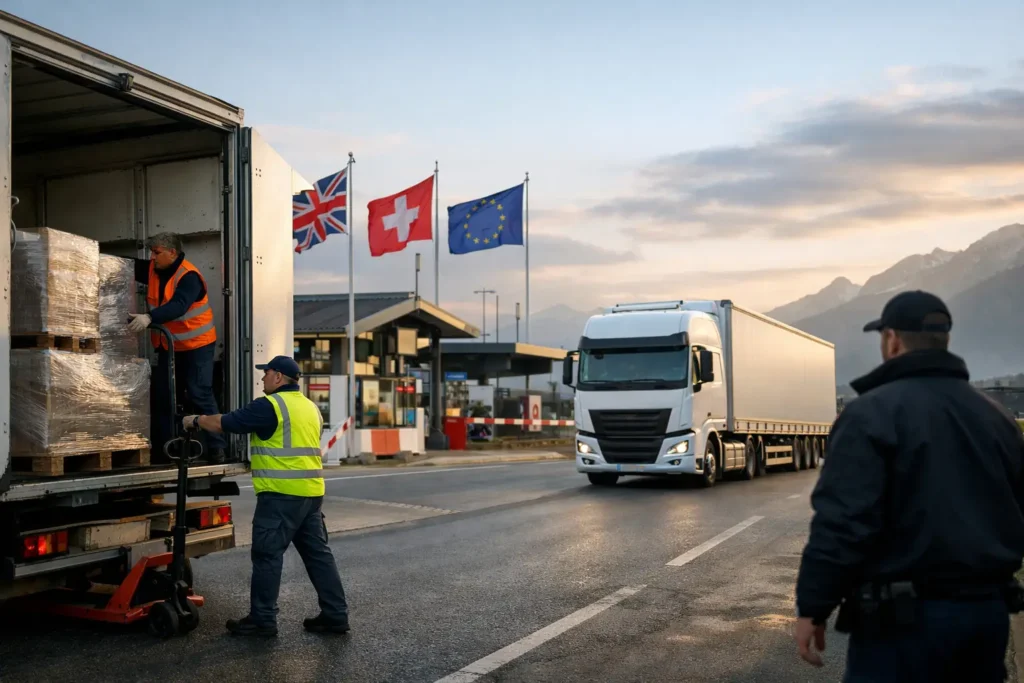
A production line does not care that a pallet was collected on time if it misses the unloading slot in Stuttgart, Birmingham or Bursa. For supply chain managers, Europe express freight delivery is usually not about speed alone. It is about recovering lost time without creating new risk at customs, on restricted routes or at handover points. The real pressure comes when an urgent shipment also crosses a border with added paperwork, limited delivery windows or special handling needs. That is where the transport plan matters more than the promise.
What Europe express freight delivery actually needs to solve
When an urgent shipment is booked, the question is rarely just, “How fast can it move?” A better question is, “What could still make this load late?” On European road flows, delays often come from factors outside pure driving time: export documents, customs clearance, driver-hour constraints, ferry or tunnel timings, and consignee restrictions.
This is why the best express movements are designed backwards from the delivery requirement. If a plant in northern Italy needs replacement parts before the morning shift, cut-off times, loading duration, border formalities and final-mile access all need to be checked before a vehicle is assigned. A fast van on the wrong route is still the wrong solution.
According to the European Commission, road freight remains the dominant inland freight mode in Europe, which is exactly why network congestion, border formalities and local restrictions can quickly affect time-critical cargo. In practice, urgent transport succeeds when planning is detailed enough to absorb those variables, not when the booking simply gets marked as priority.
When express road freight is the right choice
Not every urgent load needs a dedicated express vehicle. Sometimes the premium is justified, and sometimes it is not. The decision depends on the value of time saved versus the cost of disruption avoided.
Express road freight is usually the right fit when a delayed component could stop production, when a customer has imposed a non-negotiable delivery slot, or when a missed export connection would create larger downstream cost. It also makes sense for sensitive B2B movements where transfer points increase handling risk.
A common example is an industrial parts shipment from northern Spain to southern Germany after a supplier quality issue. If the consignee needs the replacement within hours, a dedicated vehicle gives tighter control than a groupage option. There are fewer touchpoints, easier tracking, and less exposure to hub delays. On the other hand, if the deadline is next afternoon and the load is standard palletised freight, a planned premium road service may achieve the same outcome at a better cost.
That trade-off matters. Express should protect business continuity, not become a default reaction to poor forecasting.
Europe express freight delivery on complex routes
The difficult routes are where service quality becomes visible. Mainland Europe flows can be urgent enough on their own, but the operational challenge rises quickly when the route involves the UK, Switzerland or Turkey.
For UK movements, post-Brexit customs formalities have made documentation accuracy part of delivery performance. Commodity codes, invoice details, origin data and transit arrangements all affect whether a time-critical load moves cleanly or sits waiting for clearance. Guidance from GOV.UK and HMRC makes the principle clear: even small paperwork gaps can cause disproportionate delay.
Switzerland creates a different type of pressure. It is a highly efficient market, but non-EU border procedures still require disciplined preparation. When the load is urgent, there is very little tolerance for incomplete commercial documentation or misunderstanding around customs value and Incoterms.
Turkey adds another layer again, particularly for industrial traffic where customs processes, transit planning and consignee coordination need to line up tightly. On these routes, transport buyers often underestimate how much lead time is saved by having one team manage the movement from quote through delivery rather than handing off responsibility across multiple parties.
An operational insight here is simple: on complex routes, the document check should happen before vehicle dispatch, not while the vehicle is already on the road. That sounds obvious, but it is still where many urgent shipments lose time.
The planning details that protect urgent deliveries
The difference between a controlled express shipment and a stressful one is often hidden in small decisions made early. Vehicle choice is one of them. A van may be ideal for lighter high-priority cargo because it can reduce transit time and routing constraints. A larger vehicle may still be the better answer if the load profile, securing needs or unloading conditions demand it.
Then there is loading discipline. If the shipper says collection is ready at 14:00 but the goods are not actually staged until 15:30, the transport plan is already compromised. On urgent movements, realistic loading readiness matters as much as route planning.
Communication also needs to be practical, not decorative. A supply chain team does not need vague reassurances. They need milestone-based updates: collected, border crossed, delay identified, revised ETA confirmed, delivered. That is especially important when the consignee is arranging labour, dock access or onward production.
In many cases, the best-performing express flows rely on three checks before departure:
- confirmation that goods are physically ready and labelled correctly
- validation of customs and commercial documents for the route
- agreement on delivery conditions, including opening hours and contact points
These are not glamorous steps, but they prevent the avoidable failures that make urgent transport expensive.
Cost control without undercutting service reliability
Every logistics manager knows the tension here. The business wants speed, but procurement still expects discipline on rates. Europe express freight delivery should not be judged on linehaul price alone. The real comparison is between transport cost and disruption cost.
If a late delivery stops a manufacturing cell, misses a customer launch window or triggers penalty exposure, the cheapest rate is often the most expensive decision. At the same time, over-specifying every urgent movement wastes budget and can hide planning weaknesses elsewhere in the supply chain.
A more useful approach is to segment urgent freight by impact. Some shipments genuinely need direct, time-critical delivery within hours or under 24 hours. Others need accelerated transport with precise monitoring. Others only need a standard service with stronger milestone control. Matching the service level to the operational consequence is how businesses protect margin.
This is where tailored road freight has an advantage over one-size-fits-all models. The shipment should determine the vehicle and the service design, not the other way round.
What to ask before booking an urgent cross-border load
When time is short, the booking conversation needs to get to the point quickly. The strongest transport decisions come from clear shipment data and a realistic view of risk.
Before confirming an urgent move, make sure the transport partner has the weight, dimensions, loading method, commodity description, origin, destination, ready time and required delivery time. For cross-border flows, customs status and commercial paperwork should be treated as part of the booking, not an afterthought. If the cargo is unusual, oversized or sensitive, that needs flagging immediately because specialist handling changes the plan.
It also helps to ask one direct question: what is the main risk to this delivery, and how will it be managed? A serious operator will not promise magic. They will tell you where the pressure points are and what they are doing about them.
That level of planning is what turns urgent transport from a gamble into a controlled operation. Since 1985, MAP Transport has built its work around that principle across European road freight, including time-critical and more complex cross-border routes where responsiveness and follow-up make the difference.
When your flow cannot absorb guesswork, the transport setup has to be precise from the first call. Need support on your transport flows? Contact our team for a tailored solution.
Have a question or need a quote? Contact us at (+34) 943 62 95 77 (ask for Raquel) or by email at lo*******@**********rt.com
https://shorturl.fm/YuyHj