
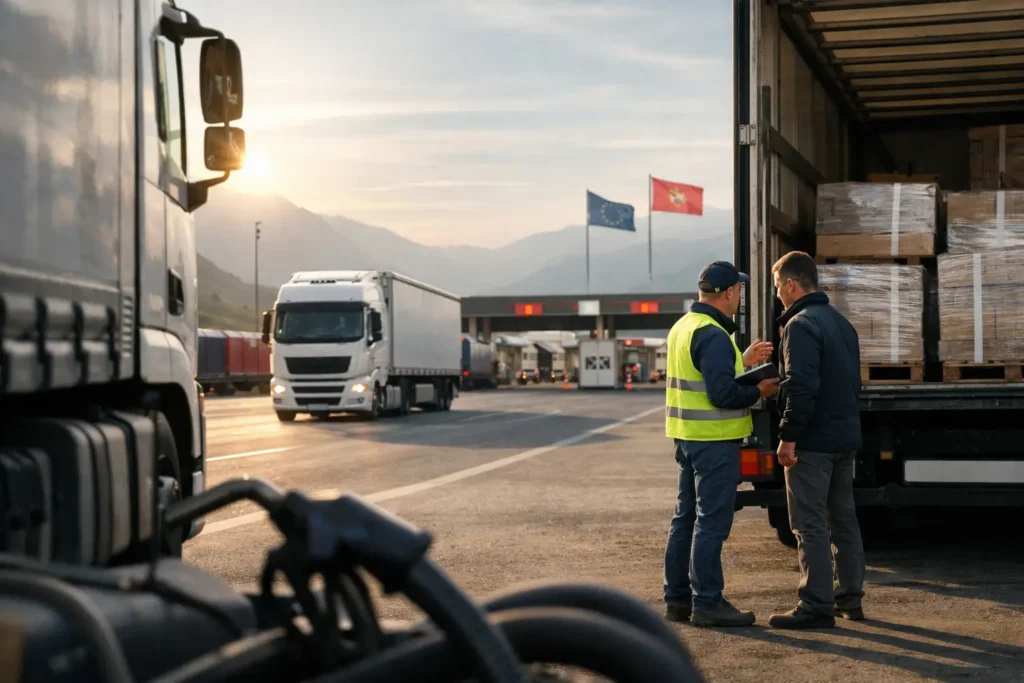
A fuel spike rarely appears on its own. It usually lands alongside tighter delivery windows, pressure on margins, and customers who still expect fixed lead times across multiple borders. That is why rising fuel costs: how to optimise your road freight strategy in 2026 is not just a procurement question. For supply chain managers moving goods across Europe, the UK, Switzerland or Turkey, fuel inflation changes routing decisions, vehicle allocation, shipment planning and even customer commitments. The companies that respond well in 2026 will not simply negotiate harder on rates. They will build transport plans that waste fewer kilometres, reduce urgent corrections, and protect reliability where it matters most.
Why rising fuel costs matter more on cross-border road freight in 2026
Fuel has always been a major cost line in road transport, but in 2026 the issue is broader than diesel prices alone. Carriers are also dealing with toll increases, longer waiting times at some borders, and route imbalances that make empty running harder to avoid. According to the International Road Transport Union, operating costs in road freight remain under sustained pressure from energy, labour and compliance-related expenses. When these factors combine, a modest fuel increase can turn into a much larger cost impact per shipment.
For shippers, the effect is uneven. A regular full-load movement between major industrial hubs may absorb cost changes better than a part-load shipment with strict delivery windows into a remote destination. The difference becomes even sharper on complex routes. A lorry heading into Switzerland or Turkey may face customs procedures, document checks or queue times that extend engine hours and reduce daily productivity. Fuel spend is not only about distance. It is about time, predictability and how efficiently each vehicle is used.
This is where many transport budgets go off course. Teams focus on the rate per load and miss the operational behaviours behind it. If your plan creates avoidable waiting, poor consolidation or frequent last-minute dispatches, fuel inflation will expose those weaknesses very quickly.
Rising fuel costs: how to optimise your road freight strategy in 2026 through network design
The biggest savings in 2026 are likely to come from planning, not from chasing the cheapest carrier on each move. Network design sounds strategic, but it has very practical effects on fuel consumption. If your shipments repeatedly move half-full, travel indirect routes, or require preventable reloading, your transport model is paying for kilometres that add no value.
Start with lane analysis. Look at your most frequent origins and destinations over the last 12 months and identify where you are buying urgency because the plan is weak. A common example is a manufacturer shipping standard goods from northern Spain into Germany and Benelux, while also sending occasional urgent consignments to the same customers because production release times are inconsistent. Those urgent vans or dedicated lorries solve a service issue, but they are also an expensive symptom of poor synchronisation.
In practice, optimisation often means changing the shipment profile rather than the carrier. You may reduce cost by moving from three poorly timed part-loads to two better consolidated departures. You may also save money by selecting a vehicle size that matches the load more precisely instead of defaulting to a larger unit. That is especially relevant when flows vary week by week.
The trade-off is simple. More consolidation usually lowers fuel cost per unit, but it can increase dwell time before dispatch. For some customers that is acceptable. For others, especially on production-critical flows, the extra day is more expensive than the transport saving. The right strategy depends on the value of the goods, the penalty of delay, and the customer promise you are trying to protect.
Choose the right service level, not the same one every time
One of the fastest ways to lose control in a high-fuel environment is to treat every shipment as equally urgent. It is understandable. Internal stakeholders push for speed because speed feels safe. But if standard freight, urgent freight and exceptional loads are all being managed with the same logic, costs rise without improving service.
A better approach is to separate flows by operational need. Standard shipments should be planned to maximise route efficiency and vehicle fill. Time-critical freight should be reserved for situations where stock-out risk, line stoppage or contractual urgency justifies the premium. Exceptional shipments need specialist planning from the start, because route restrictions, permits or escorts can multiply the cost of any mistake.
A concrete example: a distributor shipping industrial components from France to the UK may book a direct dedicated vehicle for every order to avoid customs uncertainty. In reality, only the high-priority customer orders need that treatment. The rest may move through a more cost-efficient schedule with tighter document control and realistic customs lead times. The saving does not come from cutting corners. It comes from aligning service with the commercial value of the load.
This is also where a tailored provider matters. A transport partner able to switch between classic, express and specialist handling can help avoid overbuying speed on routine flows while still securing delivery in a few hours when the situation genuinely requires it.
Reduce fuel waste hidden in customs and border delays
Fuel strategy is often discussed as if it starts when the vehicle leaves the yard. On many European routes, it starts with paperwork. Delays at customs do not just threaten lead time. They also increase idling, disrupt driver schedules, and create knock-on costs across the rest of the network.
This is particularly relevant on routes involving the UK, Switzerland and Turkey. The European Commission continues to update customs and border formalities, and even experienced shippers can lose time when document sets are incomplete or inconsistent. A missed commodity code, unclear goods description or incorrect value declaration can turn a well-priced movement into an expensive one.
Operationally, one useful discipline is to treat customs readiness as part of transport planning, not as an admin step after booking. That means validating commercial invoices, origin data, EORI details and route-specific requirements before vehicle allocation. It also means building a realistic cut-off for urgent freight. A same-day collection is not genuinely urgent if the papers are wrong and the vehicle then sits still for hours.
One statistic makes the point clearly: even a one-hour delay on a long international route can reduce asset productivity enough to affect the next job, especially where driver time regulations are tight. The visible cost is waiting. The hidden cost is the disrupted plan that follows.
Use data to control surcharge exposure and buying decisions
When fuel markets are volatile, many shippers focus only on the surcharge line. That is understandable, but it is not enough. The better question is whether your transport data shows where fuel volatility hits your network hardest.
Review lane-by-lane performance and ask three things. Which routes have the highest cost drift over time? Which customers generate the most urgent corrections? Which collection points create repeated waiting or failed loading windows? Those patterns tell you far more than a generic monthly fuel index.
A useful internal benchmark is cost per delivered unit by route and service type. If one lane looks expensive, check whether the problem is genuinely distance-related or caused by planning behaviour. Sometimes the issue is not the route but repeated late booking, poor loading discipline or unrealistic delivery appointments. Fuel cost becomes the visible headline, while process inefficiency is the real cause.
This is also where direct communication helps. A logistics partner that keeps you informed at any time of the progress can flag disruptions early enough for you to adjust before costs escalate. Fast operational feedback matters more in 2026 because delays and route changes have become more expensive to absorb.
Build resilience for urgent and exceptional movements
Even the best-planned network will face failures. A supplier misses a production slot. A border inspection takes longer than expected. A customer suddenly changes the unloading window. In those moments, fuel optimisation is not about choosing the cheapest option. It is about containing the cost of disruption.
That requires a clear escalation model. Your team should know when to use dedicated express transport, when to re-route, and when to protect margin by renegotiating delivery terms. If every issue becomes an emergency van, your annual spend will tell the story. If every issue is forced into a standard schedule, your service level will suffer.
For oversized or non-standard loads, resilience starts even earlier. Route permissions, loading constraints and escort requirements can leave very little room for error. On these movements, fuel cost control comes from specialist planning and precise execution, not from squeezing the linehaul rate.
In 2026, the stronger freight strategies will be the ones that accept a simple truth: optimisation is not only about cheaper transport. It is about fewer avoidable kilometres, fewer preventable delays, and better service choices across each lane. For supply chain teams moving goods across demanding cross-border routes, that usually means tighter planning, cleaner documentation and a transport partner that can adapt quickly when the job changes.
MAP Transport has built its work around that reality since 1985, coordinating standard, urgent and exceptional road freight with close operational follow-up across complex European flows. Need support on your transport flows? Contact our team for a tailored solution.
Have a question or need a quote? Contact us at (+34) 943 62 95 77 (ask for Raquel) or by email at lo*******@**********rt.com
https://shorturl.fm/tmBaE