
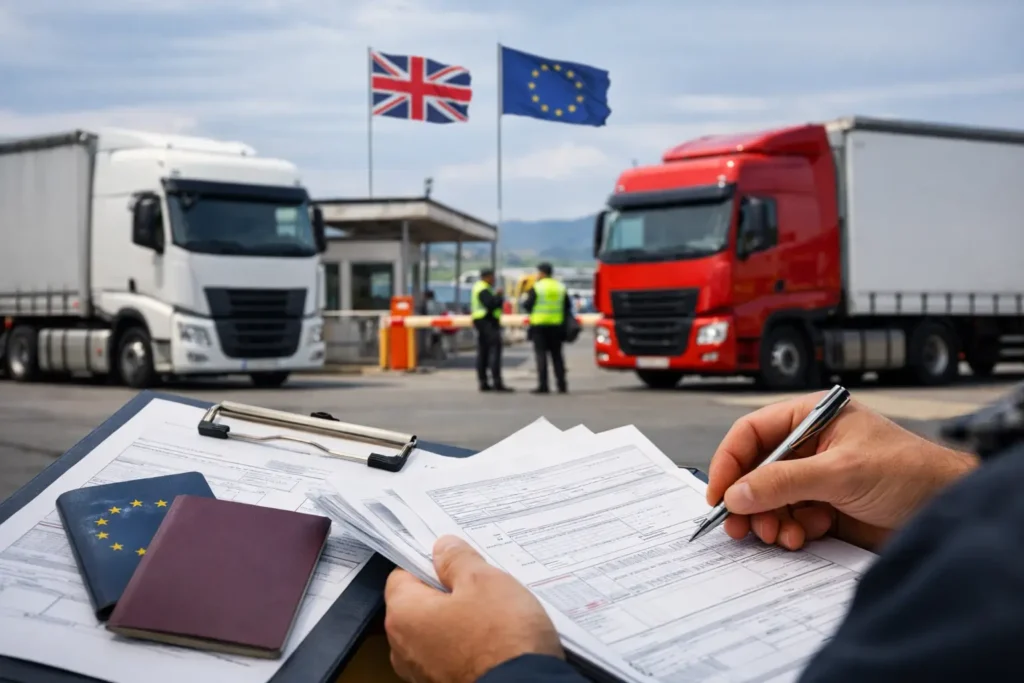
A lorry can be loaded on time, routed correctly and still lose hours at the border because one document is missing, inconsistent or badly matched to the goods. That is the part many supply chain teams feel most sharply on UK-EU lanes: the transport itself is manageable, but paperwork errors create delay, storage costs and missed delivery slots. If you are reviewing the best documents for UK EU road transport, the real question is not which papers exist. It is which ones actually protect delivery time, customs clearance and accountability when the shipment is moving under pressure.
Best documents for UK EU road transport starts with the commercial set
For most UK-EU road movements, the strongest document pack starts with three basics that must align perfectly: the commercial invoice, the packing list and the transport document, usually the CMR note. These are not administrative extras. They are the core references used by customs agents, carriers and receiving sites to verify what is moving, who owns it, where it originated and how it should be handled.
The commercial invoice needs to be precise enough for customs clearance, not just for finance. That means clear goods descriptions, correct Incoterms, commodity codes where relevant, values, currency, consignor and consignee details, and country of origin. Vague descriptions such as “industrial parts” are a common cause of checks because they leave too much room for interpretation.
The packing list matters just as much when goods are split across multiple pallets, crates or mixed references. Border checks become much easier when the load can be physically matched to the declared packaging. On urgent flows, that detail often determines whether an inspection takes fifteen minutes or two hours.
The CMR note then ties the shipment to the actual movement. It records the parties, the loading and delivery points, package count and transport instructions. On cross-border road freight, that operational visibility matters. If there is a discrepancy between invoice, packing list and CMR, the risk of delay rises immediately.
A practical example: a manufacturer shipping machine components from the Midlands to northern France may have correct values on the invoice but list 18 pallets on the packing list and 16 on the CMR. Even if the goods are legitimate, that mismatch can trigger a hold until the discrepancy is explained. In time-critical transport, that is avoidable damage.
Customs documents are where UK-EU delays usually begin
Since Brexit, customs compliance has become the pressure point on UK-EU routes. The best documents for UK EU road transport therefore always include the customs data and references required for the specific flow, not just the basic commercial paperwork.
Depending on the movement, that may include export declarations, import declarations, EORI numbers, transit documents, statements of origin or licences for controlled goods. If the goods move under transit, the MRN and accompanying documentation must be available and correctly communicated before the vehicle reaches the relevant checkpoint.
According to UK government border guidance, incomplete customs declarations remain one of the main reasons goods are stopped or delayed at the frontier. The European Commission and HMRC have both made the same point repeatedly: border performance depends heavily on data quality before departure, not after the vehicle has arrived.
What catches many shippers out is that customs readiness is not only about having the right document. It is also about having the right version, with the right sequence of submission. A declaration raised too late, an origin statement omitted, or an import pre-notification not lodged in time can leave the driver waiting with a fully compliant load that still cannot move forward.
That is why experienced operators check document flow against route design. A standard movement from Belgium to England is not managed in exactly the same way as a groupage consignment from Spain to the UK or a high-priority van load into a production site with a narrow unloading window.
Best documents for UK EU road transport depend on the goods
There is no single perfect checklist for every shipment. The best documents for UK EU road transport change with the cargo type, customs status and delivery requirements. Supply chain managers usually see the biggest problems when they apply a generic document pack to specialised goods.
If the goods qualify for preferential origin under the Trade and Cooperation Agreement, the origin evidence must be prepared correctly or the importer may lose duty preference. If the load includes food products, plant materials or animal-origin items, sanitary and phytosanitary paperwork may be required in addition to the standard transport file. If the cargo is hazardous, ADR-related documentation and handling rules come into play.
Oversized or exceptional loads create another layer. Permits, route approvals and technical shipment details may be needed before departure. In these cases, the transport document pack is not simply about customs clearance. It is also about road legality, escort planning and delivery-site acceptance.
This is where tailored planning makes a measurable difference. A standard pallet shipment and a high-value urgent consignment do not carry the same documentary risk. On an express movement, a missing customs reference can wipe out the entire speed advantage of using a dedicated vehicle.
The best document pack is the one checked before loading
The most useful operational insight is simple: document quality should be validated before the vehicle is dispatched, not while the goods are already in transit. That sounds obvious, yet many delays happen because paperwork is treated as a final admin step rather than part of transport planning.
A pre-departure check should confirm that names and addresses match across all documents, pallet counts are consistent, weights are credible, customs references are live, and any route-specific formalities are already lodged. It should also confirm who is responsible for each filing under the agreed Incoterm. When that ownership is unclear, border issues often turn into disputes instead of quick fixes.
For regular flows, this is worth standardising. One shipper moving weekly goods from Germany to the UK can save significant time by using a repeatable document control process rather than rebuilding each file from scratch. The Road Haulage Association and IRU have both stressed that border resilience increasingly depends on digital preparation and early data exchange between shipper, forwarder, customs agent and carrier.
There is also a cost angle. A delayed vehicle does not only create a late delivery. It can trigger rebooking fees, missed production input, driver waiting time and reduced equipment utilisation. For companies running lean replenishment models, the paperwork risk is often larger than the linehaul cost difference between providers.
Common document mistakes that create avoidable border holds
Most UK-EU border problems are not caused by rare legal complexity. They come from routine errors repeated under time pressure. The most expensive ones are usually straightforward:
- vague goods descriptions on commercial invoices
- mismatched weights, package counts or pallet totals
- wrong consignee or delivery address details
- customs declarations submitted too late
- missing origin statements where duty preference is expected
- incomplete supporting paperwork for controlled or specialised goods
One concrete example is urgent spare parts for a factory stoppage. The transport may be arranged for same-day collection and next-morning delivery, but if the invoice describes the cargo too generally and the import side cannot validate classification quickly, the shipment may sit at the border while the production line waits. In these scenarios, speed is won or lost in the office before the van leaves.
The trade-off is that tighter document control requires more discipline at order stage. Some teams resist that because they want faster booking. In practice, a five-minute document review usually saves far more time than it costs.
How to build a safer UK-EU document process
For supply chain managers, the goal is not to memorise every document type. It is to create a process where the right paperwork is assembled, checked and shared without depending on last-minute problem solving.
Start by separating standard requirements from shipment-specific ones. Every movement needs a clean commercial and transport file. Beyond that, the exact customs and compliance documents should be triggered by route, cargo type and delivery terms. That makes it easier to spot when a load to the UK, Switzerland or Turkey needs a different treatment from an intra-EU movement.
Next, make one party clearly responsible for document completeness before loading. That responsibility can sit with the shipper, customs broker or transport partner, but it must be explicit. Shared responsibility often means nobody catches the error.
Finally, use partners who can align vehicle choice, urgency and border preparation. If a shipment needs delivery within hours, the paperwork cannot follow behind the vehicle. It must be ready at dispatch, and any customs or transit steps must already be coordinated with the route plan.
That is where experienced road freight operators add practical value. Since 1985, MAP Transport has supported cross-border flows where timing, customs accuracy and shipment type all matter at once, especially on more sensitive UK and non-EU European routes.
The best documents for UK EU road transport are the ones that match the goods, the route and the delivery promise from the start. When paperwork is treated as part of execution rather than admin, border crossings become more predictable, urgent freight stays urgent, and your team spends less time firefighting. Need support on your transport flows? Contact our team for a tailored solution.
Have a question or need a quote? Contact us at (+34) 943 62 95 77 (ask for Raquel) or by email at lo*******@**********rt.com